SOWLE
Sowle is a surname of English provenance, traceable to the medieval period of the British Isles. Its bearers are predominantly found in the United Kingdom and the United States, with a small but noteworthy presence in Ireland and other European regions.
The name originates from the Middle English term soule, which translates directly as “soul” in contemporary English. In the medieval context, surnames were frequently adopted as affectionate or descriptive nicknames; hence, it is thought that an individual noted for compelling spiritual or moral qualities might have been given this appellation. The connection between the word’s meaning and its social use is well documented in a number of contemporary records.
On a more linguistic level, Sowle is believed to derive from the Old English constructs sawol or sawle, again signifying “soul.” In some instances, the surname can be seen as a variation of the personal name Sewell, itself possibly sourced from the Old English elements Sige (victory), sae (sea), and weald (rule). This construction would convey the notion of “sea power” or might have been bestowed upon seafarers. Alternative derivations point to the medieval given names Siwal(d) or Sewal(d), which evolved from the Old English compound Sigeweald or Soeweald, further attesting to the name’s Anglo‑Saxon roots.
Another plausible origin is locational. The surname may have been adopted by individuals residing in or near certain place‑names that feature the element wella, meaning “spring” or “stream.” Examples include Sewell in Bedfordshire, Showell in Oxfordshire, and Seawell or Sywell in Northamptonshire. Such place‑based surnames were commonplace in the transition from the personal to the hereditary system during the late Middle Ages.
Throughout its history, Sowle has manifested in a variety of spellings. These include Soole, Sole, Soul, Soule, and others. The fluid nature of orthography in medieval English, coupled with regional dialects and the influence of foreign scribes, accounts for these variations. Modern attempts at standardisation have largely settled on the form Sowle, although other forms persist in census and parish records.
Documentary evidence attests to the antiquity of the surname. The earliest surviving record is a court document from 1220 naming William Sewald, dated during the reign of King Henry I, a period extending from 1100 to 1120. Additional evidence comes from a christening register of 1549, where an Ann Sowle is recorded at Christchurch, Greyfriars, Newgate. These entries place the surname firmly within the fabric of medieval English society.
Contemporary distribution data indicate that the surname remains rare within the United Kingdom and Ireland. Estimates place the total number of living bearers in the United Kingdom at less than five hundred individuals, with a comparable but slightly smaller figure in Ireland. In contrast, the United States hosts a larger cohort, likely numbering in the thousands, particularly in states with early colonial settlement such as Pennsylvania, Vermont, and South Carolina. The historical migration of English families to North America during the eighteenth and nineteenth centuries accounts for this demographic spread.
In summary, the surname Sowle exemplifies the complex interplay of linguistic evolution, social identity, and geographic migration that characterises many English family names. While it remains uncommon in modern discourse, its lineage extends from early medieval Christian society to the diaspora of English communities across the Atlantic, preserving a distinct cultural heritage that endures to this day.
Similar and related surnames
Related and similar names are generated algorithmically based on the spelling, and may not necessarily share an etymology.
How to communicate the surname Sowle in...
Braille
⠎⠕⠺⠇⠑
Morse
...---.--.-...
Semaphore

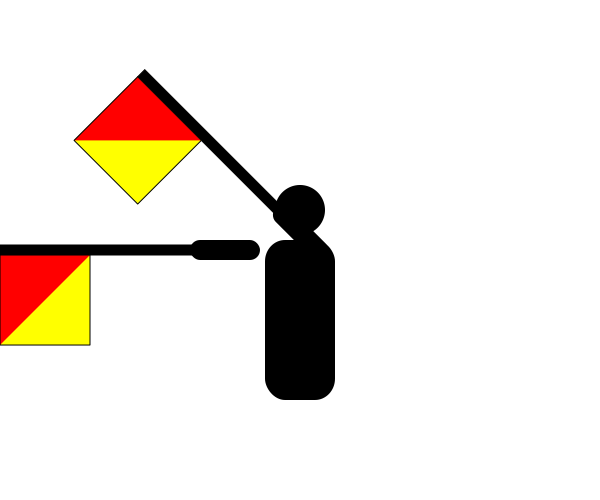
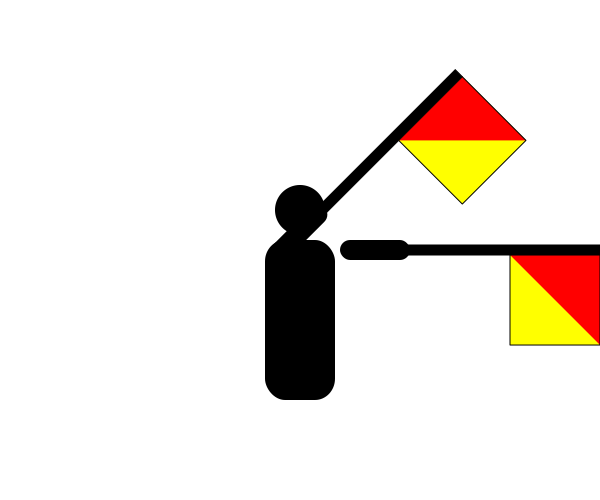


There are approximately 39 people named Sowle in the UK. That makes it one of Britain's least common surnames. Only around one in a million people in Britain are named Sowle.
Origin: English
Region of origin: British Isles
Country of origin: England
Religion of origin: Christian
Language of origin: English
