SOUTHERS
Southers is an English surname that can be traced back to the Middle English word souther, meaning a southerner or a person who hails from the south. It is a topographic or locational name which was traditionally given to individuals who lived in or came from the southern part of a particular region or country.
The earliest recorded variants of the name appear in the 13th and 14th centuries, for example Robert de Sotherun in 1243, Isabella South in the 1297 “Accounts of the Earldom of Cornwall”, Henry Le Suthereen in the 1325 Court Rolls of Suffolk, and William del South in the 1379 Poll Tax Rolls of Yorkshire. These early spellings illustrate the fluid nature of orthography at the time and the influence of local dialects on the written form of the name.
In England, the surname is believed to derive from the Old English word suth, pre‑7th century, which also gave rise to other regional surnames such as North, East and West. During the period following the 1066 Norman Invasion and until the decline of feudalism in the Middle Ages, persons who travelled westward to other parts of the country were often given a name that reflected their place of origin, allowing a straightforward way of identification. The surname Southers, therefore, designates a familial link to the south at a time when mobility was limited.
Well‑documented bearers of the surname include the poet John Souther (also known as Southern) who served Queen Elizabeth I, the preacher Robert South who was appointed to the court of Queen Anne in 1702, and the actor Edward Lytton Sothern (1856‑1887) who achieved international renown in the late 19th century. The arms most commonly associated with the family are described as a red field with a silver chevron between ten bezants.
In addition to Southers, a variety of spellings have appeared across historical records, reflecting phonetic variation and regional linguistic influences. Variants such as Souther, Southerland, Suther, Suthers, and Sothers are commonly cited; in some areas the surname appears as Suther, especially across Scotland and northern England, while in the United States the spelling Souther has become frequent.
During the 17th century, the name was transported across the Atlantic. The first recorded American instance involves Thomas Southers, who arrived in Virginia in 1649. He is believed to have originated in Somersetshire, where the Old English component suth‑erne again denotes south. In the United States, the surname has remained most prominent in North Carolina, particularly in counties such as Haywood, Cumberland, Durham, Guilford, Wake and Johnston, with additional concentrations in California, Florida, Maryland and South Carolina. Over recent decades the name has spread to other parts of the country, reflecting broader internal migration patterns.
Collectively, the evidence suggests that Southers is a historically grounded locational surname of Old English origin, denoting southern provenance, with a recognised pattern of orthographic variation and a documented presence both in England and abroad, particularly in North America.
Similar and related surnames
Related and similar names are generated algorithmically based on the spelling, and may not necessarily share an etymology.
How to communicate the surname Southers in...
Braille
⠎⠕⠥⠞⠓⠑⠗⠎
Morse
...---..--......-....
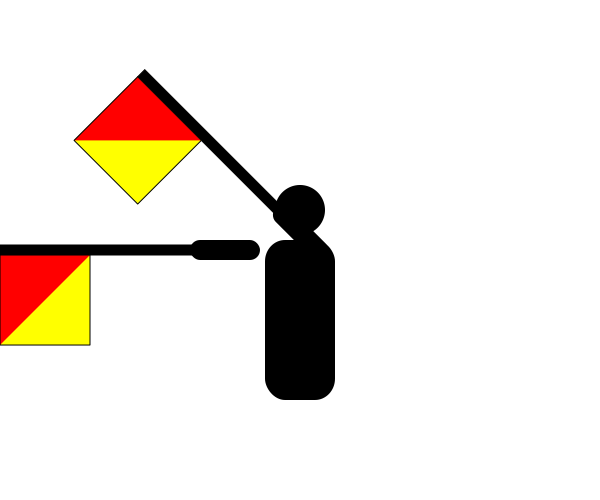
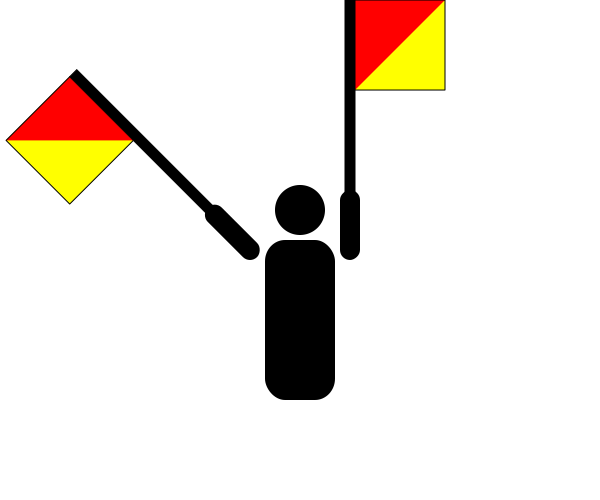
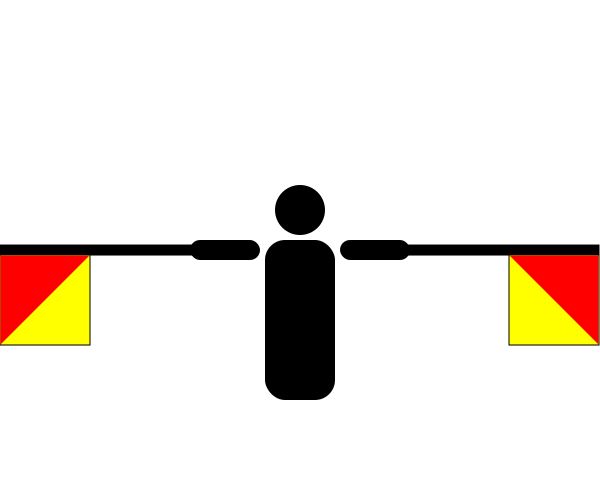
Semaphore




Sorry, we don't have any statistics on this name. That's probably because it's very uncommon in Britain.
