SOLLARS
The surname Sollars is chiefly of English origin. It is derived from the Old English word solar, which means “hall” or “manor house.” As a locational surname, it was originally applied to individuals who lived near or were employed at a great residence or estate.
Other scholars argue that the name may also come from the Medieval English “Solas” or the Old French “Solaz,” both of which translate as “comfort.” These derivations place the name in the context of a familiar or affectionate nickname for a person known for providing solace or joy. Historical records show that such a nickname could become a hereditary family name.
In addition, there is a third conceivable origin tied to the political environment of the 17th and 18th centuries. The French‑Huguenot surname “Soulier,” meaning “shoe‑maker,” was anglicised to “Souller” around 1779 and then to variants such as “Soller” or “Sollar” by the mid‑19th century. The earliest documented instance of the name is that of Robert Solace, who witnessed the Northumberland Assize Court in 1269 during the reign of King Henry III, a period in which French was often referred to as “The Frenchman.”
Spelling variations are common. Over the centuries the surname has appeared as Sollers, Sellers, Sellars, Syllers, Sholars, Salors, Shalers, Shallers and Schollars. These differences reflect shifts in pronunciation and the influence of regional dialects. In Germany the name is sometimes rendered as Sollau or Sollaur, whereas in the Netherlands it may appear as Solaar. In the United Kingdom, the spelling Sollars remains relatively uncommon but is still found, particularly in the English Midlands.
Census records for the surname in England date back to the nineteenth century, especially in Staffordshire and Warwickshire. There, individuals bearing the name were often identified as residents of localities called Solars or Sollars, indicating a continued link between the family and its geographical origin.
From the early twentieth century onward, branches of the family have migrated to the United States, where the name has a notable presence in Midwestern states such as Ohio, Indiana and Wisconsin. While the concentration remains highest in the Midwest, pockets can also be found in Pennsylvania, Missouri, West Virginia, Montana, Florida and California. In the United States the surname and its variants are most commonly documented as Sellers, a form that has become particularly widespread, though Sollars remains recorded in many families.
Thus, the surname Sollars carries a rich tapestry of linguistic and geographic significance. Its roots in the Old English, French and medieval English traditions underscore a multifaceted heritage that has persisted from the Middle Ages through to contemporary times across both sides of the Atlantic.
Typical given names associated with the Sollars surname
Male
- Andrew
- Andy
- Anthony
- Barnaby
- Daniel
- Doug
- Douglas
- Gary
- James
- Martin
- Michael
- Paul
- Peter
- Richard
- Steven
Female
- Allyson
- Cleo
- Deborah
- Elizabeth
- Jean
- Julia
- Karen
- Laura
- Lisa
- Margaret
- Mary
- Sarah
- Susan
Similar and related surnames
- Sallars
- Scolar
- Scolard
- Scolari
- Scolaro
- Scoler
- Scollar
- Scollard
- Scollary
- Scollier
- Sellars
- Sellors
- Sillars
- Skolar
- Solar
- Solarek
- Solares
- Solari
- Solarie
- Solaris
- Solaro
- Solarska
- Solarski
- Solarte
- Solaru
- Solarz
- Solas
- Soler
- Solera
- Solier
- Solla
- Sollas
- Sollaway
- Soller
- Sollers
- Sollery
- Sollors
- Sollory
- Solorz
- Sowler
- Szollar
- Zollar
- Zollars
- Zoller
Related and similar names are generated algorithmically based on the spelling, and may not necessarily share an etymology.
How to communicate the surname Sollars in...
Braille
⠎⠕⠇⠇⠁⠗⠎
Morse
...---.-...-...-.-....
Semaphore

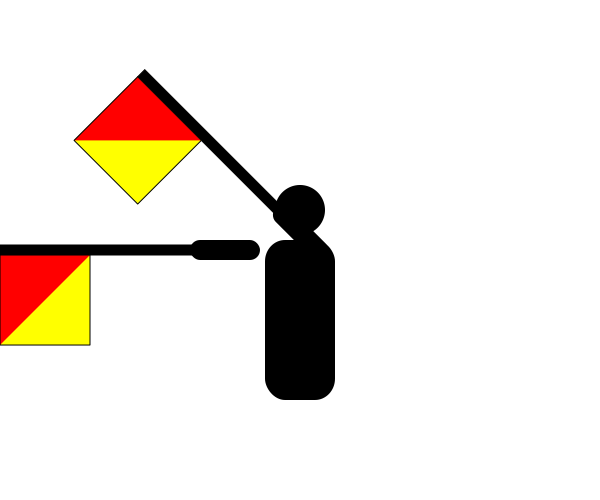


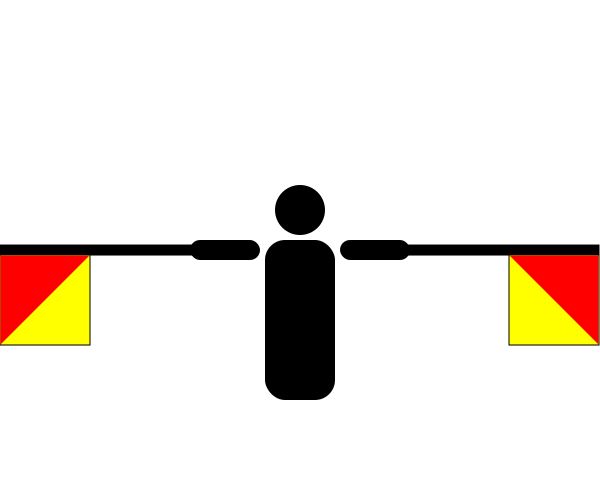
There are approximately 326 people named Sollars in the UK. That makes it one of Britain's least common surnames. Only around five in a million people in Britain are named Sollars.
Origin: English
Region of origin: British Isles
Country of origin: England
Religion of origin: Christian
Language of origin: English
