SNEATH
Sneath is a surname of English origin that is believed to have arisen in the British Isles, specifically within England. The name is derived from the old7th English word snoed or snad, which referred to a piece of land, a clearing or a patch of woodland. The meaning has remained linked to the idea of cutting or pruning, as the surname was originally used as an occupational name for a pruner or cutter of trees and hedges.
In addition to its occupational roots, the surname Sneath is also recorded as a rural locational name. Early medieval references place the name in Yorkshire, with the village of Snaith in Humberside being cited in documents such as the Pipe Rolls of Yorkshire (1169). The name also appears in other rural settings: Sleep Farm in Rock, Wreysmire, Snoad's Hole in Linton, Snoad Farm in Otterden and Snoadhill in Betterden, Kent. These instances indicate that the surname was applied to people dwelling by a clearing or woodland, consistent with its etymological origin.
The earliest recorded spelling of the surname is Ailnoth de Snode, dated 1214 in the Curia Regis Rolls of Kent during the reign of King John (1199–1216). Alternative spellings found in historic records—including Snoed (1327, The Subsidy Rolls of Worcestershire) and later forms such as Sneck, Snoid, and Sright—illustrate how the name evolved over time. These variants include Snaith, Snead, Sneed, and Sneyd, all of which retain the same core pronunciation but differ slightly in orthography.
Religious documentary evidence places the surname within the Christian community of England. For example, in 1577 Ales Snead was recorded as marrying Ryc Wilkinson at St. Stephen's Coleman Street, London. In 1589, Elizabeth Sneade married James Ince at St. Peter le Poer, London, and in 1620 Jane, daughter of George and Elizabeth Snead, was christened at St. Andrew's Holborn, London. These entries provide evidence of the surname’s continued use among Christian households in the capital during the Tudor and early Stuart periods.
Overall, the surname Sneath conveys a clear connection to both geography and occupation within medieval England. Its origin from an Old English term for clearing or land, combined with its appearance in early medieval legal and church records, supports the interpretation that the name was used for both individuals who worked as pruners or cutters and for those who resided in or near cleared woodland areas. The longevity of the surname, as attested by records spanning several centuries, underscores its established presence within English society.
Typical given names associated with the Sneath surname
Male
- Andrew
- Anthony
- Christopher
- David
- James
- John
- Jonathan
- Michael
- Paul
- Richard
- Robert
- Stephen
- Stuart
Female
- Dorothy
- Elizabeth
- Irene
- Joan
- Julie
- Linda
- Lisa
- Margaret
- Patricia
- Rebecca
- Sarah
- Susan
- Winifred
Similar and related surnames
Related and similar names are generated algorithmically based on the spelling, and may not necessarily share an etymology.
How to communicate the surname Sneath in...
Braille
⠎⠝⠑⠁⠞⠓
Morse
...-...--....
Semaphore

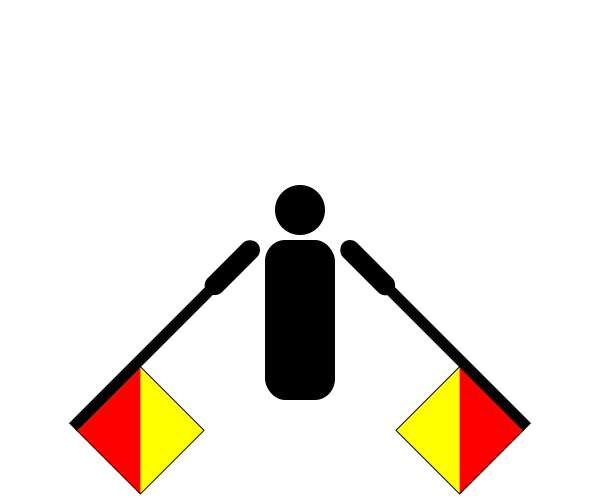


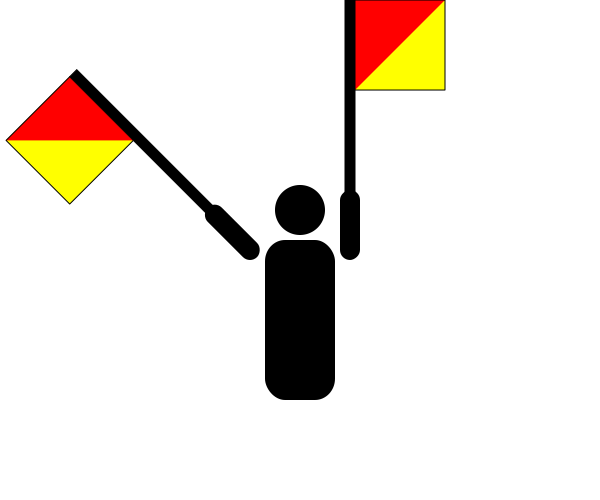

There are approximately 728 people named Sneath in the UK. That makes it roughly the 9,413th most common surname in Britain. Around 11 in a million people in Britain are named Sneath.
Origin: English
Region of origin: British Isles
Country of origin: England
Religion of origin: Christian
Language of origin: English

Famous people named Sneath
- Peter Sneath - Microbiologist (1923 to 2011)
- William Sneath - Cricketer
Names and descriptions courtesy of Wikipedia, and may contain errors. This is not intended to be an exhaustive list of every famous person with this name.