SMYTHE
Smythe is an English surname of occupational origin, deriving from the Old English word smið or smithe, meaning “smith” or “metalworker”. It denotes an ancestral connexion to those who worked as blacksmiths, a skilful profession that involved forging and shaping metal for everyday and martial use.
The name first appeared in medieval England as Smith, Smithe, or Smythe, and later acquired patronymic forms such as Smiths and Smithson. The addition of the letter y in Smythe is a phonetic spelling that reflects a regional variation in pronunciation. Though the modern surname is most common in the southern and eastern parts of England, its roots lie in the Anglo‑Saxon tradition that spread across the British Isles.
Historically, surnames often reflected an individual’s occupation, so those bearing the name Smythe were commonly blacksmiths or people who lived near a smithy. Blacksmiths played a crucial role in every village and town, providing tools, weapons and household items. As a result, the surname became one of the most recorded since the Middle Ages and has since been adopted by many who had no direct connection to the trade.
In the United Kingdom the surname is most frequent in England, followed by Scotland, Wales and Northern Ireland. The distribution extends beyond the UK; the name Smythe is second most common in Ireland and is well represented in the United States, Canada and Australia. In the United States it is most common in the western states of California, Utah and Arizona; in Canada it is mainly found in British Columbia and Ontario; and in Australia it is increasingly common in New South Wales and Victoria.
Record evidence for the surname dates back to the late 10th century. The earliest known spelling is that of Eceard Smid, dated 975 a.d. in the English Surname Register for County Durham during the reign of King Edward of England, known as “The Martyr”. The surname continues to be documented in medieval guild lists and civic registers, and over five hundred coats of arms have been granted to holders of the name, a testament to its historical prominence.
Alternative spellings and related surnames arise from the same root. Variants include Smith, Smit, Smiths, Smithson, Smithers, Smithe, Smitheman, Smitherman, Smytherman and Smithersone. Each preserves the core meaning associated with smithing or metalworking, though some emphasise patronymic or locational aspects. The name Smythe itself has remained a standard spelling in many families through successive generations.
Typical given names associated with the Smythe surname
Male
- Andrew
- Colin
- David
- James
- John
- Mark
- Michael
- Paul
- Peter
- Robert
- William
Female
- Christine
- Elizabeth
- Emma
- Karen
- Lesley
- Margaret
- Mary
- Nicola
- Patricia
- Sarah
- Susan
- Tracey
Similar and related surnames
- Brownsmith
- Smith
- Smyth
- Smithe
- Smithee
- Smithey
- Smit
- Schmitt
- Schmid
- Schmidt
- Smiht
- Smithies
- Smaith
- Smeth
- Smiith
- Smithes
- Smithh
- Smithie
- Smitha
- Symthe
- Samath
- Simmeth
- Simth
- Smath
- Smeath
- Smeeth
- Smeethe
- Smite
- Smithem
- Smithen
- Smither
- Smithet
- Smiths
- Smithy
- Smithyes
- Smitt
- Smitte
- Smitth
- Smmith
- Smooth
- Smoth
- Smth
- Smyter
- Smythers
- Smythey
- Smythie
- Smythies
- Ssmith
- Sumathi
- Sumith
- Symeth
- Symith
- Symth
- Zamith
Related and similar names are generated algorithmically based on the spelling, and may not necessarily share an etymology.
How to communicate the surname Smythe in...
Braille
⠎⠍⠽⠞⠓⠑
Morse
...---.---.....
Semaphore

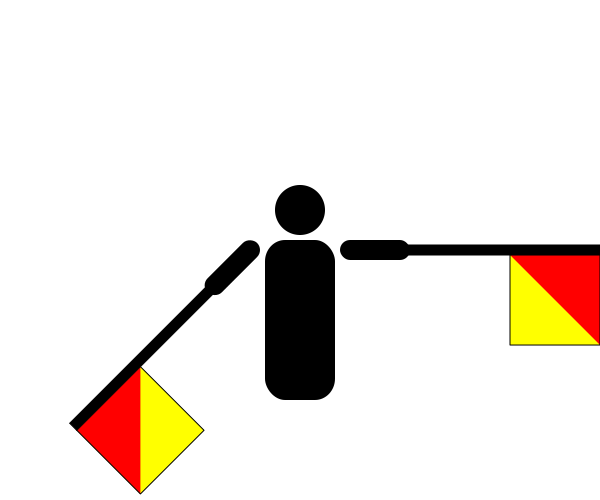
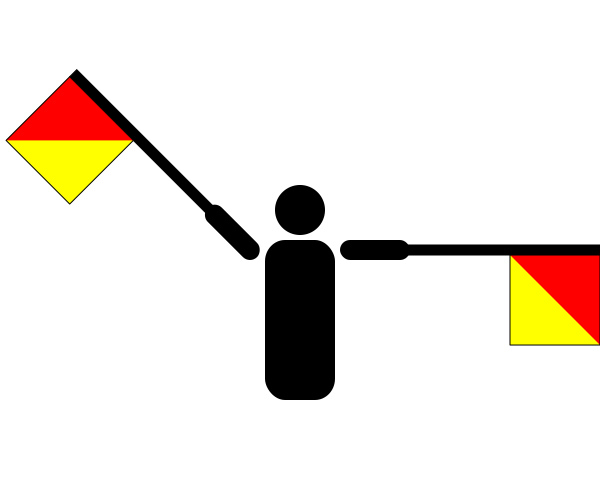
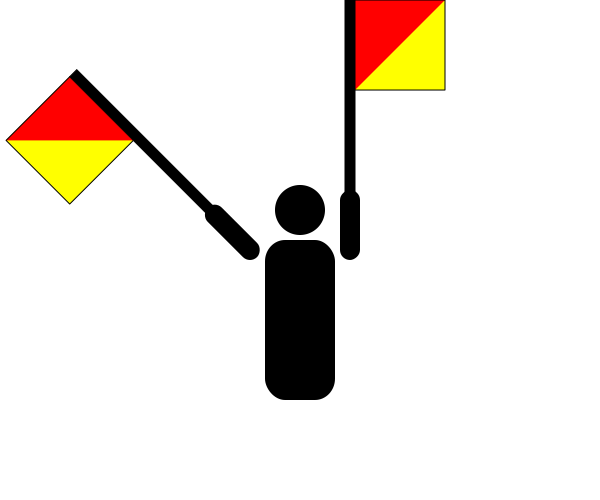


There are approximately 2,625 people named Smythe in the UK. That makes it roughly the 3,393rd most common surname in Britain. Around 40 in a million people in Britain are named Smythe.
Surname type: Occupational name
Origin: English
Region of origin: British Isles
Country of origin: England
Religion of origin: Christian
Language of origin: English

Famous people named Smythe
- Frank Smythe - Mountaineer, botanist, author and photographer (1900 to 1949)
- Pat Smythe - Equestrian (1928 to 1996)
- Nekoda Smythe-Davis - Judoka
- Ernest Smythe - Cricketer (1904 to 1975)
- Albert E. S. Smythe - Journalist and author (1861 to 1947)
Names and descriptions courtesy of Wikipedia, and may contain errors. This is not intended to be an exhaustive list of every famous person with this name.