SMEAD
Smead is a surname of strictly English provenance, its earliest known occurrences dating back to the early twelfth century. The name is rooted in the Old English lexeme smead or smeath, signifying a level or smooth expanse of ground. This etymology suggests that the original bearer of the name perhaps inhabited a plain area recognised for its even terrain, or that it served as a descriptive nickname for an individual of a calm, even‑tempered disposition.
The name has survived in several orthographic permutations over the centuries. Historical documents record forms such as Smethe, Smeeth, Smeed and Smeth. The earliest attestation of the family name is a 1202 entry in the Pipe Rolls of Cornwall during the reign of King John. In 1275 the Hundred Rolls of Kent mention Laurence de Smethe, and the following year, 1279, a record from Oxfordshire lists William le Smeth. The continuity of the name is further illustrated by the 1612 marriage of Robert Smee and Agnes Turner at Uxbridge, London, and by the christening of Thomas, son of Lewis and Luce Smee, in 1638 at St. Dunstan’s, Stepney, London.
The surname is overwhelmingly concentrated in the south of England. Modern demographical surveys show that it is most frequently encountered in counties such as Gloucestershire, Herefordshire, Somerset and Wiltshire, with notable clusters in the metropolitan boroughs of London and the city of Bristol. The peak of its distribution remains Wiltshire, a pattern that mirrors the geographic spread recorded after the Middle Ages, indicating a remarkable stability in its regional localisation.
Variations of Smead are abundant. In addition to the forms previously cited, contemporary sources recognise spellings including Smed, Smeedd, Smede, Smeedle, Smeeda, Smeadd and Smeid. While some of these have roots in Germanic tradition—most notably Smeedle—the vast majority remain firmly within the English linguistic sphere. The persistence of the original spelling in the modern era, together with its limited yet concentrated geographic presence, suggests that the name will likely continue to be a recognised, if uncommon, surname within the British Isles for the foreseeable future.
Although the name has occasionally been described in the past as deriving from a personal nickname meaning “small and meek,” such an interpretation remains unconfirmed relative to the stronger topographical and linguistic evidence. Nonetheless, the variety of recorded forms reflects the rich philological history of the surname and underscores its enduring connection to the English landscape and its people.
Similar and related surnames
Related and similar names are generated algorithmically based on the spelling, and may not necessarily share an etymology.
How to communicate the surname Smead in...
Braille
⠎⠍⠑⠁⠙
Morse
...--..--..
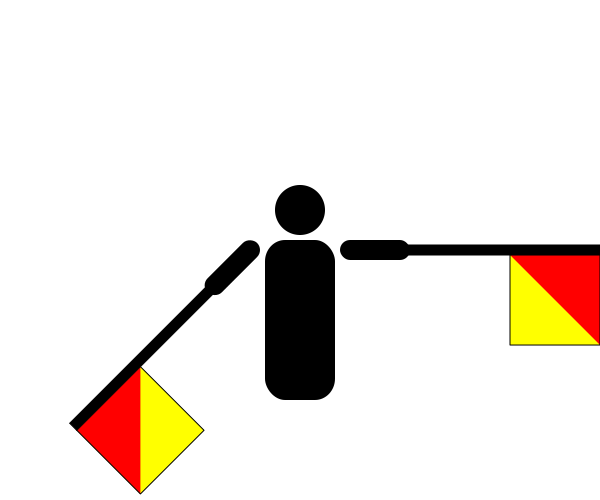
Semaphore



Sorry, we don't have any statistics on this name. That's probably because it's very uncommon in Britain.
