SLEVIN
Slevin is a surname of Gaelic Irish origin, most commonly found within the British Isles. The name derives from the Old Irish Ó Sleibhín, meaning “descendant of Sleibhín” where the personal name Sleibhín is a diminutive of sliabh, the Irish word for “mountain”. Consequently, the surname is typically understood as a topographic designation for a person dwelling near or upon a mountain.
The earliest surviving reference to the name appears in the early medieval period, with the chief bard of Ulster in the reign of Brian Boru (1002‑1014), recorded as Giolla Comhghaill Ó Sleighin. This individual is regarded as one of the first recorded bearers of the surname. In 1514, a record from the Liberty Court of Tipperary identified a Terrelagh Ó Slevin as a “pure Irish of the Irish Nation”, a description that hindered his ownership of land; by 1603, the Slevin clan in County Fermanagh were noted as coarbs (hereditary holders of church lands), and the 1659 census listed Slevins as significant landowners in County Westmeath.
The surname has a documented presence in several Irish counties. By the late twelfth century three main branches are recorded: one settled in Moate, another in Fermanagh, and a third in Kilkenny. Further migration within Ireland led to notable associations in Donegal, where the family line produced seven noble houses during the sixteenth century, including those at Tamney and Killybegs. In the eighteenth century, William Slevin witnessed a deed at the Church of St. Nicholas Within, Dublin, on 1 June 1739, illustrating the family's continued social involvement.
The surname entered the wider diaspora during the nineteenth century. A notable emigrant, Thomas Slevin, aged 22, departed from Liverpool aboard the ship Cornet in May 1846 as part of the great famine exodus to America. Subsequent immigration has spread bearers of the name throughout the United States, Canada, France, Australia, New Zealand, and other parts of the world. In the United States the majority of recent immigrants with the surname come from Ireland, followed by Scotland and England; significant communities also exist in the United Kingdom and continental Europe.
In spelling, variations have evolved over time. Common forms include Slevin, Sleavin, Sleevan, Sleaven, Sleapen, Slavin, and Slewain. These correspond to the original Gaelic Ó Sleibhín, Ó Sleibhe, or Ó Sleiváin. Geographic associations for particular variants are as follows: Slavin and Sleevan are frequently found in Counties Fermanagh and Antrim; Sleavin in Westmeath; and Slevan in Down and Tyrone. The variant Slewain might relate to Ó Sliabháin and is occasionally recorded in County Leitrim, a tradition that appears from the fifteenth century onward.
Throughout its history the surname has been linked with a range of occupations. In the medieval period, individuals bearing the name were known to serve as poets (bards), warriors and administrative figures; later records include agriculturalists, fishermen and craftsmen. The legacy of the name, both in its ancestral homeland and abroad, reflects a sustained presence that has adapted across centuries while remaining recognisable through its linguistic heritage and geographical ties.
Typical given names associated with the Slevin surname
Male
- Andrew
- David
- James
- John
- Mark
- Michael
- Patrick
- Paul
- Peter
- Sean
- Stephen
- Thomas
Female
- Anne
- Catherine
- Elizabeth
- Emma
- Jane
- Joanna
- Kathleen
- Louise
- Margaret
- Marie
- Martina
- Mary
- Michelle
- Sarah
Similar and related surnames
- Slavin
- Slaven
- Selvin
- Salvin
- Slavinsky
- Slavinski
- Celvin
- Sallivan
- Salvagno
- Salvan
- Salven
- Salvini
- Salvona
- Salvoni
- Selfin
- Selivan
- Selvan
- Selvini
- Selvon
- Silevan
- Silivan
- Sillavan
- Sillivan
- Silvagni
- Silvain
- Silvan
- Silvani
- Silvano
- Silvino
- Slavan
- Slavon
- Sleavin
- Slevan
- Sleven
- Sliven
- Sloven
- Slovin
- Solivan
- Soliven
- Solven
- Sulavan
- Sulaven
- Sulevan
- Sulivan
- Suliven
- Sullavan
- Sullaven
- Sullavin
- Sullavon
- Sullevan
- Sulliavan
- Sullivan
- Sulliven
- Sullivin
- Sullivon
- Sulllivan
- Sullovan
- Sullvan
- Sulvan
- Sylvain
- Sylvan
- Sylvani
- Sylven
- Sylvian
- Sylvin
- Zelviene
Related and similar names are generated algorithmically based on the spelling, and may not necessarily share an etymology.
How to communicate the surname Slevin in...
Braille
⠎⠇⠑⠧⠊⠝
Morse
....-......-..-.
Semaphore


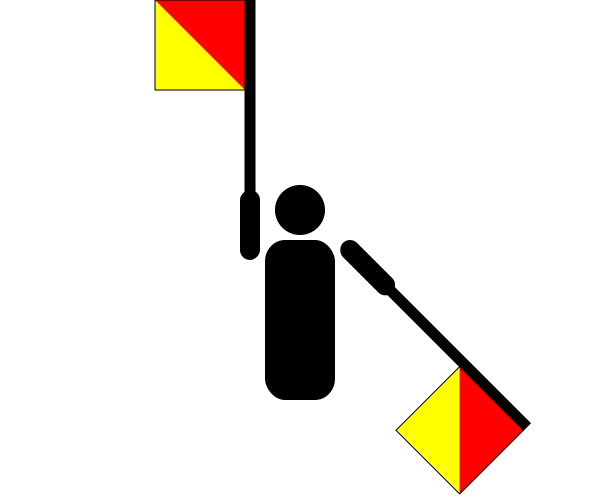
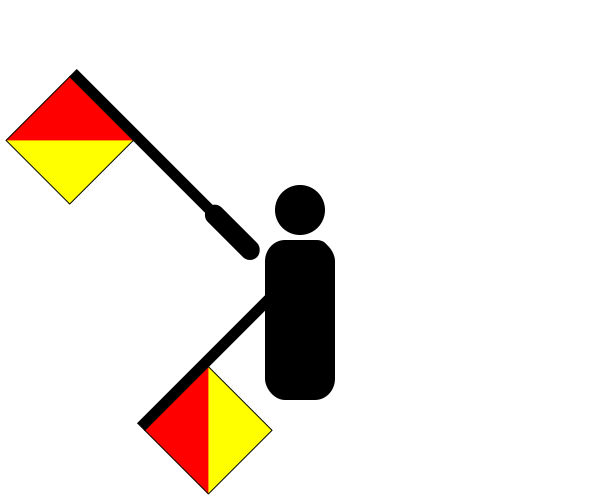
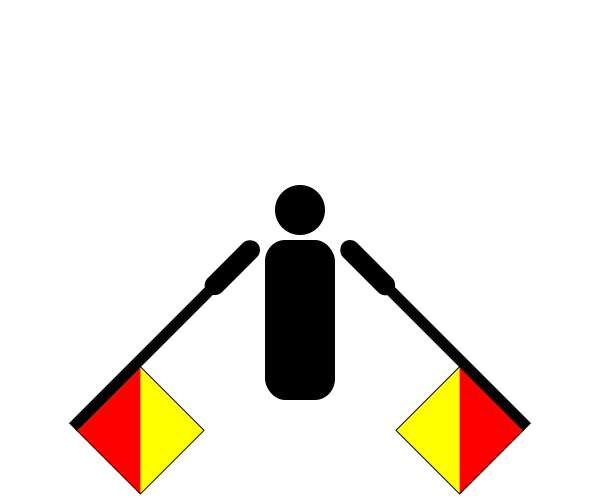
There are approximately 1,024 people named Slevin in the UK. That makes it roughly the 7,235th most common surname in Britain. Around 16 in a million people in Britain are named Slevin.
Origin: Celtic
Region of origin: British Isles
Country of origin: Ireland
Religion of origin: Christian
Language of origin: Gaelic
