SLEIGHT
Sleight is a surname of English provenance, firmly rooted within the cultural and linguistic heritage of the British Isles. Its recorded presence dates back to the early medieval period, and it has maintained a discernible linkage to the English language and to Christian communities across England.
The primary etymological source for Sleight is the Middle English word sleight, which conveyed the notions of cunning or skillfulness. As a sobriquet, it was applied to individuals whose wit or craftsmanship exceeded the ordinary expectations of their contemporaries, thereby bestowing a descriptive surname that reflected personal aptitude.
In a parallel tradition, the surname appears to have arisen from the Northern Middle English terms sleght or slyght, meaning smooth, sleek, slender or slim. This origin is believed to draw ultimately from Old Norse, underscoring the linguistic intermingling that characterises much of northern British onomastics. The spelling variants Slight, Slaight, Sleicht, Sleit and Slite have been documented, particularly in Scotland and in the English counties of Lincolnshire and Nottinghamshire from the late sixteenth century. The earliest surviving instance is that of John Slycht, who witnessed a sasine in the barony of Bamff in 1507.
A separate, locational derivation has been attributed to a place in Dorset, situated within the Wimborne and Cranbourne rural district. The place name is thought to derive from the Old Norse word sletta, interpreted as a level field or flat meadow. This locational hypothesis explains the appearance of the surname in domestic settings where the geographic feature was prominent.
Archival evidence supports the antiquity of the name: the first recorded spelling of the family name is found in the Records of Brokhale and Butterden dated 1431, where Richard Sleyght is mentioned during the reign of King James I of Scotland. The name is further cemented by the heraldic grant to Robert Sleght in the reign of Richard XI (1377‑1399), whose armorial bearings comprise a gold shield with a chevron between ten black crosses crosslet, six in chief and four in base.
In contemporary times, the surname Sleight remains most common within the United Kingdom, with a notable concentration in Yorkshire and in the counties of Lincolnshire and Nottinghamshire. Its presence extends beyond British shores to Canada and to smaller populations in the United States. Variants such as Sleighth, Sleighte, Sleite and Sleit occur sporadically, reflecting historical spelling diversity. The surname therefore continues to embody the linguistic and cultural continuities that have shaped English onomastics over the centuries.
Typical given names associated with the Sleight surname
Male
- Andrew
- Anthony
- Christopher
- David
- James
- John
- Mark
- Paul
- Peter
- Richard
Female
- Amanda
- Angela
- Christine
- Claire
- Emma
- Helen
- Jane
- Jennifer
- Lisa
- Margaret
- Moira
- Susan
- Tracy
- Victoria
Similar and related surnames
Related and similar names are generated algorithmically based on the spelling, and may not necessarily share an etymology.
How to communicate the surname Sleight in...
Braille
⠎⠇⠑⠊⠛⠓⠞
Morse
....-.....--.....-
Semaphore


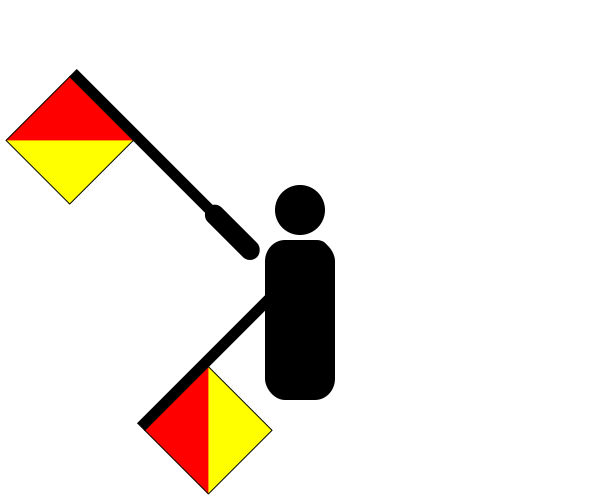


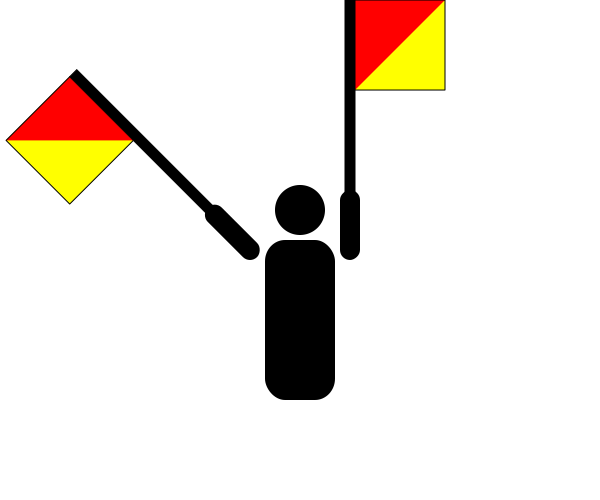
There are approximately 1,593 people named Sleight in the UK. That makes it roughly the 5,100th most common surname in Britain. Around 24 in a million people in Britain are named Sleight.
Surname type: Location or geographical feature
Origin: English
Region of origin: British Isles
Country of origin: England
Religion of origin: Christian
Language of origin: English
