SLAYTON
The surname Slayton is of purely English origin and has been established in the British Isles for many centuries. It derives from a combination of Old English and Old Norse lexical components, each of which conveys a distinct sense of the occupation or the landscape associated with the name.
One theory holds that Slayton originates from the Old English words slege or slæge, meaning a sledgehammer or heavy hammer. In a medieval context the term would have applied to a craftsman who forged metal or to a worker who employed a sledgehammer to break or crush stones. In such a setting the surname would have functioned as an occupational identifier for a blacksmith or a labourer accustomed to wielding a sledgehammer.
Another well‑documented derivation links Slayton to the Old Norse verb sleigh(t), derived from sletta “level field” combined with the Old English pre‑7th‑century term tun meaning a farm or settlement. As a topographic surname it would have identified someone who lived or worked on a flat meadow. The earliest documentary evidence of this form appears in the late sixteenth century; the name Sleighton is recorded in Berkshire in 1673 and Slatten in 1717. A significant early instance is the 1590 record of Thomas Sleighton, who married Scisila Siggens at St. Margaret Westminster.
A further etymology stems from the Old English word sleah, meaning “wood” or “clearing.” This points to families who cleared woodland for agriculture, a common practice in the regions of Yorkshire, Lancashire and Cheshire. The name has also been associated with a place called Saulden, later adapted as Slayton, near Kirkcudbright in southern Scotland. Consequently, the surname spread from the English Midlands to Scotland, Wales and, centuries later, to the colonies.
Historical evidence shows the name in civil and parish registers throughout the early modern period. William Salyton’s marriage to Ann Dine in St. Benet, Paul's Wharf, London on 11 June 1616, and Sushannah Slayton’s marriage to Edward Fleet on 13 May 1773 at St. Mary le Strand, Westminster, are further early attestations. The pattern of spelling variation – from Sleighton to Sleeton, Sleeton, Sleyton, and Slaten – reflects the fluid orthographic practices of the time.
In the United Kingdom today the surname exists in all constituent states but remains most frequent in England, with smaller communities in Scotland, Wales and Northern Ireland. In the United States the name is relatively common, ranking as the 3,647th most frequent surname in the 2020 Census. New York leads the U.S. in concentration, followed by Pennsylvania, Florida, California, North Carolina, Georgia, Wisconsin, Indiana and Tennessee. Instances of the surname can also be found, though less commonly, in Australia, Canada, Ireland, Italy and other former colonies.
Variations of the name have evolved both phonetically and orthographically. Modern variants include Slayton, Sleighton, Sleeeton, Sleeton, and Sleyton, as well as more distant cognates such as Sladen, Slaight, Slayter and Slayte. Some rare patronymic forms—Slaytzer, Slaytoner, Slaytonman—do appear in archival material, indicating a broader family network rooted in a shared ancestor.
In summary, Slayton is an English surname with roots that trace back to both occupational and topographic traditions. Its earliest documentary instances date to the late sixteenth century, though its linguistic components originate from the Old English and Old Norse eras. Over the past centuries the name has spread from the British Isles to North America and beyond, retaining its distinct heritage while adapting to new linguistic and cultural contexts.
Similar and related surnames
Related and similar names are generated algorithmically based on the spelling, and may not necessarily share an etymology.
How to communicate the surname Slayton in...
Braille
⠎⠇⠁⠽⠞⠕⠝
Morse
....-...--.-------.
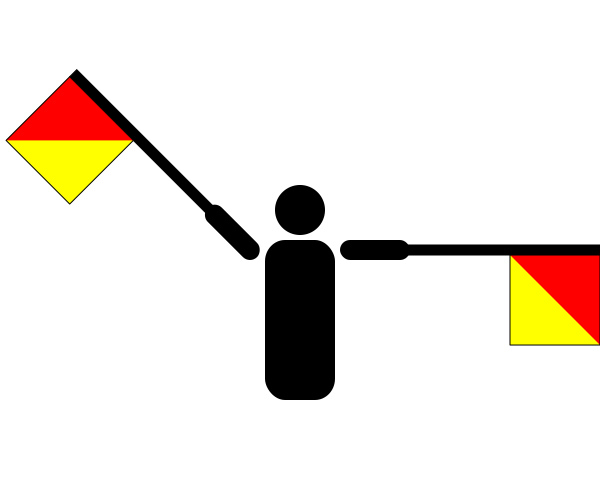
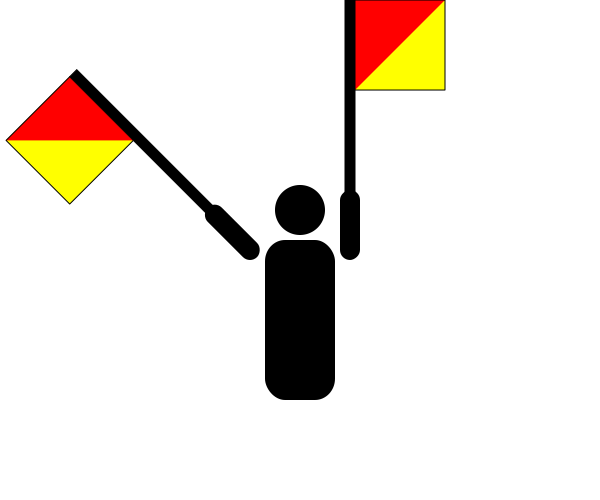
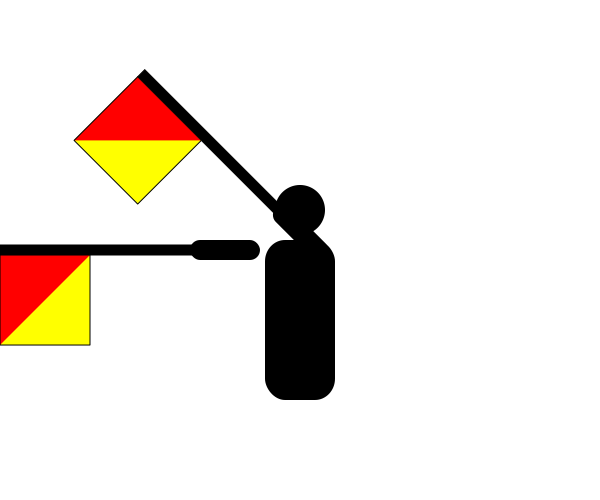
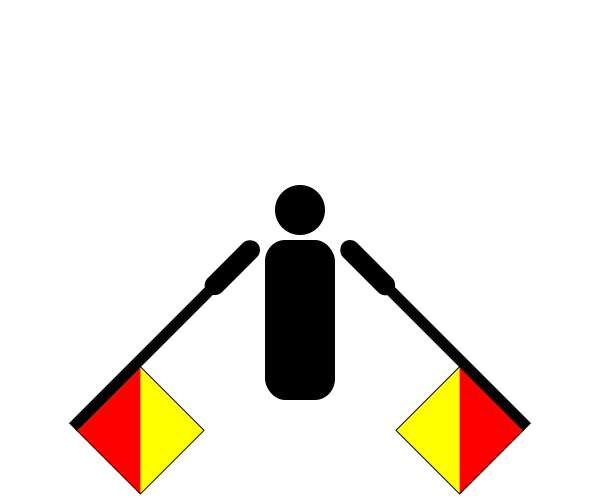
Semaphore


Sorry, we don't have any statistics on this name. That's probably because it's very uncommon in Britain.
Origin: English
Region of origin: British Isles
Country of origin: England
Religion of origin: Christian
Language of origin: English