SLAY
Slay is a surname of early medieval English origin that can be traced back to the British Isles, specifically England, where it emerged from the customary use of nicknames and descriptive topographical references.
From an etymological perspective, the name appears to have multiple roots. It may be a variant of sleigh, derived from the Old English word sleah meaning “sledge” or “cart.” It could also arise from the Old English term slea, referring to a “slough” or a “ditch” and would have been a topographic name for someone dwelling near a valley or hollow. A third possibility is that the surname developed from the Middle English word slegh, meaning “strike” or “slay,” and would have served as a nickname for a person known for skill in fighting or hunting. Consequently, the surname Slay carries a variety of meanings that differed according to family and region.
The surname is first recorded in surviving English documentation in the early twelfth and thirteenth centuries. Notable early references include Thomas Sleh of Lincolnshire in 1219, Robert Sley of Warwickshire in 1221, and the mentions of John Sleth and Andrew Sleth in Aberdeen in the 1270s. The spelling of the name has long varied, being documented as Slay, Slee, Sly, Sleigh, Sleith, Slight and Sleath. In 1770 John Sleath, a noted headmaster of St. Paul's School in London, married Anne Rowe in Northwich, Cheshire, a detail that appears in the *Dictionary of National Biography*.
A distinctive element of the family identity is the heraldic design granted to the Sleath line: a gold shield bearing three red escallops in chief and a gold crane as crest. The earliest known spelling of the name observed in the *Feet of Fines of Essex* dates back to 1219 during the reign of King Henry VIII, who is sometimes called “The Frenchman.” This evidence places the surname firmly within the early English linguistic framework.
In contemporary times the surname is most widely found outside the United Kingdom, particularly in the United States where it is prevalent in the Midwest, the Southern states and among African-American communities. Nonetheless, its original connotations remain centered on physical strength, craft or topographical association, rather than the modern slang usage that describes success or dominance. The spectrum of spellings that has broadened the reach of the name includes Slay, Slee, Sly, Sleigh and Sleath, each reflecting regional linguistic evolution across the British Isles, North America, Canada, Ireland and Australia.
Typical given names associated with the Slay surname
Male
- Andrew
- Ben
- Benet
- Daniel
- Steve
Female
- Dian
- Helen
- Hilary
- Rosemary
Similar and related surnames
Related and similar names are generated algorithmically based on the spelling, and may not necessarily share an etymology.
How to communicate the surname Slay in...
Braille
⠎⠇⠁⠽
Morse
....-...--.--
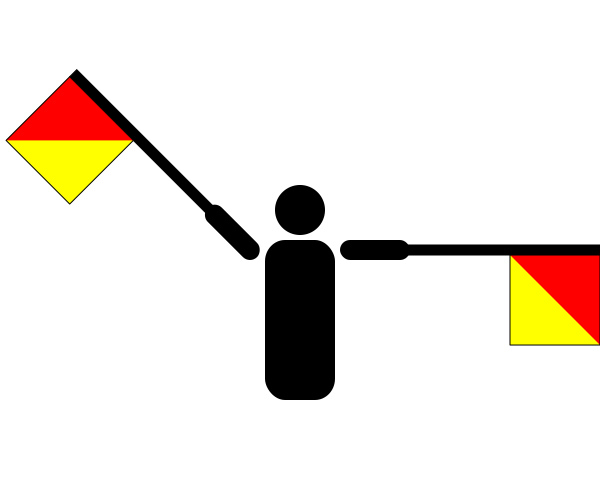
Semaphore


There are approximately 93 people named Slay in the UK. That makes it one of Britain's least common surnames. Only around one in a million people in Britain are named Slay.
Origin: English
Region of origin: British Isles
Country of origin: England
Religion of origin: Christian
Language of origin: English
