SKEEN
Skeen is a surname of Celtic provenance, with its earliest attestations situated within the Gaelic-speaking territories of the British Isles. The name is principally associated with Scotland, where it appears in medieval charters and parish registers dating from the late thirteenth century. Its roots are linguistic, deriving from the Gaelic word sgein, which means “knife” or “dagger”. The term was presumably applied as a nickname to an individual renowned for skill in the use of bladed weapons, or to a craftsman engaged in the manufacture or sale of such implements.
In addition to the occupational connotation, later scholarship has identified a geographical variant of the name. The surname may also have arisen from the old Gaelic exonyms *sceathin* (meaning a bush or clump of trees) or *sceach* (a briar). Such toponymic origins would link the name to the barony of Skene in Aberdeenshire, where the earliest documentary evidence—such as the homage rendered by Robert de Skene to the Interregnum Government of Scotland in 1296—has been preserved. The barony itself was situated between the parishes of Glenmuick and Glenrinnes, a location sometimes referred to as “The Skein.”
Recorded across the centuries are numerous orthographic variants of the name. These include Skeene, Skene, Skeyne, Skehan, Skehen, Skehens, Skin, MacSkeagan, MacSkeaghan, and O’ Skehan. Many of these forms demonstrate the fluidity of medieval spelling and the influence of regional dialects on the transcription of Gaelic sounds into Latin and Anglicised script.
In Ireland the surname appears particularly in the counties of Monaghan, Louth and Tipperary, where it was sometimes altered to the English placename Thornton, a penalisation that perhaps echoed the original meaning of “briar.” Early Irish instances date from at least the early eighteenth century, such as the marriage of Terence Skin (Stabannan, County Louth, 1710) and the unions of Margaret Skeen (St. Munchin, Limerick, 1731) and of Denis and Mary Skehan (Newport, County Tipperary, 1864). These records illustrate a distinct, albeit parallel, genealogical trajectory to that of the Scottish Skeens.
The surname has encountered a degree of migration to North America. In the United Kingdom, individuals bearing the name were recorded in the twelve‑th century as early as 1177 and 1296. The earliest American Skeen appears to be Thomas Skeen of Chester County, Pennsylvania, who is believed to have emigrated from Ireland during the late eighteenth century. His descendants later dispersed widely across the United States, notably within the states of Virginia, Texas, Ohio and Pennsylvania.
Across the Atlantic Canadian Skeens are traditionally linked to Uriah Skeen, who arrived in Ontario in the mid‑nineteenth century. While the contemporary estimate of the surname’s prevalence in the United States is fewer than five thousand individuals, the name remains more obscure in Canada, with figures below one thousand. The persistence of the surname in both countries reflects the broader diaspora of Scots and Irish settlers during the colonial era.
The name also carries traces of Norse influence, particularly in reference to the word skei, meaning a race course. This etymological note points to the possibility that some bearers of the name were associated with sporting activities or with the maintenance of reindeer herding tracks in northern Scotland. Such associations, however, are less documented than the occupational and toponymic origins established in earlier records.
Variants of the surname reflect its adaptation to different linguistic contexts. The English version has been linked to the Old English word sceon, meaning “free”, and to the place‑name term sceon meaning a hill or hillside. Consequently, the surname may have functioned as a toponymic identifier for individuals residing in or near small hills. This interpretation aligns with the broader pattern of surnames derived from geographical features in medieval Britain.
The surname Skeen persists with distinction within several English‑speaking communities worldwide. In Britain, it remains concentrated in Scotland and specific counties of England, while in North America it is principally found within the United States and Canada. The name’s endurance is a testament to the interweaving of linguistic heritage with regional identity that characterises many surnames of Celtic origin.
In summary, the surname Skeen derives from Gaelic linguistic roots, embodies a mix of occupational, toponymic and, to a lesser extent, Norse elements, and bears a documented presence across Scotland, Ireland and the broader English‑speaking diaspora. Its array of orthographic variants reflects the historical fluidity of surname spelling and the distinctive pathways of migration that have shaped its current distribution. The surname remains a recognised marker of Celtic heritage and a testament to the enduring nature of family names through the centuries.
Typical given names associated with the Skeen surname
Male
- Andrew
- Charles
- Colin
- David
- James
- Jamie
- John
- Michael
- Paul
- Peter
- Richard
- Robert
- Thomas
Female
- Alison
- Anna
- Anne
- Christina
- Donna
- Gillian
- Janet
- Karen
- Linda
- Margaret
- Olivia
- Ryma
- Sarah
- Susan
Similar and related surnames
Related and similar names are generated algorithmically based on the spelling, and may not necessarily share an etymology.
How to communicate the surname Skeen in...
Braille
⠎⠅⠑⠑⠝
Morse
...-.-..-.
Semaphore

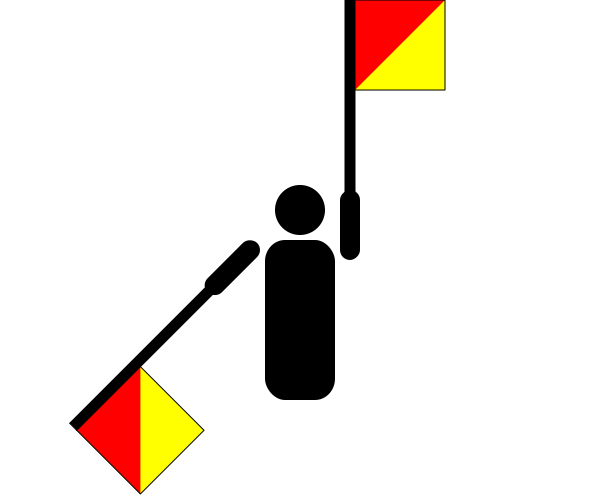

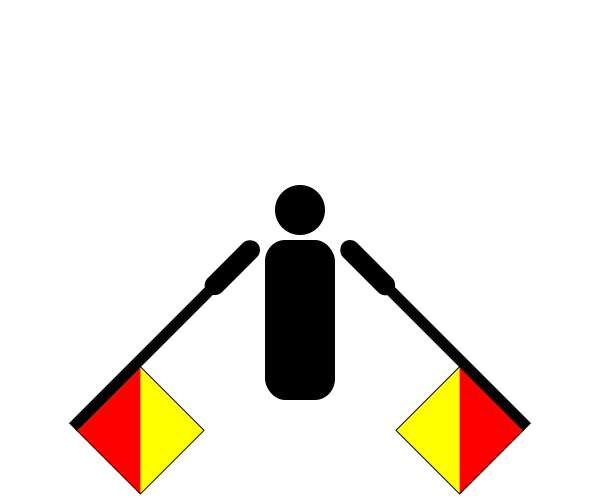
There are approximately 370 people named Skeen in the UK. That makes it one of Britain's least common surnames. Only around six in a million people in Britain are named Skeen.
Origin: Celtic
Region of origin: British Isles
Country of origin: Scotland
Religion of origin: Christian
Language of origin: Gaelic

Famous people named Skeen
- Andrew Skeen - Indian Army general (1863 to 1935)
- Ken Skeen - Football player
Names and descriptions courtesy of Wikipedia, and may contain errors. This is not intended to be an exhaustive list of every famous person with this name.