SIKORA
Sikora is a surname of Polish origin, derived from the Polish word sikora, meaning titmouse or chickadee. The name was frequently borne by individuals who lived in regions where these small birds were abundant or who were perceived to possess qualities characteristic of the bird, such as agility or vivacity.
The surname appears in several orthographic forms across Central and Eastern Europe, including Sikorski, Sikorsky, Sykora and Szikora. In Czech usage the form Sykora is common, while in Hungarian the version Szikora is standard. Each variation retains the same etymological root, referencing the bird species that inspired the original nickname.
Although no town bearing the name Sikora has been recorded, the addition of the suffix -ski (in Polish) or -sky (in Russian and some German contexts) is historically indicative of land ownership or minor nobility, comparable in function to the German von or the French de. The appellation therefore signified both an affectionate moniker and a social status marker.
Coat‑of‑arms traditions reflect this relationship between name and symbol; in the 18th century a family bearing the name Sikorski received arms in the former German state of Pomerania, a blazon depicting three small black birds upon a silver field, a canting example that visually links the heraldry to the literal meaning of the surname.
Inhabitants of Poland, Slovakia, and the Czech Republic, especially in the Silesian region and the Slovak eastern borderlands, retain a high density of the surname today. Among other places of concentration are Bavaria, Saxony and Brandenburg in Germany, and regions of northern Ukraine and Kazakhstan. In the United States, this name is predominantly found in states with large Polish communities such as Illinois, Michigan, New York, New Jersey, Pennsylvania and Massachusetts, reflecting patterns of early twentieth‑century migration.
Historically notable bearers of the surname include Władysław Sikorski (1881–1943), a Polish military commander who defended Warsaw against Russian forces in 1920 and subsequently led the Free Polish forces from London during the Second World War, until his untimely death in an aircraft crash near Gibraltar. Another prominent figure is Igor Sikorsky (1889–1972), a Russian‑born aerospace pioneer who, following the 1917 revolution, emigrated to the United States where he designed and built the first successful helicopter in 1939.
In addition to Eastern European origins, the surname has been adopted by Jewish communities, particularly those who took the name in connection with the town of Vilkomir in Belarus during the twentieth‑century period when surnames were mandated for civic registration. This broad trans‑regional usage underscores the surname’s role as a linguistic bridge across cultural and national boundaries.
Although the frequency of the surname has fluctuated over time, it remains a testament to the intertwined histories of Polish, Czech, Slovak and Jewish heritage, and continues to indicate a shared cultural lineage rooted in the natural world.
Typical given names associated with the Sikora surname
Male
- Adam
- Damian
- Jerzy
- Krzysztof
- Marcin
- Marek
- Michal
- Nigel
- Pawel
- Piotr
- Rafal
- Tomasz
- Zbigniew
Female
- Agnieszka
- Anna
- Emma
- Ewa
- Grazyna
- Joanna
- Katarzyna
- Lucy
- Magdalena
- Malgorzata
- Monika
- Paulina
- Shirley
Similar and related surnames
Related and similar names are generated algorithmically based on the spelling, and may not necessarily share an etymology.
How to communicate the surname Sikora in...
Braille
⠎⠊⠅⠕⠗⠁
Morse
.....-.----.-..-
Semaphore

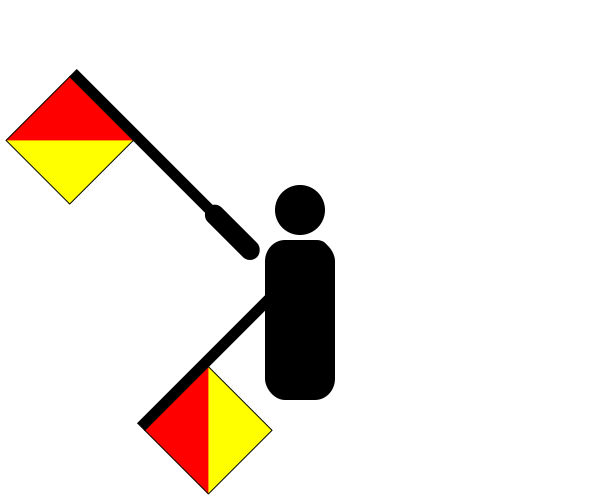
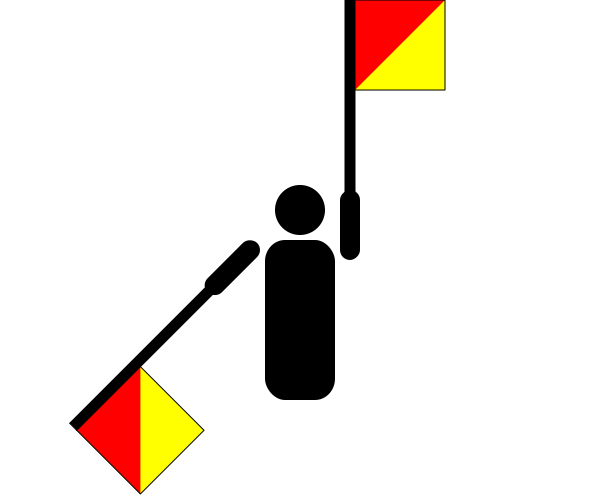
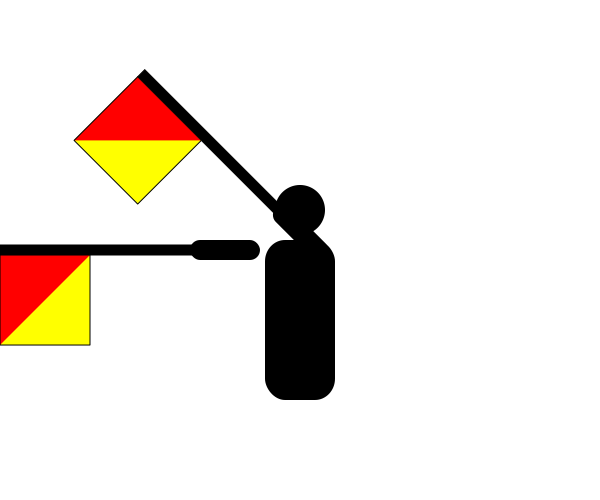
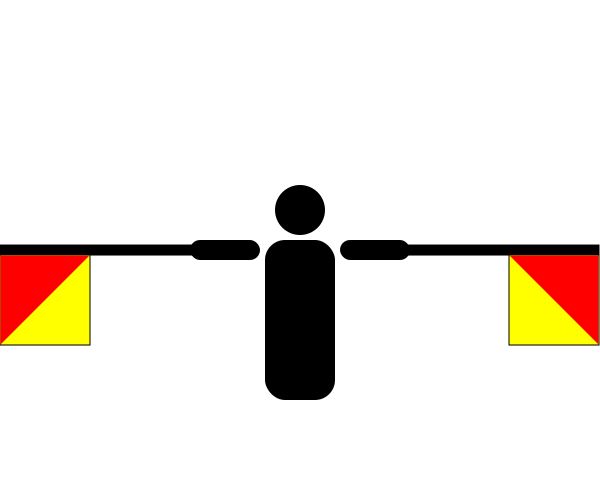

There are approximately 628 people named Sikora in the UK. That makes it one of Britain's least common surnames. Only around ten in a million people in Britain are named Sikora.
Region of origin: Europe
Country of origin: Poland
Language of origin: Polish

Famous people named Sikora
- Joseph Sikora - American actor
Names and descriptions courtesy of Wikipedia, and may contain errors. This is not intended to be an exhaustive list of every famous person with this name.