SEWARDS
In England, the surname Sewards is a patronymic name arising from the medieval personal name Siward, a name that itself derives from Old English elements combining the idea of victory and guard. The meaning of Siward has been understood as “victory guard” or “victorious guardian”, a designation that was commonly used to identify the descendants of a man bearing this name and thus the surname Sewards.
The earliest documentary evidence for the personal name appears in the Domesday Book of 1086, where it is recorded in several spellings such as Sauwurder, Seuuard, Seuuart and Siuuard. These early variants refer to the same Anglo‑Saxon elements: for instance, the form Saeweard incorporates the Old English words for sea (“sae”) and victory (“sige”), together with the protective suffixes “weard”. By the early Middle Ages the original names had become confused, giving rise to the popular conformations Seward and Siward, which appear as “Sewarde” in the Norfolk Hundred Rolls of 1275.
Recorded usage of the surname itself can be traced back to the late twelfth and early thirteenth centuries. An example from 1275 names Richard Seward of Shropshire, while a 1260 entry records Richard Syward of Cambridgeshire. In the fourteenth century a further personal form appears as William Saywart in 1385 at Cheshire. These instances illustrate the early spread of the name across varied regions of England.
Over the centuries, a number of orthographic variants have survived, the most common of which are Seward, Sewards, Sewart, Seaward, Saward and Sayward. Church registers provide additional evidence of the surname’s continuity: the marriage of John Saward with Elianora Kynge at Thaxted in Essex on 20 October 1547, and the union of William Saward and Elizabeth Coxon at St. Dunstan’s in Stepney, London, on 12 April 1596. These records indicate that the name remained in regular use well into the sixteenth century.
The heraldic association most commonly attached to the family name depicts a silver shield bearing three blue boars’ heads arranged bendwise. The specific tinctures and charges, as well as the exact blazon, have been preserved in several heraldic manuscripts, providing a visual symbol through which the family’s historical identity has been recognisable.
One of the earliest authoritative spellings of the family name appears in the “Book of Fees of Oxfordshire” dated to 1235, where the name is listed as Richard Siward or Suard. The document was produced during the reign of King Henry, who is sometimes described as “the Frenchman”. Henry’s reign spanned 1216 to 1272, a period that witnessed substantial Norman influence on English nomenclature.
Despite the influx of Continental names following the Norman Conquest of 1066, the Anglo‑Saxon origin of Sewards and its cognate forms represents a vivid illustration of the persistence of native personal names. The fused elements “victory” and “guard” continue to echo in the surname’s linguistic heritage, and the name’s documented recurrence from the eleventh century to the present day underscores its durability within the English onomastic tradition.
Typical given names associated with the Sewards surname
Male
- Andrew
- Charles
- David
- Jason
- Lee
- Mark
- Mike
- Nigel
- Paul
- Peter
- Philip
- Robert
- Rupert
- Stephen
Female
- Anna
- Emma
- Gwendoline
- Julie
- Katie
- Lisa
- Mary
- Paula
- Susan
- Victoria
Similar and related surnames
Related and similar names are generated algorithmically based on the spelling, and may not necessarily share an etymology.
How to communicate the surname Sewards in...
Braille
⠎⠑⠺⠁⠗⠙⠎
Morse
.....--.-.-.-.....
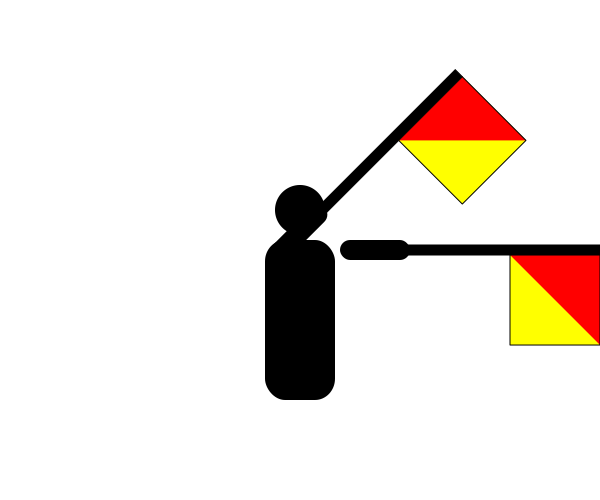
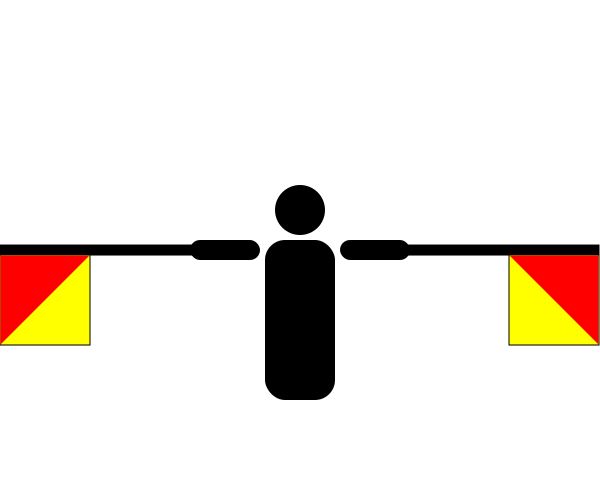
Semaphore




There are approximately 205 people named Sewards in the UK. That makes it one of Britain's least common surnames. Only around three in a million people in Britain are named Sewards.
