SENTER
Senter is a surname of English origin that has been recorded in the British Isles from the early medieval period. The name is classed as an occupational name rather than a patronymic; it is first documented in the 12th century and has persisted, albeit rarely, into modern times.
The earliest known spelling appears in the Early London Personal Names database and dates to 1060, where an individual named Edmund Seintier is listed. This form of the name is linked to the Old French word santier, which referred to a bell‑founder or metal‑worker who produced bells, buckles and other fittings. In medieval England the occupation was sometimes called a senter, and the surname would have been applied to a craftsman engaged in these metal‑working trades.
Alternate derivations for the surname also exist. The Middle English word senter is recorded as meaning “centre” or “middle.” Under this theory, Senter could have been a topographic surname given to someone residing in the centre of a village or town. A further, less widely accepted possibility links the name to the Old French sans ‘without’ and terre ‘land’, suggesting it might have been a nickname for a supporter of King John, known by the sobriquet “Lackland.” However, this latter theory is based on a linguistic construction that was not definitively attested in contemporary records.
In Yorkshire the name appears in early church and court records. In 1602 the christening of Josua, son of John Sainter, is recorded at Snaith; in 1621 Elizabeth, daughter of Peter Sainter, was christened at Pontefract; and in 1629 George Sainter married Elizabeth Richardson at Snaith. These entries, all of which use variants such as Sainter or Senter, demonstrate the surname’s continued use in the region during the 17th century.
Variation in spelling is common in the historical record. Forms such as Santer, Center, Sentner and Centner have been documented, often reflecting the phonetic spelling practices of parish clerks and the limited standardisation of English orthography before the 18th century.
Today, the surname remains uncommon across the United Kingdom and is more frequently found in the United States, particularly in the states of North Carolina and Texas, according to contemporary genealogical databases. In England it is still encountered, though rarely, and has also made its way into Canada and Australia, often among descendants of earlier British emigrants.
Typical given names associated with the Senter surname
Male
- Andrew
- Anthony
- Christopher
- Daniel
- David
- Gary
- Howard
- John
- Mark
- Michael
- Paul
- Richard
- Troy
Female
- Andrea
- Catherine
- Christine
- Helen
- Jacqueline
- Jennifer
- Joyce
- Kate
- Nicola
- Polly
- Sarah
- Susan
- Wendy
Similar and related surnames
- Cender
- Centauro
- Center
- Centore
- Centra
- Centre
- Centro
- Cintra
- Sainter
- Sandar
- Sander
- Sandere
- Sandor
- Sandra
- Sandre
- Sandri
- Sandro
- Sandru
- Sanetra
- Saniter
- Sanitor
- Sannder
- Santars
- Santer
- Santerre
- Santers
- Santiero
- Santor
- Santore
- Santori
- Santoro
- Santory
- Santra
- Saunder
- Saunter
- Senator
- Senatore
- Sendder
- Sender
- Sendor
- Sendra
- Sendur
- Sener
- Sent
- Senters
- Sentes
- Sentier
- Sentner
- Sentor
- Sentry
- Senturk
- Shanter
- Sinatra
- Sinder
- Sineter
- Sinnadurai
- Sinter
- Sneader
- Sneider
- Sneidere
- Snider
- Snitter
- Snowder
- Snyder
- Sonder
- Sondore
- Sondur
- Sontar
- Sonter
- Sonttar
- Soundara
- Sounder
- Soundur
- Sundar
- Sundara
- Sunder
- Sundra
- Sunter
- Synder
- Szantyr
- Szendera
- Szendrei
- Szendroi
- Xander
- Zander
- Zehnder
- Zender
- Zentar
- Zientara
- Zunder
Related and similar names are generated algorithmically based on the spelling, and may not necessarily share an etymology.
How to communicate the surname Senter in...
Braille
⠎⠑⠝⠞⠑⠗
Morse
....-.-..-.
Semaphore


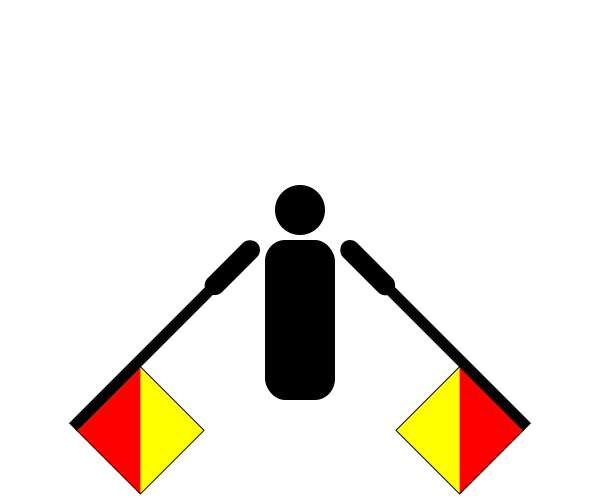
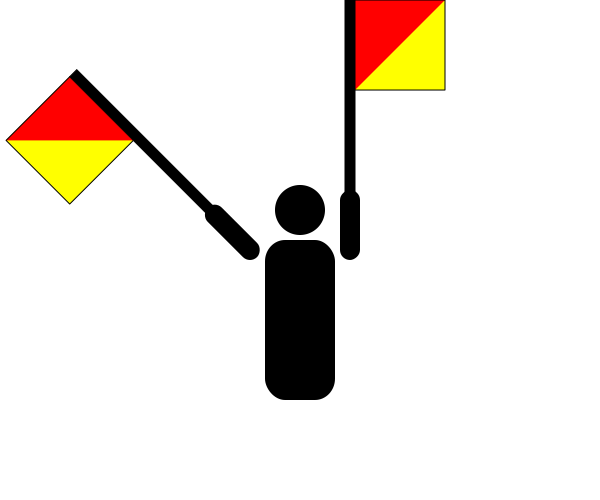
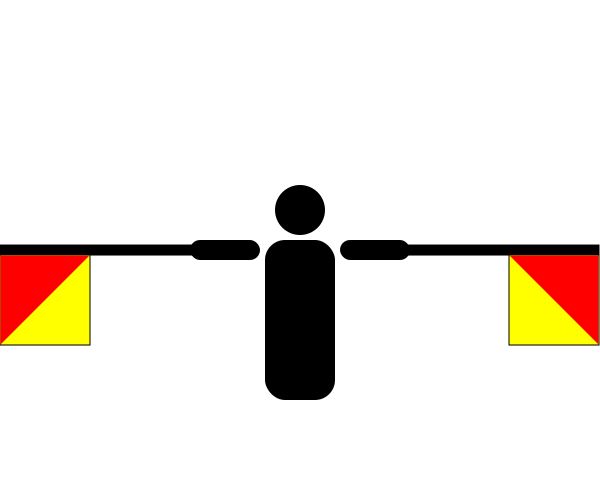
There are approximately 317 people named Senter in the UK. That makes it one of Britain's least common surnames. Only around five in a million people in Britain are named Senter.
Surname type: Occupational name
Origin: English
Region of origin: British Isles
Country of origin: England
Religion of origin: Christian
Language of origin: English
