SEID
Seid is a surname of predominantly Germanic origin, traced back to the Middle High German term seide, meaning silk. The name is occupational in nature, historically applied to individuals engaged in the silk trade, whether as merchants, weavers or dyers, and it entered the German nomenclature in the early medieval period.
The toponymic and occupational forms of the surname appear in a variety of medieval records. A notable early mention records Herman Sida of Bronnbach in 1214, while Theobald Seidener of Stadtschule in Ulm is dated 1462. In the early modern era, Andreas Seidenbusch served as organist in Munich during the period 1641–1729, an example of the name persisting into the 17th century.
The surname can be found in several variants: Seid, Seide, Seidner, Seidenman and Seidler are common German forms, and a Polish adaptation is Zajdler. Compounds such as Seidenband (silk ribbon), Seidenbaum (silk tree) and Seidenschnir (silk rope) also use the root ‘seide’ to describe objects associated with silk. These forms illustrate the breadth of the surname’s occupational connotation.
Beyond the Germanic context, the spelling Seid appears in other linguistic traditions. In Arabic, Seyyid denotes a descendant of the Prophet Muhammad, and the surname Seid in the Middle East derives from this term, conferring a sense of religious distinction. In Turkish and certain Central and Eastern European cultures, Seid may emanate from nouns meaning “house‑father” or guardian. The surname also exists as a patronymic in German families, linked to the name Seidl, which itself stems from an Old German word meaning wide.
English‑speaking countries have absorbed the name in diverse forms: Seyd, Sayd, Seide, Seied, Seidl, Seilent, and in some cases a phonetic Anglicisation to Seed. The evolution of spelling reflects both linguistic integration and the desire for a more familiar orthography among immigrant communities.
Today, the surname Seid is recorded throughout Europe and North America. In the United Kingdom, it is most frequently observed within areas with substantial South Asian populations, notably in London, Birmingham and Manchester, where it often correlates with British Pakistani families. In the United States, census data show a concentration in states with large Arab or South Asian demographics, including California, Michigan, Florida, New York and New Jersey. Canadian and Irish occurrences are comparatively rarer but present.
In summary, the surname Seid encapsulates a multifaceted heritage: a Germanic occupational name linked to the silk industry, a patronymic extension of Seidl, and an Arabic designation of religious lineage. Its persistence across centuries and continents demonstrates the dynamic pathways of surname development and the interweaving of cultural identities in onomastic history.
Similar and related surnames
Related and similar names are generated algorithmically based on the spelling, and may not necessarily share an etymology.
How to communicate the surname Seid in...
Braille
⠎⠑⠊⠙
Morse
......-..
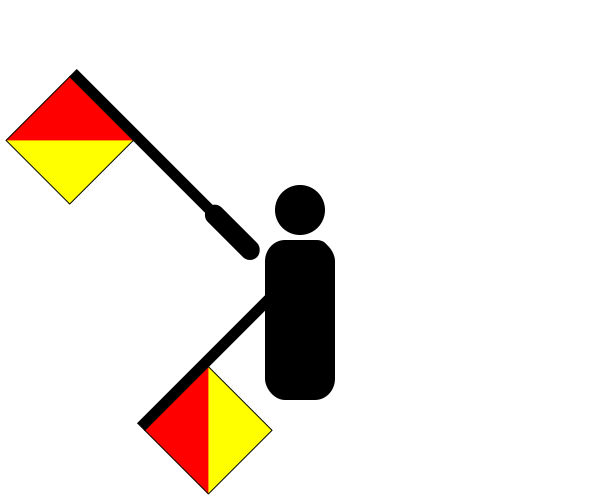
Semaphore



Sorry, we don't have any statistics on this name. That's probably because it's very uncommon in Britain.
