SEEGER
The surname Seeger has its roots in Germanic languages and is traditionally classified as an occupational name. It is believed to have been applied to an individual who performed a substantial feat of strength or triumph in the field of endeavour, whether that be in war or in a competitive arena.
The derivation from the Middle High German word siger, meaning “victory”, suggests that the original bearer of the name was regarded as a victorious warrior or a successful champion. This etymological association is supported by the contemporary usage of the term in medieval German records to denote a conqueror.
In parallel, some evidence indicates that the surname also has Anglo‑Saxon or Norse‑Viking origins. The personal name saegar, translating as “sea‑spear”, may have been the source of the early form of the name. Records dating back to the late twelfth century, such as the 1207 Curia Regis Rolls of Bedfordshire that list a Ralph Segar, illustrate the endurance of the name after the Norman Invasion of 1066.
The earliest documented instance of the surname appears in the Pipe Rolls of Dorset, dated 1195, where a Walter Sagar is recorded. This predates many other European instances and highlights the name’s early establishment in the British Isles.
During the Middle Ages the surname also appeared in continental Europe; for example, it is recorded in Holland and is associated with Sir William Segar, who served as Garter King of Arms to King Charles the First until his death in 1633. His coat of arms, awarded in 1612, is described as a blue field charged with a silver cross moline – a detail that evidences the name’s recognition across the continent.
There are several accepted modern spellings of the name, including Sager, Sagar, Saiger, Segar, Seager, Seegar and Seeger. Variants such as Seay, Seabourn and Seaver are occasionally recorded, as are a few others that developed through changes in pronunciation and regional orthography.
In terms of contemporary distribution, the surname remains common in its country of origin, Germany, where approximately 17 240 individuals bore the name in 2020. In the United States it ranked as the 2 805th most frequent surname in 2019, with an estimated 11 948 bearers, and it is also found in Canada and Switzerland, where about 350 households and 1 941 individuals respectively carry the name.
The persistence of the surname across centuries and continents illustrates both its strong cultural roots and its adaptability to a variety of linguistic contexts. Whether recognised as a sign of victorious prowess, a maritime legacy, or a simple professional association, Seeger remains a testament to the historical importance of personal achievement recorded in family names.
Typical given names associated with the Seeger surname
Male
- Barry
- Brian
- Carl
- Charles
- Christopher
- Colin
- George
- Guy
- Jeremy
- John
- Michael
- Peter
- Stefan
- Wolfgang
Female
- Clara
- Elizabeth
- Jacqueline
- Judith
- Julie
- Karen
- Katrin
- Lesley
- Linda
- Lisa
- Mavis
- Susan
- Victoria
Similar and related surnames
- Saager
- Saeger
- Sagar
- Sageer
- Sager
- Sagers
- Sagger
- Saghera
- Saghir
- Sagier
- Sagor
- Saigar
- Saiger
- Scager
- Seagar
- Seagars
- Seager
- Seagers
- Seagger
- Seagor
- Seegar
- Seegers
- Seegert
- Segar
- Segarra
- Segars
- Seger
- Segers
- Seggar
- Segger
- Seggers
- Seggery
- Seghir
- Segree
- Segura
- Seguro
- Seigar
- Seiger
- Seuger
- Sezger
- Sieger
- Siegers
- Sweiger
- Zager
- Zaiger
- Zeegers
- Zegar
- Zeger
- Zegers
- Zeiger
- Zieger
- Ziegers
Related and similar names are generated algorithmically based on the spelling, and may not necessarily share an etymology.
How to communicate the surname Seeger in...
Braille
⠎⠑⠑⠛⠑⠗
Morse
.....--...-.
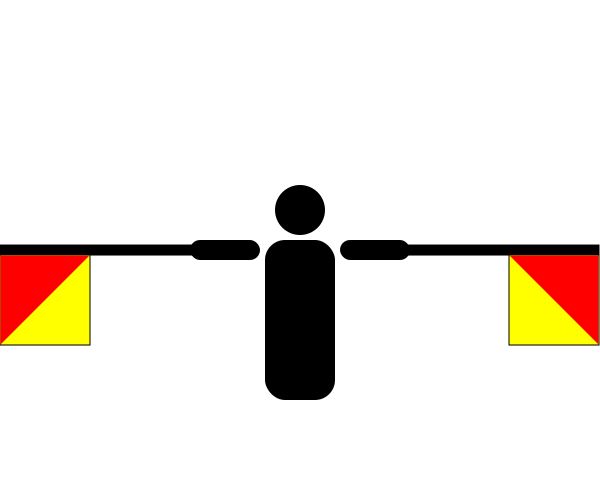
Semaphore


There are approximately 215 people named Seeger in the UK. That makes it one of Britain's least common surnames. Only around three in a million people in Britain are named Seeger.
Surname type: Occupational name
Origin: English
Region of origin: British Isles
Country of origin: England
Religion of origin: Christian
Language of origin: English
