SCROGGS
The surname Scroggs is principally of English origin, though its early usage shows a notable Scottish influence. In the middle ages it was recorded as Robert de Scrogges in 1208 in the Records of Peeblesshire, Scotland, during the reign of King William «The Lion» (1165–1214). By 1296 figures such as Adam of Skrogges, a burgess of Haddington, and William del Skogges of Peeblesshire were documented rendering homage, illustrating the name’s spread through the barony of Stobo and beyond.
The etymology of Scroggs is derived from the Middle English word scrog, meaning a stunted, twisted tree or shrub. Consequently, the name is classified as a topographic surname, given to individuals who lived near such vegetation or who inhabited a place named with this term. It reflects a strong connection between the bearer and the natural environment of the local landscape.
Alternate derivations associate the surname with the Scottish and northern English dialect words scrag and scrog, which are parallel in meaning to the Old English pre‑7th‑century “stocc” or “stock”, denoting a stump of a tree. During the Middle Ages, migration for employment prompted many to adopt their former village or estate name as an identifier, thereby dispersing the name widely across the British Isles. This practice aligns with the linguistic evidence found in medieval church registers, where variations such as Scragg and Scrag appear in christenings and marriages in the 15th and 17th centuries.
Another theory proposes that Scroggs may have early medieval English origins as a nickname for a thin, bony person, derived from the Middle English scrag meaning scrawny. This interpretation is supported by contemporary records, including the christening of Danyell Scragg at St. Botolph’s (London) in 1558 and the marriage of Alexander Scrag in Aberdeen in 1656. While these entries highlight variant spellings, they also confirm the surname’s persistence across several centuries.
In the 17th century, the earliest recorded spelling in Northern England and Scotland appears in a series of historical documents. By that period, the name had acquired various orthographic forms, such as Scroggs, Scroggins, Scroggles, and Scroggen. The spellings often differed according to regional dialects; for example, Scroggles is especially common in Scotland, whereas in England the spelling Scroggs predominates. Additionally, the name has variants in other languages—French Scroggins, Irish O'Scroggs, and German Schroggs—all retaining the core meaning derived from the Middle English nickname.
In contemporary times, Scroggs remains predominantly found within the English‑speaking world, particularly in the United Kingdom and the United States. Within the United Kingdom, Leicestershire hosts the largest concentration, with over 400 individuals carrying the name, followed by London, Kent, South Yorkshire, and Hampshire. Across the Atlantic, Tennessee possesses the highest number of bearers, exceeding 1,500, with significant communities also in North Carolina, Arkansas, Virginia, Alabama, and Georgia. Outside these two countries, the surname is relatively rare, occurring in small numbers in Canada, Australia, and Ireland.
Overall, the surname Scroggs encapsulates a blend of topographic and descriptive origins, reflecting both environmental associations and personal characteristics. Its recorded presence from the early 13th century to the present day attests to a resilient lineage that has evolved in spelling and geography while maintaining a consistent link to its linguistic roots.
Typical given names associated with the Scroggs surname
Male
- Cedric
- Daniel
- Duncan
- James
- Lewis
- Nicholas
- Paul
- Philip
- Richard
- Robert
- Simon
- Stephen
Female
- Carol
- Charlotte
- Fiona
- Hannah
- Haylie
- Jane
- Josephine
- Julia
- Karen
- Lucy
- Rebecca
- Susan
- Wendy
- Zinia
Similar and related surnames
Related and similar names are generated algorithmically based on the spelling, and may not necessarily share an etymology.
How to communicate the surname Scroggs in...
Braille
⠎⠉⠗⠕⠛⠛⠎
Morse
...-.-..-.-----.--....
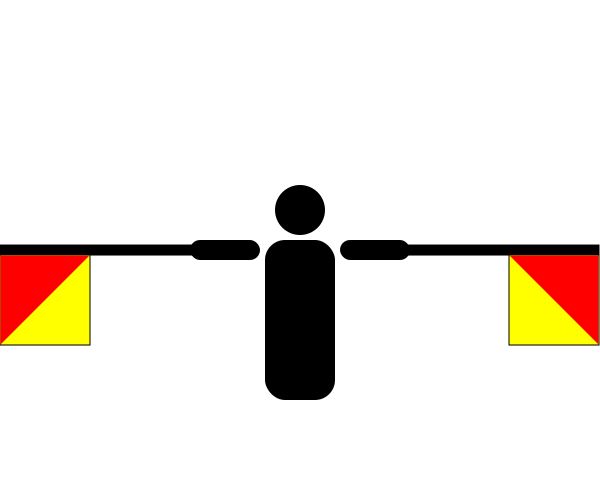
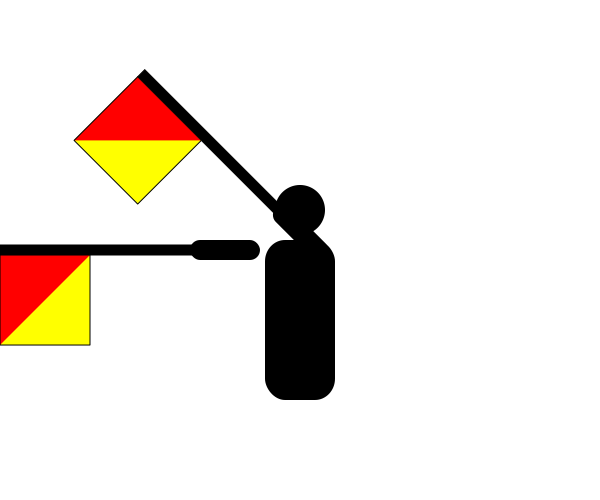
Semaphore



There are approximately 123 people named Scroggs in the UK. That makes it one of Britain's least common surnames. Only around two in a million people in Britain are named Scroggs.
