SCOGIN
Scogin is a surname of English and Scottish origin whose early usage dates back to the thirteenth century. Its earliest recorded form is Scoggan, appearing in the Medieval Records of Norfolk in 1357, during the reign of King Edward the First, the monarch often referred to as the father of the navy. The name is believed to have been derived from the Old English word scoggan, meaning “shrewd” or “cunning.”
During the Middle Ages, the medieval personal name Scogin was used as a diminutive form of the name Scot. In that period, Scot was a nickname denoting someone from Scotland or a person exhibiting Scottish characteristics. Consequently, the surname Scogin likely originated as a descriptive nickname for an individual with Scottish ancestry or traits. In some early parish registers the name appears in a Latinised form, for example as Scioggin or Scoggan in the fifteenth‑century entries of London, Suffolk, Yorkshire, and Durham.
Additional documentary evidence reveals that the surname is also of Old Scandinavian origin. It is considered one of the patronymic forms of the surname Scog(g)in or Skog(g)in, itself a diminutive of the Norse byname Skeggi or Skoggi, meaning “the bearded one.” In the late eighth and ninth centuries, waves of Scandinavian invasion and settlement reached the east coast, the north and the north‑western counties of Britain. This migration is mirrored by the distribution of modern forms of the name—Scogan, Scoggan, Scogin, Skoggin, Scoging, and Scogans—which appear in church registers such as William Skoggen of London (1550), Edward Scogin of Suffolk (1554), Charles Scoggan of Yorkshire (1562) and Robert Skoggin of Durham (1594).
The earliest surviving variation of the surname that incorporates a prefix is the Fitz‑Scogin, traditionally used to mark legacy or illegitimacy. Such prefixes were not uncommon in medieval England for identifying lineage or social status. While the usage of Fitz‑Scogin is scarce, the prefix remains a possible component in a family line that later migrated to the British colonies.
Following the colonisation of the Americas, the surname Scogin became increasingly common in the southern United States. In the early eighteenth century, John Scogin (born c. 1705) migrated to South Carolina, where the family settled and expanded. By the nineteenth and twentieth centuries, the name was most concentrated in Alabama, Georgia, Arkansas, Mississippi and Louisiana. Contemporary records indicate that the Scogins of these states continued to value hard work, dedication and family solidarity, attributes that were already evident in the original bearers of the name in Britain.
Variations of the surname are numerous, reflecting phonetic shifts and regional spellings. Aside from the historically recorded Scoginn and Scoggan, newer forms seen in later records include Scuggin, Scruggs, Scruggins and Scarugin. Some scholars link the suffix ‑in or ‑ing with the Old French escouguier meaning “crossbowman,” suggesting that the original name may have encompassed a martial role. Other lesser‑known derivatives are Scugens, Scooks, Scondi and Scaffins, all of which are considered to descend from the core Scogin lineage.
Heraldic records associate the surname with a particular coat of arms: a gold fess dancettee between three gold curlews on a blue shield. This imagery is emblematic of the family’s reputed strength and perseverance, qualities that have been upheld throughout the centuries by its descendants.
In summary, the surname Scogin bears a rich heritage that intertwines English and Scottish origin with Scandinavian heritage. Its earliest expressions arise in the thirteenth‑century records of Norfolk, and its later forms illustrate the spread of the name through medieval England, northern Europe, and eventually the southern United States. Today, members of the Scogin family remain notable in the UK and the US, upholding a legacy that is grounded in a strong sense of identity and community.
How to communicate the surname Scogin in...
Braille
⠎⠉⠕⠛⠊⠝
Morse
...-.-.-----...-.
Semaphore


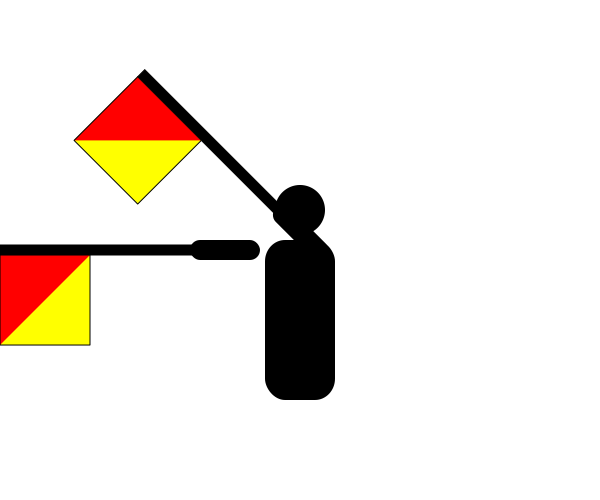

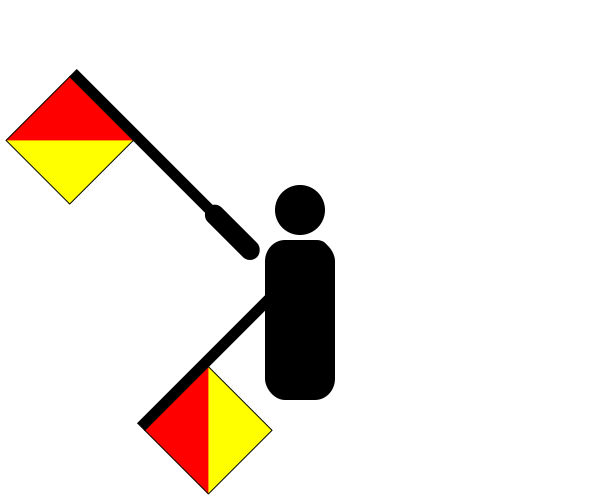
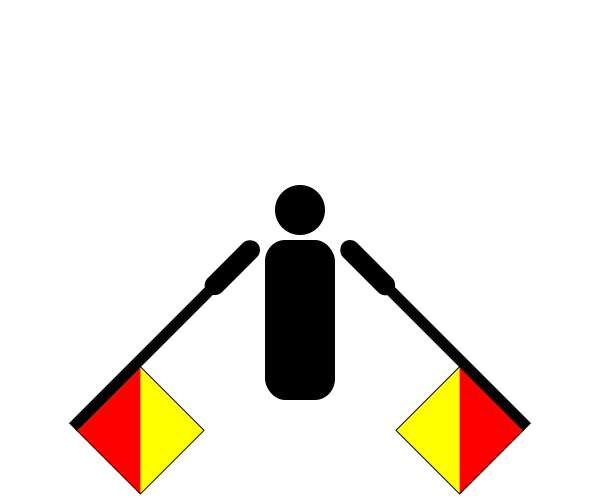
Sorry, we don't have any statistics on this name. That's probably because it's very uncommon in Britain.
