SCOGGIN
The surname Scoggin has its earliest roots in Gaelic, a language of the Scottish Highlands. The word sgogach, meaning "bushy" or "shaggy", is understood to have been applied as a nickname to a person with wild or unkempt hair. From this descriptive nickname the family name evolved into the hereditary surname Scoggin and has since been borne by several generations of a lineage tracing itself back to Scotland.
In addition to its Gaelic origin, the surname is also associated with the Old Norse personal name Skokkr, meaning "a jumper" or "a prankster". The suffix -kin – a diminutive indicator – suggests a small or little version, rendering the literal sense of the name as "the little jumper" or "the little prankster". This element records the influence of Norse settlers who arrived in parts of Britain during the eighth and ninth centuries; the name is therefore most often found in the east coast, northern and north‑western counties of England.
Historical records attest to the early presence of the name in both England and the Scottish border regions. The first documented spelling that appears in the medieval archives is that of Robert Scogan, dated 1357 in Norfolk, during the reign of King Edward the First. Subsequent entries include William Skoggen in London in 1550, Edward Scogin in Suffolk in 1554, Charles Scoggan in Yorkshire in 1562 and Robert Skoggin in Durham in 1594. A parish record from Little Staughton, Bedfordshire, documents the marriage of Thomas Scogings and Hannah Evans on 31 December 1805.
The heraldic badge most commonly attached to the name depicts a gold fess dancettee between three gold curlews on a blue shield. This emblem, along with the name itself, has long been linked to families who claimed descent from the early Scottish and Norse settlers of Britain.
Through England to the New World, the surname travelled with emigrants and has consequently become established in several overseas territories. Contemporary demographic information indicates that the surname is predominantly found in the United States – particularly in the southern states of Texas, Alabama, Georgia, Mississippi and Tennessee – but is also present in the United Kingdom, Australia and, to a lesser extent, Ireland, Canada, Norway, Sweden and Finland. In the United States, the 2020 Census recorded approximately 1 750 individuals bearing the name, concentrated mainly in rural communities within the south.
The name has been recorded in myriad variant forms, a reflection of the linguistic diversity in the communities that settled near the original name bearers. Common variants include Scogging, Scoogin, Scogin, Scoogen, Scoggan, Scoggane, Scoggans and Skogen. Other regional spellings appear throughout the British Isles: Scoigen, Skoog, Skoug, Scuggen, Skoigan, Skoigin, Skeggen and Skeggan. Similar forms can also be found in continental Europe, such as French Scagon and German Schogen. These variations reveal the broad reach of the name across Europe, colonisation routes and migration streams.
While modern sources occasionally reference the surname in the context of American literature, the claim that the protagonist of Harper Lee’s To Kill a Mockingbird bears the surname Scoggin is not supported by verified evidence. The association remains a contested claim within literary scholarship rather than an established fact.
Similar and related surnames
Related and similar names are generated algorithmically based on the spelling, and may not necessarily share an etymology.
How to communicate the surname Scoggin in...
Braille
⠎⠉⠕⠛⠛⠊⠝
Morse
...-.-.-----.--...-.
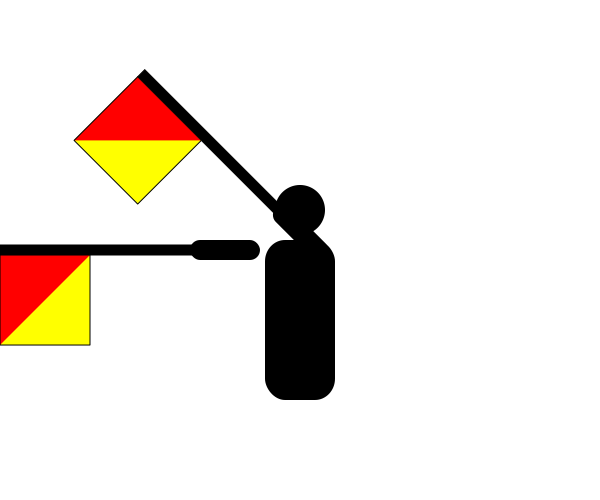
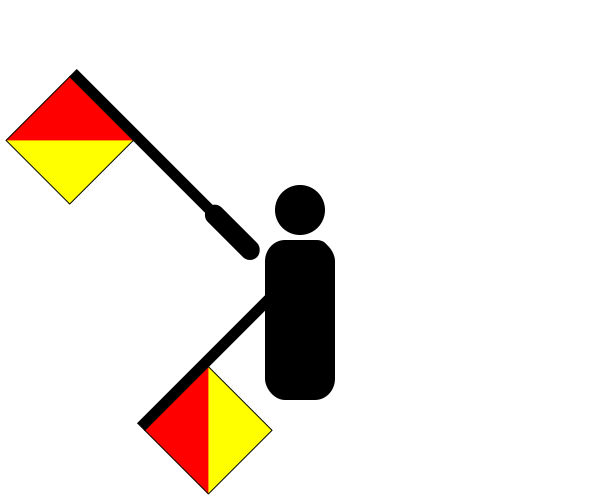
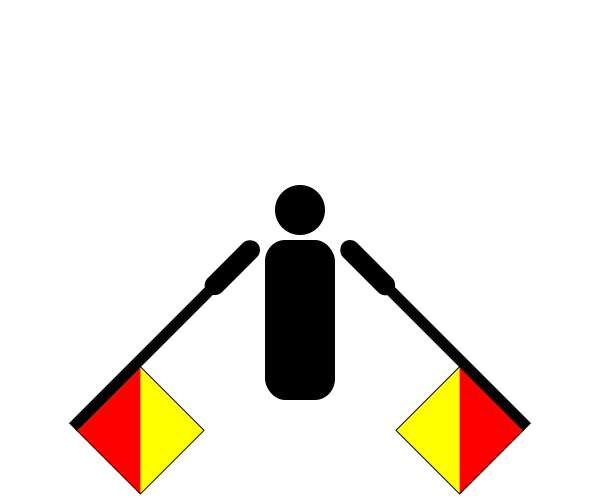
Semaphore



Sorry, we don't have any statistics on this name. That's probably because it's very uncommon in Britain.
