SCHOLTZ
Scholtz is a surname of German origin that traces its roots to the Middle High German word schultheize, meaning “village headman” or “mayor.” The term was originally an occupational designation for an individual who held a position of authority within a village or town, responsible for administering local governance and collecting dues on behalf of the lord of the manor.
The name appears in a wide range of medieval spellings, including Schult, Schulter, Schulz, Schultz, Schultze, Schulthe, Schulthiss, Scholtis, Schulte, Schout, Soltys, Sule, Sole, Scholzel, Schuling, Schouteden and Szulczewski. These variations record the name in Switzerland, Germany, Flanders, Poland, The Netherlands, and the Czech and Slovak republics, reflecting the movement of German‑speaking peoples across northern Europe.
Early documentary evidence for the surname is found in authentic medieval charters. For example, Godescalus Sculte is recorded as a citizen of Hamburg in 1249; Cuonradus Scultus appears in Zurich, Switzerland, in 1258; Nicolas Schultetus is listed as burgermeister of Chemnitz in 1357; and Klaus Schultz is mentioned as a member of the ratsherren near Stolp in 1476. These entries demonstrate that the surname was already in use by the twelfth and thirteenth centuries.
In German jurisdictions the surname is most commonly encountered today, and it was among the most popular German family names by the seventeenth century. The name also occurs in Austria, the Czech Republic and Poland, where it is sometimes rendered as Szoltz or Szolc. In The Netherlands the variant Scholten and related forms are found, while in France and the United Kingdom the spelling Scholtz is rarer but still present.
The migration of German families in the nineteenth and early twentieth centuries brought the name to North and South America. In the United States the surname is most frequently seen in urban centres such as New York, Philadelphia and Los Angeles, but small numbers are also recorded in Canada, Australia and New Zealand. The spelling remains largely unchanged in English‑speaking countries; however, some families have adopted versions such as Shultz or Schult.
The etymological development of Scholtz can be summarised in two phases. Initially it signalled a schultheize, an intermediary between the village inhabitants and the feudal lord, responsible for the levying and remittance of dues. By the thirteenth century the sense had narrowed to that of a local magistrate or alderman. The later shift to a hereditary surname coincided with the general Latinisation of Germanic names during the medieval period.
The name’s many orthographic variants are a direct result of dialectal differences and the lack of standardised spelling before the nineteenth century. As such, genealogical research involving the surname often requires consideration of alternative spellings such as Schulz, Schultz, Scholz and occasionally Schultze. Spelling changes rarely reflect substantive differences in lineage but rather regional linguistic practices.
In summary, Scholtz is a German occupational surname that historically denoted a village headman or mayor. Its extensive medieval record, numerous spelling variants, and broad geographic distribution testify to its lasting presence in European onomastics and its enduring legacy in the diaspora. The surname continues to appear in contemporary records across Europe and the Americas, maintaining a modest but recognisable footprint in populations today.
Typical given names associated with the Scholtz surname
Male
- Adrian
- Andre
- David
- Fredrik
- Jacques
- John
- Jonathan
- Leon
- Richard
- Steven
- Wayne
- Werner
- William
Female
- Catherine
- Christine
- Geraldine
- Jan
- Kiara
- Lindsay
- Pamela
- Samantha
- Sarah
- Zoe
Similar and related surnames
Related and similar names are generated algorithmically based on the spelling, and may not necessarily share an etymology.
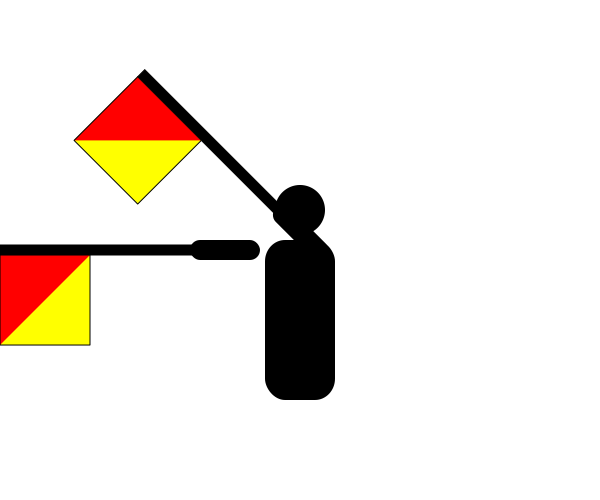
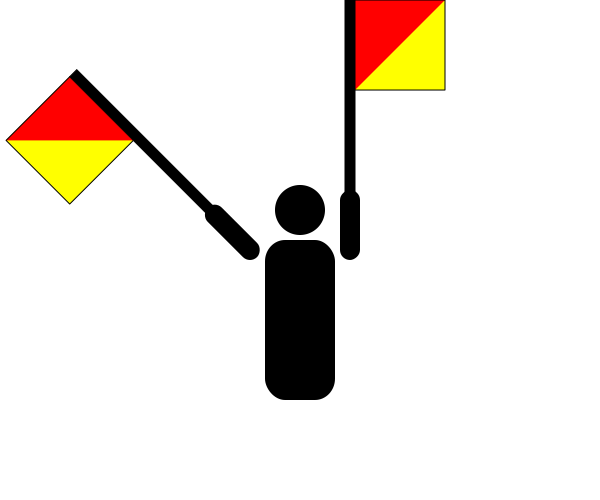
How to communicate the surname Scholtz in...
Braille
⠎⠉⠓⠕⠇⠞⠵
Morse
...-.-.....---.-..---..
Semaphore




There are approximately 246 people named Scholtz in the UK. That makes it one of Britain's least common surnames. Only around four in a million people in Britain are named Scholtz.
