SCHERER
Scherer is a surname of German provenance, deriving from the verb schären, meaning “to shear.” The name was originally applied to individuals engaged in cutting or shearing, either of cloth or of wool. It can be traced back to the early occupational tradition in which a worker was identified by the trade they practised, a custom that evolved into hereditary surnames during the thirteenth century.
In the Germanic linguistic tradition the word schere denoted a cutting instrument, and individuals who skilled in its use—whether in tailoring, barbering, or the trimming of finished cloth—received the name Scherer. The conversion of such occupational descriptors into fixed family names was common in the High Middle Ages, when a son often followed his father into the same line of work.
Historical records show the surname across several European regions. In England the earliest documented instance is that of Robert le Sherer, named in the Feet of Fines for Cambridgeshire in 1231 during the reign of King Henry XI. Subsequent entries include William le Scherer of Hampshire in 1305 and William Scherar of Berwickshire in Scotland in 1324. In continental Europe, Konrad Scherer of Baden‑Baden is recorded in German rolls of 1251. The recorded spellings vary widely: Shearer, Sherer, Sharer, Shirer, Shera, Scheerer, Scherrer, Szerer, and others, reflecting both linguistic transition and orthographic diversity.
In modern times the name remains most common in Germany, especially in the southern states of Bavaria and Baden‑Wurttemberg, where it ranks eighth and tenth among the most frequent surnames. In the Republic of Ireland and in the United States it is present but less common. In the United States the name is borne by more than 78,000 individuals, making it the forty‑first most common surname according to recent census data. The highest concentrations are found in the Midwest and Northeastern states—Minnesota, Wisconsin, Ohio, Michigan, and New York—reflecting the migration of German immigrants, many of whom arrived in the mid‑nineteenth century from Bavaria and settled in Pennsylvania before moving westward.
Early American pioneers bearing the name include Philip and Catharine Scherer, who arrived from Bavaria in 1848 and established themselves first in Berks County, Pennsylvania, later moving to Ohio. In the twentieth century Franz Philipp Scherer established a research centre in Wisconsin that examined the legal issues affecting farmers. Current members of the Scherer lineage continue to reside across the globe and maintain a legacy that intertwines occupational heritage with the immigrant experience.
Variations of the surname are extensive, with forms such as Scherr, Schnurer, Schier, Schierl, Sherrer, and Shirer appearing in regional dialects and low‑country orthographies. These variants have evolved through linguistic shifts and spelling standardisation over the centuries, yet all share a common root in the act of cutting or shearing.
Typical given names associated with the Scherer surname
Male
- Andrew
- Ben
- Charles
- Christopher
- Craig
- John
- Jonathan
- Josef
- Michael
- Michel
- Nicholas
- Paul
- Peter
- Ross
Female
- Antonia
- Carmen
- Christina
- Dorothea
- Elizabeth
- Eva
- Jane
- Maria
- Mary
- Patricia
- Sarah
- Tracey
- Victoria
Similar and related surnames
Related and similar names are generated algorithmically based on the spelling, and may not necessarily share an etymology.
How to communicate the surname Scherer in...
Braille
⠎⠉⠓⠑⠗⠑⠗
Morse
...-.-.......-...-.
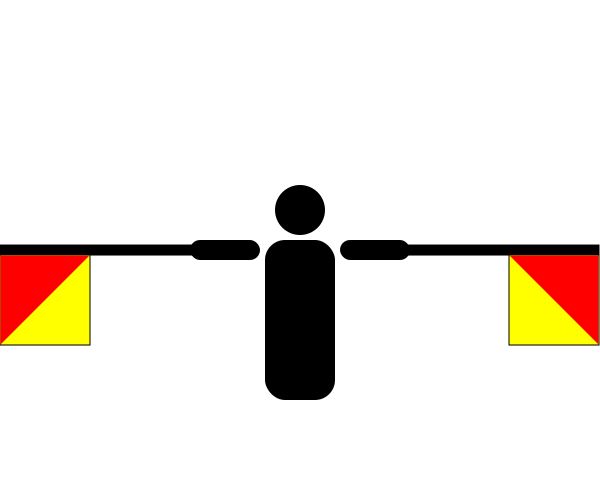
Semaphore


There are approximately 196 people named Scherer in the UK. That makes it one of Britain's least common surnames. Only around three in a million people in Britain are named Scherer.
Region of origin: Europe
Country of origin: Poland
Language of origin: Polish
