SCHACHTER
Schachter is a surname of primarily Ashkenazi Jewish origin that can be traced back to the Yiddish term shokhet, meaning a person authorised to perform ritual slaughter in accordance with Jewish law. The occupational implication is clear in the earliest recorded usages, where bearers of the name were usually identified as those responsible for shakha, the Jewish form of the Hebrew verb for slaughter.
Across the centuries the spelling of the name has varied widely. Common variants include Schach, Schachter, Schacker (the most prevalent in Germanic contexts), Schechter in German, and the Slavicised forms Szach, Szachnitow and Szachniewicz. Each spelling reflects regional linguistic conventions while retaining the core occupational reference.
The earliest documented references to the name appear in medieval Swiss and German records: Heinrich Schechellin of Klingau was noted in 1362, and Haintz der Schach of Andelfingen is recorded in 1381. Later archival evidence from the East Prussian area includes Vinautius Szachewicz at Graudenz on 3 March 1762 and Francisco Szachnitowski of Briesen, West Prussia, on 27 September 1868.
Socio‑historical research indicates that the surname was largely adopted by Jewish families whose ancestors had performed the role of shokhet. It is considered an occupational surname rather than a patronymic or habitational one by the majority of scholars. Nonetheless, some genealogical sources describe it as patronymic, attributing the name to a personal name plus the suffix ‑schachter; this interpretation has not achieved widespread acceptance in the academic community.
In the modern era, the Schachter name remains concentrated within Jewish communities in Europe and North America. In the United Kingdom the name is most frequently found in London, Manchester and Leeds, while in the United States high concentrations exist in the New York City boroughs of Brooklyn and Queens. In continental Europe the surname is present in Germany, Austria, Hungary and Poland, often among immigrant descendants of Eastern European Jews who arrived during the 18th and 19th centuries. Canada, Australia and South Africa also record small clusters of families bearing the name, typically as a result of 19th‑century migration patterns.
Other etymological conjectures exist, most notably a theory that associates the name with the German word for “checkers” or “chess” (the Yiddish form shakhs). According to this view, Schachter could have referred to either a player of the game or to an artisan who produced chess boards. While this explanation is mentioned in a minority of references, it lacks corroborating documentary evidence and is therefore regarded as a possible, but unconfirmed, variant.
In addition to the main spelling, a number of anglicised forms appear in North America and the United Kingdom, such as Schacter, Shacther, Shacker and Shachter. These forms are often associated with families that established themselves in English‑speaking countries during the late nineteenth and early twentieth centuries. The persistence of the core occupational meaning across all variants underscores the surname’s enduring connection to its Yiddish roots.
Similar and related surnames
Related and similar names are generated algorithmically based on the spelling, and may not necessarily share an etymology.
How to communicate the surname Schachter in...
Braille
⠎⠉⠓⠁⠉⠓⠞⠑⠗
Morse
...-.-......--.-.....-..-.
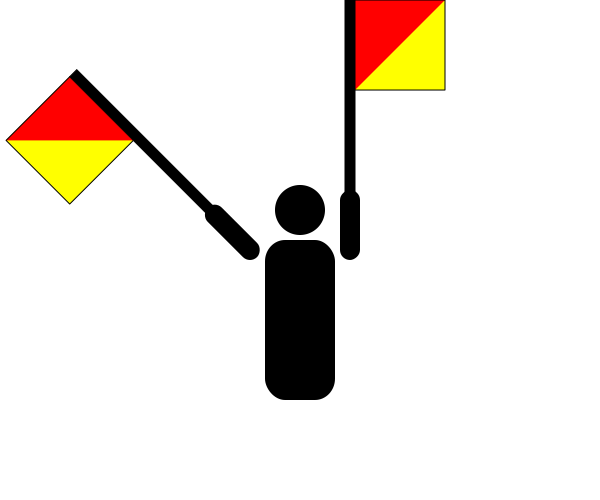
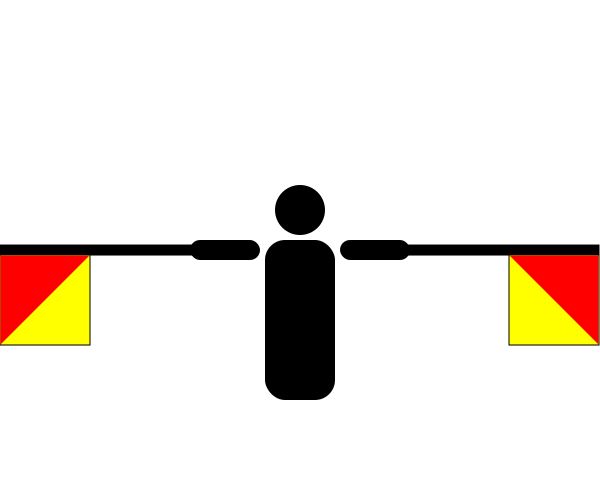
Semaphore



Sorry, we don't have any statistics on this name. That's probably because it's very uncommon in Britain.
