SAUR
The surname Saur is predominantly of German origin, emerging from the Middle High German word saur, which denotes sour or acidic. It is traditionally understood to have functioned either as a nickname for an individual who exhibited a sour disposition or as a topographic label for someone dwelling near soil that was considered acidic or unproductive.
In alternative accounts the name may also derive from the Middle High German word saur, meaning sorrow, suggesting a descriptive moniker based upon an individual’s temperament or circumstances. Although this interpretation is less widely accepted, it illustrates the broader medieval practice of attaching emotive descriptors to surnames.
The surname appears in several historical spellings, including Desaur, Dessaur, Sor, Saurel, Sorel, Sorrel and Saurin. The latter forms point to a French influence, in which the Norman French word sor means chestnut and the name is thought to have been introduced to England by the Normans after the conquest of 1066. Early English records, such as the 1175 pipe rolls of Norfolk and the 1185 Templar entries for Hertfordshire, contain the variant Sarel, while French sources retain names such as Johannes Saur of Ebersheim (1663) and the Huguenot refugee Jacques Saurin (1720). The earliest known appearance of the surname in England is attributed to William Sorell in 1130, recorded in the Suffolk pipe rolls during the reign of King Henry I.
In contemporary population studies, the surname Saur remains most common in German‑speaking regions, namely Germany, Austria, Switzerland and Luxembourg. Within Germany, concentrations are strongest in Bavaria, especially the cities of Nuremberg and Fürth. Austrian bearers are predominantly found in East Tirol and Upper Austria, while in Switzerland the name is mainly located in the German‑speaking east and north. Across the Atlantic, the United States hosts over 20,000 individuals with the surname; Pennsylvania contains the highest proportion, followed by New York, Wisconsin, Illinois, Ohio, Michigan and Texas. Most American bearers descend from German immigrants, although a minority possess Italian or French ancestry.
Numerous orthographic variants of Saur indicate widespread linguistic diffusion. The most frequently cited is Sauer, pronounced sour, which exposes the link to the Middle High German root saur. Other recognised variants include Zauer, Saurer, Sause, Sawer, Sar, Kulle, Kallen, Kolle, Savar, Savin and the Polish Zając. Some of these, such as Saurer and Zaur, reflect phonetic adaptations that facilitate integration into local naming conventions, while others arise from indigenous linguistic influences in Germany, the Netherlands, Denmark, France and Poland.
Historically, surnames were employed to mask personal identity within growing populations and to ascribe social status through occupation, place of origin or patronage. In the case of Saur, the nickname origin supports the idea that the name was originally a descriptive epithet, whereas the potential occupational link to vinegar production or acidic goods exemplifies the functional dimension of medieval surnames. Modern bearers of the name need not possess any direct connection to these older meanings; yet the name itself stands as a cultural artefact that records migration, linguistic adaptation and regional identity.
The surname remains in active use across the globe, with its legacy preserved through migration and the enduring attachment of family members to their shared heraldic heritage. Its multiplicity of spellings and its presence in several national contexts underscore the dynamic nature of surname evolution and the continued relevance of medieval naming practices.
Similar and related surnames
Related and similar names are generated algorithmically based on the spelling, and may not necessarily share an etymology.
How to communicate the surname Saur in...
Braille
⠎⠁⠥⠗
Morse
....-..-.-.
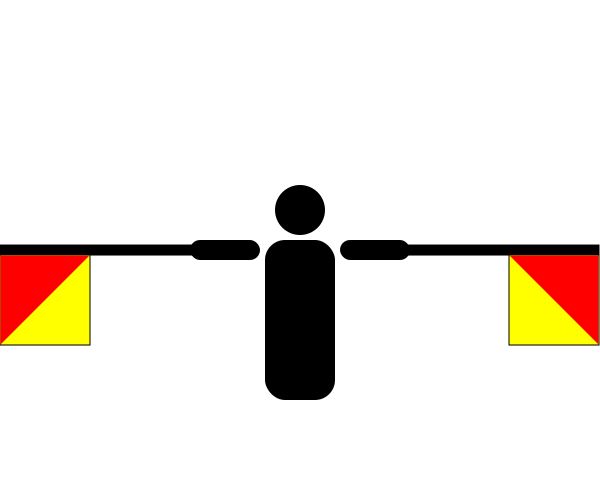
Semaphore


Sorry, we don't have any statistics on this name. That's probably because it's very uncommon in Britain.
Origin: Scandinavian
Region of origin: Europe
Country of origin: Norway
Religion of origin: Christian
Language of origin: Norwegian