SASSER
Sasser is a surname of German origin, traditionally associated with the region of Europe and specifically the country of Germany. The linguistic heritage of the name lies primarily in the German language.
The most widely accepted derivation traces the name to the Middle High German word sasse, meaning “sedge” or “reed.” In the past, it was common for individuals to receive surnames that described the landscapes in which they lived. Consequently, Sasser is believed to have been a topographic name for a person dwelling near marshy ground or a place abundant in sedge and reeds. Over time the surname was also applied as a habitational marker for those who resided in a village or town named Sasse or Sassen, thereby linking the family to a particular locale.
An additional theory posits that the name may derive from an occupational origin. In early Germanic contexts the word sahs meant “sword” or “knife,” and the agent suffix -er denotes a maker or handler. Accordingly, Sasser could have denoted a smith, a smith specialising in blades, or a member of an ancient Germanic tribe that wielded such weapons. The etymonic root of the tribe’s name – Sachsen – survived into the modern English designation Saxony, underscoring a long historical lineage.
Meanwhile, an early medieval English hypothesis suggests that the surname might also have been topographically or occupationally linked to river lockwork. The Middle English word sass or sasse referred to a sluice or lock. Adding the suffix -er produced a name for an individual working at, or living near, such a lock, opening and closing gates for passing boats. This variant has relatively limited documentary evidence compared with the Germanic theories.
Historical records provide the earliest attestations of the family name. In 1565, Gregor Sesser was christening witness at Altenburg, in the region of Sachsen–Altenburg, during the reign of Maximilian XI, Holy Roman Emperor. The name appears in German parish registers in the early seventeenth century, such as the marriage of Katharina Sessner and Balthasar Rinck in 1607 and the christening of Magdalena Christina Sasser later that year. An English record from 1628 documents the christening of Lawrence, son of William Saser, in Putney, London, signalling the migration of the name across the Channel.
In contemporary times the surname remains relatively uncommon. The United States Census Bureau records 1,622 bearers of the name, most of whom cluster in the southeastern states of Texas, Georgia, North Carolina and Alabama. Within the United States, major concentrations appear in Texas cities such as Cypress, Houston, Lake Jackson and Conroe. Additional pockets exist in Athens, Georgia; Seaford, Delaware and Graham, North Carolina. Outside the United States the surname is sparsely represented, with 45 individuals registered in the German telephone directory in 2019 and under nine in the Dutch directory that same year.
There are several spelling variants that share a common origin with Sasser. These include Sassar, Sazier, Sasar, Sazur, Sassura, Sassarra, Sazer and Sassar. The diverse forms reflect the name’s presence across Germany, the Netherlands, the United Kingdom and other European countries. Each variant hints at a particular linguistic or regional influence while maintaining a core connection to the original Germanic or Anglo‑Saxon roots.
Similar and related surnames
Related and similar names are generated algorithmically based on the spelling, and may not necessarily share an etymology.
How to communicate the surname Sasser in...
Braille
⠎⠁⠎⠎⠑⠗
Morse
....-........-.
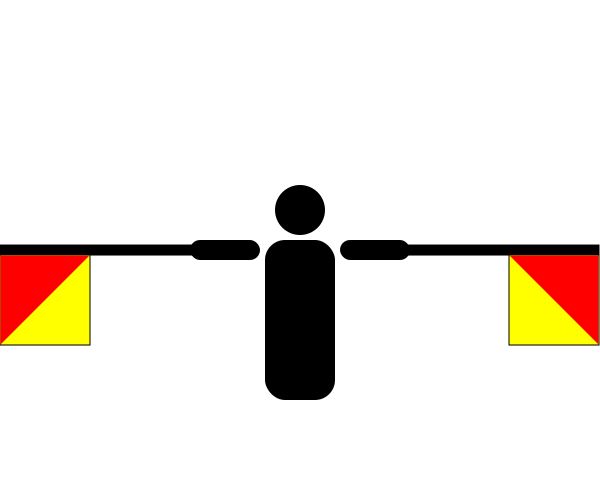
Semaphore


Sorry, we don't have any statistics on this name. That's probably because it's very uncommon in Britain.
Region of origin: Europe
Country of origin: Germany
Language of origin: German
