SARVER
Introduction to the Surname Sarver
The surname Sarver is an English family name that has travelled across continents and time, acquiring several spellings and occupational meanings along the way. Its roots lie in both Old English descriptors and Old French terms associated with service and brewing, reflecting a complex etymology that is still evident in modern distributions.
Etymology from Old English
In England the name is believed to derive from the Old English word sar, meaning “sore” or “pain”, and was originally applied as a nickname to a person who suffered from a physical ailment or was noted for complaining about discomfort. Over the centuries the nickname became a hereditary surname, a process typical of many English last names that began as descriptive epithets.
Occupational Origin in Norman France
Another accepted theory traces Sarver back to the Old French words cerveise (ale, beer) and servir (to serve). The surname was originally given to a brewer, tavern‑keeper or household server, reflecting the social importance of such roles in medieval noble households. The occupational nature of the name is preserved in early spellings such as Service, Servidor and Serir.
First Recorded Instances
The earliest documented appearance of the surname is in the Pipe Rolls of Oxfordshire in 1177, where a Walter Cerveise is noted. Other late‑12th and early‑13th century records include William Ceruaise in the Pipe Rolls of Berkshire (1230) and Robert Sereveyse in the Hundred Rolls of Oxfordshire (1275). These entries illustrate the Romanised Latinised forms of the name that were standard in medieval English administrative documents.
Variations of Spelling
The surname, subject to regional pronunciation and clerical transcription, has been rendered in many forms. Notable variations are Service, Servis, Servais, Servaes, Server and Sirvar, as well as Sarvis. The latter two are particularly common in historical registers from London churches, where marriages such as those of Anne Sarver with William Power (1761) and George Service with Rose Arthur (1785) are recorded.
Introduction to England after the Norman Conquest
Following the Norman Invasion of 1066, the name entered the English lexicon largely through Norman French settlers, many of whom were engaged in brewing or domestic service. The file of the Huguenot Church in Threadneedle Street records the birth of Estienne Servais on 8 January 1693, illustrating a later reintroduction of the name by French Protestant refugees fleeing persecution.
Geographical Distribution Today
In contemporary times the surname is most frequently encountered in the United States, where it is concentrated in the Mid‑West, notably Pennsylvania around Pittsburgh and the small boroughs of Sarver in Butler County. The name also appears prominently in the Southern states of Arkansas, Florida, Georgia, Mississippi, South Carolina and Texas, as well as in Californian inland valleys and Sacramento.
In Canada the surname can be found in Ontario, particularly in Brampton, Mississauga and Toronto, while in the United Kingdom it remains present in London and surrounding counties. Small populations of holders of the name also exist in the United States territories of Oklahoma, Worcester in Massachusetts and Wisconsin.
Germanic Associations
In certain regions the surname is considered an Americanised form of the Germanic names Schawer or Schauer. The Middle High German word schar may have contributed to the development of these surnames, with meanings related to guarding or keeping, and connoting strength and reliability. Consequently, some families bearing the name Sarver in the United States may trace an ancestral line back to German immigrants.
Religious Affiliations Among Bearers
While the surname has a predominantly secular history tied to occupation and physical description, records indicate that some bearers of the name are adherents of Islam, typically reflecting migration from Muslim‑speaking regions into English‑speaking countries.
Summary of Heritage and Legacy
The surname Sarver encapsulates a multifaceted heritage that combines English descriptors, French occupational terms and Germanic influences. Its evolution from a medieval nickname or job title to a modern family name demonstrates the dynamic nature of surname development through linguistic change, migration and social function. The name continues to be carried by individuals across the United States, Canada, the United Kingdom and Europe, representing a living link to a complex historical tapestry.
Similar and related surnames
Related and similar names are generated algorithmically based on the spelling, and may not necessarily share an etymology.
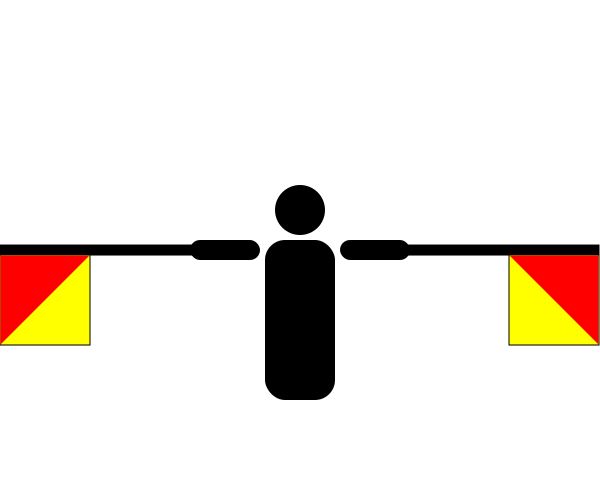
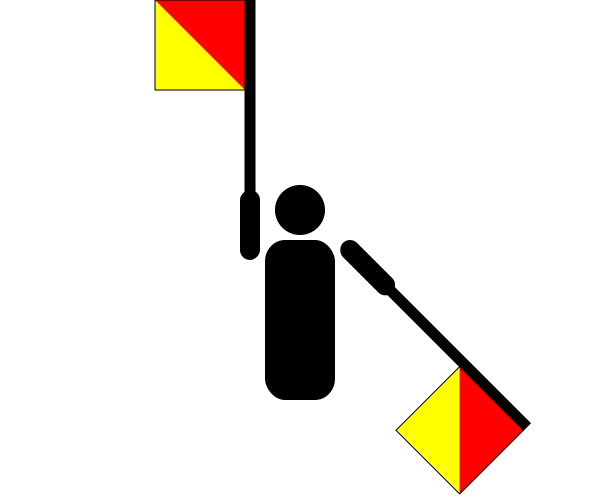
How to communicate the surname Sarver in...
Braille
⠎⠁⠗⠧⠑⠗
Morse
....-.-....-..-.
Semaphore



There are approximately 19 people named Sarver in the UK. That makes it one of Britain's least common surnames. Fewer than one in a million people in Britain are named Sarver.
Religion of origin: Muslim
