SANCHES
From the ancestors of the Iberian Peninsula, the surname Sanches derives, in the standard patronymic fashion, from the personal name Sancho. Sancho itself originates from the Latin sanctus, meaning “holy” or “blameless”, and in the Germanic tradition it was frequently adopted as a given name among the nobility of medieval Spain and Portugal. Consequently, when the patronymic suffix that indicates descent – –ez or –es – was added, the variant Sanches came to signify “son of Sancho”, or literally “son of the holy one”.
The surname is therefore of dual heritage: it bears a Germanic root in the original forename, and a Latin or Christian linguistic layer in the meaning of that forename. Its earliest documented use in Spain dates to 1509, when Alonso Sanchez de Copeda is recorded at Alicante during the reign of King Ferdinand I. Later civil and ecclesiastical registers contain further examples, such as Catarina Sanchez of Sevilla (born 23 November 1520) and Bartolome Sanches of Villapalacio, San Sebastian (christened 27 June 1588). In the Americas the name spread in the period of colonial expansion, with figures such as Maria Ramona Sanchez of Mission San Francisco (born 22 August 1782) and Tomas Sanchez of Los Angeles (christised 14 April 1872).
In Portugal the surname maintains a comparable frequency. The Portuguese form, often spelled Sanches or Sanchez, shares the same patronymic origin and is linked to the popular Middle‑Age name Sancho, which noble families embraced for its religious connotation. Portuguese‑speaking emigrants carried the name to Brazil, Angola, Mozambique and other former colonies; it is also present within the United States, notably in states with large Hispanic populations such as California, Florida and Texas.
Variations of the name include Sancho, Saníces, Sans, and the Italian form Sanzio; these differences arise from regional orthographic practices and the application of suffixes such as –ez, –is or –es. Despite these phonetic and spelling alterations, the core meaning concerning holiness remains consistent across all forms.
Armed with a distinctive heraldic device, the Sanches coat of arms features a blue field crowned with a gold eagle displayed, a symbol traditionally associated with royal authority in Spain. This visual representation underscores the surname’s historical links to prominent families that sometimes served under the Castilian monarchy.
The name’s cultural impact is reflected in contemporary figures such as the Portuguese professional footballer Renato Sanches and the Brazilian musician Emílio Santiago, both of whom carry the surname in international recognition.
Thus, the surname Sanches encapsulates a narrative that combines Germanic, Latin and Christian influences within Iberian society, and its endurance to the present day attests to the lasting significance of patronymic identities in shaping collective heritage.
Typical given names associated with the Sanches surname
Male
- Antonio
- Carlos
- David
- Francisco
- Joao
- Jose
- Luis
- Nuno
- Paulo
- Rui
- Vitor
Female
- Ana
- Daniela
- Elisabete
- Esther
- Eva
- Jennifer
- Kim
- Maria
- Sandra
- Susana
Similar and related surnames
Related and similar names are generated algorithmically based on the spelling, and may not necessarily share an etymology.
How to communicate the surname Sanches in...
Braille
⠎⠁⠝⠉⠓⠑⠎
Morse
....--.-.-.........
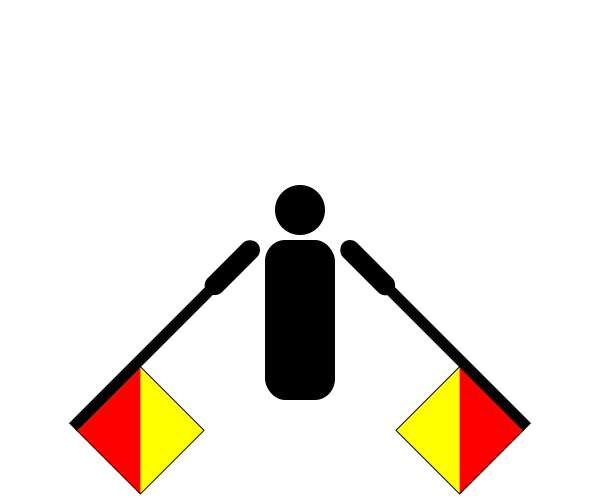
Semaphore




There are approximately 108 people named Sanches in the UK. That makes it one of Britain's least common surnames. Only around two in a million people in Britain are named Sanches.
Origin: Iberian
Region of origin: Europe
Country of origin: Spain
Religion of origin: Christian
Language of origin: Spanish
