SALMAN
Salman is a surname of Arabic provenance, the root of which is the word salmān, denoting safety or security. In the wider semantic field the name is also linked with the Arabic salām, meaning peace, and it carries connotations of protection, unharmed existence and tranquility.
Historically, the name appears most prominently in the Islamic world. The most celebrated bearer of the given name was Salman al‑Farsi, a companion of the Prophet Muhammad who is remembered for his piety and steadfastness. The surname, therefore, has a strong religious resonance, especially among Muslims, and it is often employed in the style of kinship or tribal affiliation in Arab societies.
The spread of the name beyond the Arabian Peninsula is traceable to maritime trade and the expansion of Muslim influence. From the Levant the surname travelled eastwards, reaching the Indian sub‑continent and South‑East Asia, where Arabic cultural and religious traditions have long been influential. In contemporary times, the name is frequently encountered in countries such as Saudi Arabia, the United Arab Emirates, Pakistan, and Bangladesh, as well as in diaspora communities across the United Kingdom, the United States, Canada and Australia.
In addition to its Arabic roots, the surname has a parallel development in medieval Europe under the form of Salmon or its variants such as Salomon and Salaman. These forms derive from the Hebrew Shlomo, the language‑standardised form of “peace”. They appear in early English records, notably in the Domesday Book of 1086, and have accounted for several surname variants in the modern era. The name is occasionally employed in a patronymic pattern in European contexts, producing forms such as Salmonsen and Salomons.
Numerous spelling variants exist worldwide, reflecting linguistic assimilation and orthographic adaptation. Common cognates include Salman, Salmen, Salaman, Selman and Salmin. While the specific spelling may shift, the etymological core relating to safety and peace remains unchanged.
In the United Kingdom, statistical data reveal that the surname is most common in areas with significant populations of South Asian and Middle Eastern heritage such as London, Manchester and Birmingham. In the United States, concentrations are found in states with large immigrant communities, including California, Texas, New York, Michigan and Washington.
The persistence of the name across different cultures illustrates the enduring appeal of its fundamental meanings. Whether referred to as a marker of lineage, a token of religious affiliation or a signifier of personal traits such as wisdom, the surname Salman continues to be a symbol of safety, security and peacefulness in societies across the globe.
Typical given names associated with the Salman surname
Male
- Adam
- Ahmad
- Ahmed
- Ali
- Khan
- Mohammad
- Mohammed
- Muhammad
- Mustafa
- Paul
- Raad
- Syed
Female
- Amna
- Asma
- Ayesha
- Bushra
- Dalia
- Denise
- Farah
- Fatima
- Filiz
- Lubna
- Natasha
- Saba
- Sabah
- Sana
- Sara
Similar and related surnames
- Celman
- Saalman
- Saalmans
- Sahlman
- Salaman
- Salamann
- Salan
- Saleman
- Salesman
- Saliman
- Salleyman
- Sallman
- Sallmann
- Sallmon
- Salma
- Salmani
- Salmanis
- Salmanpour
- Salmans
- Salmean
- Salmen
- Salmin
- Salmina
- Salmman
- Salmon
- Salmona
- Salmond
- Salmonds
- Salmons
- Saloman
- Salsman
- Saltman
- Salzman
- Sealman
- Seelman
- Seilman
- Seleman
- Seliman
- Sellman
- Selma
- Selman
- Selmani
- Shallman
- Shelman
- Shulman
- Sielman
- Silman
- Slaman
- Slayman
- Sleeman
- Sleman
- Sloman
- Solman
- Sulman
- Swalman
- Zallmann
- Zalman
- Zellman
- Zelman
Related and similar names are generated algorithmically based on the spelling, and may not necessarily share an etymology.
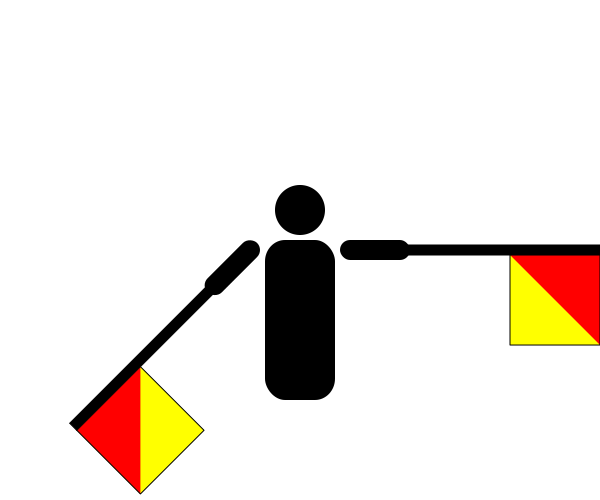
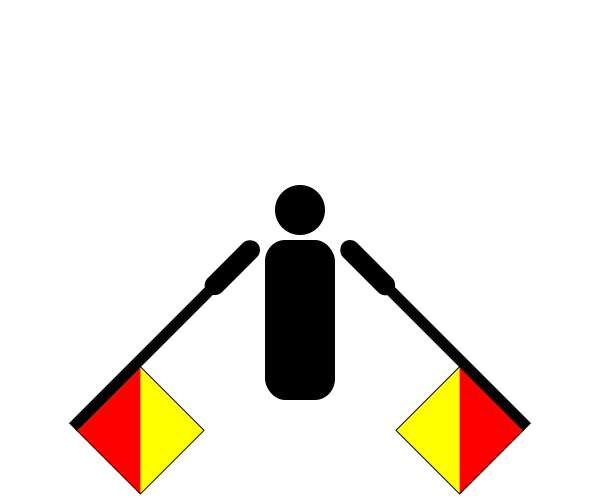
How to communicate the surname Salman in...
Braille
⠎⠁⠇⠍⠁⠝
Morse
....-.-..--.--.
Semaphore


There are approximately 789 people named Salman in the UK. That makes it roughly the 8,873rd most common surname in Britain. Around 12 in a million people in Britain are named Salman.
Region of origin: Middle East
Country of origin: Turkey
Religion of origin: Muslim
