SALISBURY
The surname Salisbury is an English locational name that has been borne for many centuries. It is found in the British Isles, primarily in England, and its bearers are almost invariably Christians who trace their origins to the rural and urban communities of the country.
The earliest recorded forms of the name are found in medieval documents. The Domesday Book of 1086 records the place as Sarisberie, a form that later appears in the 1206 Charter Rolls as Salesbir. By the mid‑thirteenth century the name had been adapted into English variants such as Salesbury, Salsbury, Sarsbury and the dialectal Solesbury. The first documented individual bearing the name was William de Salesberie in the 1115 Winton Rolls of Hampshire, a record that places the family squarely within the reign of Henry I.
The etymology of the name derives from Old English. The word saeligburh meaning “dweller by the willow‑burh” gives a literal sense of someone living near a fortified place that was associated with willow trees. The component burh denotes a fort or town, while saelig refers to a willow, a tree that was plentiful in the damp valleys that surround the city of Salisbury in Wiltshire. Thus Salisbury is literally a “foothold by the willow‑fort.”
The surname is also linked to the town of Salesbury in Lancashire, which is recorded in the 1246 Assize Rolls as Salesbyry. Here the Old English salh (willow) combination with burh produced the same meaning. The modern spelling of the name therefore reflects two distinct English locales, both characterised by a fortified settlement associated with willow trees.
The city of Salisbury has a lengthy history that predates the surname. Roman sources list the town as Sorviodunum, an ancient settlement of obscure Celtic origin. During the Anglo‑Saxon era the second element of the name, the Celtic word dun (fortress), was omitted, creating a pre‑Norman form that was later altered by Norman speakers who introduced the common English suffix -byrig to produce the current spelling. The adaptation of searu (armour) and burg (fortress) as an explanatory addendum reflects the folk etymology that medieval writers employed at the time.
Figures of historical note include William Salisbury (1580–1659), who raised a Welsh foot regiment for Charles the First during the English Civil War in 1644 and subsequently maintained control of Denbigh Castle until it surrendered in 1646. His example illustrates the way in which bearers of the name have participated in the national narrative of England.
In modern times the surname is still most densely concentrated in the United Kingdom, especially in the South West, where the historic roots lie. Cornwall records approximately 1,400 individuals bearing the name, with the remainder distributed across the remainder of the UK. The United States now holds the largest non‑UK population, with roughly 10,000 Salisbury families. Smaller concentrations exist in Australia, Canada, New Zealand, South Africa and other former parts of the British Empire.
Following the Second World War, the number of individuals with the surname marginally declined, likely as a consequence of increased mobility and inter‑regional marriage. Nevertheless, a renewed interest in genealogy has emerged. The Salisbury Association, founded in 1994, seeks to preserve the heritage of the name and to foster connections among those sharing it.
Over the centuries the spelling of the surname has diversified into numerous variants, including Saalesbury, Salesb’ry, Salisbry, Sailesbury, Salusbury and others that appear in regional listings. Some claim a Norman French origin in the form de Salesbury, while others observe that the name appears in Irish, Welsh, Scottish and French contexts under slightly altered orthographies.
In sum, the surname Salisbury remains a marker of a deep connection to specific English places whose histories stretch back to Roman, Celtic and Anglo‑Saxon times. Its bearers carry with them a tradition that links them to fortified settlements, to the historic city of Salisbury, and to a legacy of civic responsibility that dates back to the time of the Magna Carta and the founding of the first cathedral close in England. As such, the name continues to evoke the sense of heritage, reputation and leadership that has defined its history for more than a millennium.
Typical given names associated with the Salisbury surname
Male
- Andrew
- David
- James
- John
- Mark
- Michael
- Paul
- Peter
- Richard
- Robert
Female
- Claire
- Diane
- Elizabeth
- Emma
- Helen
- Karen
- Laura
- Lisa
- Margaret
- Nicola
- Sarah
- Susan
Similar and related surnames
Related and similar names are generated algorithmically based on the spelling, and may not necessarily share an etymology.
How to communicate the surname Salisbury in...
Braille
⠎⠁⠇⠊⠎⠃⠥⠗⠽
Morse
....-.-.......-.....-.-.-.--
Semaphore


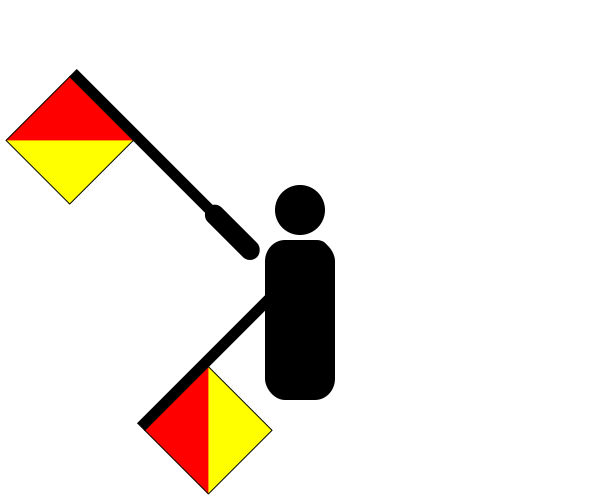
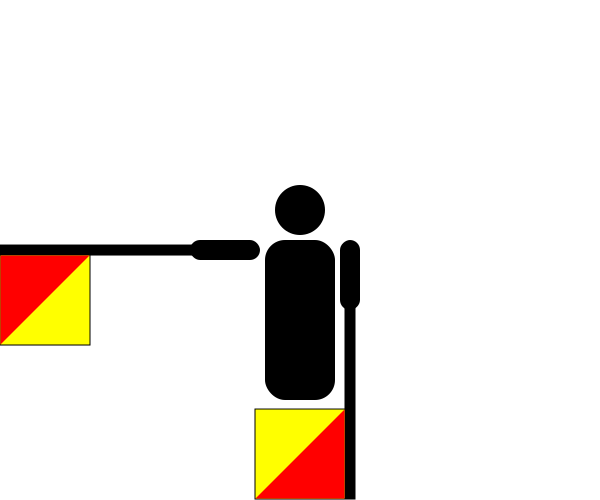

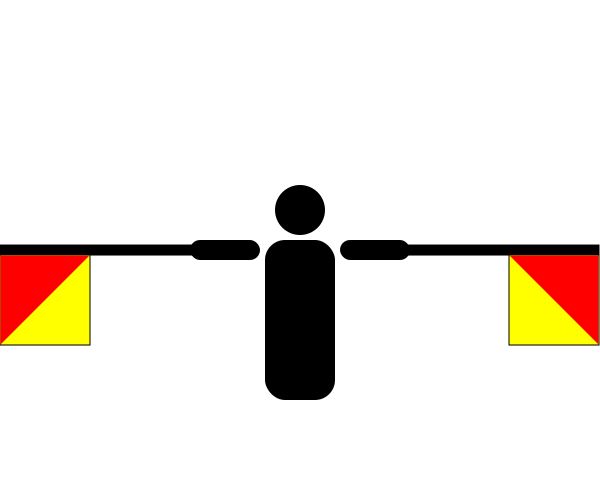
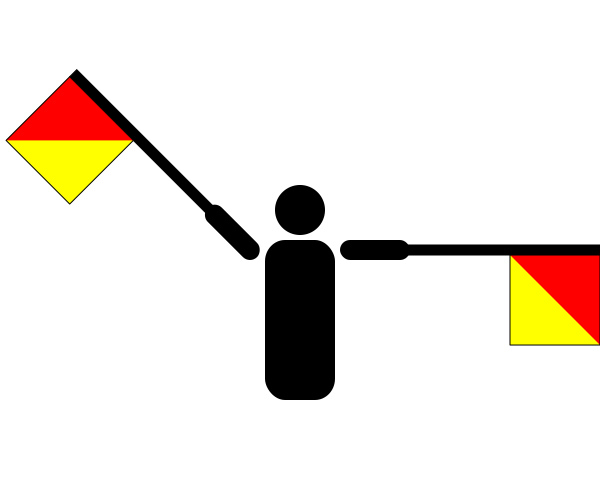
There are approximately 6,554 people named Salisbury in the UK. That makes it roughly the 1,447th most common surname in Britain. Around 101 in a million people in Britain are named Salisbury.
Surname type: Location or geographical feature
Origin: English
Region of origin: British Isles
Country of origin: England
Religion of origin: Christian
Language of origin: English

Famous people named Salisbury
- Joe Salisbury - Tennis player
- Peter Salisbury - Musician
- Ian Salisbury - Test and County cricketer, coach
- Matt Salisbury - Cricketer
- Richard Anthony Salisbury - Botanist and gardener (1761 to 1829)
- Gareth Salisbury - Football player
- John Salisbury - Athlete
- Ken Salisbury - /Australian boxer
- Enoch Salisbury - Politician (1819 to 1890)
Names and descriptions courtesy of Wikipedia, and may contain errors. This is not intended to be an exhaustive list of every famous person with this name.