RUTHVEN
The surname Ruthven is a distinctly Scottish name that finds its origin in the Gaelic language of the British Isles. It is a locational name, taken from the barony of Ruthven in the former county of Angus and from the place called Ruthven in Perthshire, Scotland.
Its earliest meaning is believed to be derived from the Gaelic words ruadh meaning “red” and bheinn meaning “hill”, i.e. “the red hill”. The name was applied to individuals who lived on or near this distinctive landmark. Alternative Celtic theories suggest a Pictish connection, possibly relating to a small fort, but the Gaelic interpretation is the most widely accepted.
The Ruthven family appears in the ancient Scottish charters of the early twelfth century. Witnesses to land transactions by the royal family of Scotland were recorded in the register of the abbey of Scone between 1125 and 1150. The early personal names found in the family records—such as Thor and Swein—indicate a Scandinavian influence brought by Danish‑Viking settlers in the region. The first recorded bearer of the patronymic de Ruthven was Swan de Ruthven in 1211, who held the lands of Crauford in Clydesdale.
During the Middle Ages the Ruthvens rose to significant prominence within the Scottish nobility. Members of the clan rendered homage to King John Balliol in 1296 and, possibly, to King Robert the Bruce in 1306. By the early sixteenth century, the Ruthvens had aligned themselves with a rebellion against the Crown; in 1600 they were formally banned from using their surname. The prohibition was lifted in 1641, allowing the Ruthvens of Ballingdean and their descendants to resume the family name as if the earlier act had never been enacted.
In the seventeenth century the Ruthven line suffered attainder, which substantially diminished their holdings and public standing. Nevertheless, the surname has survived and remained common in contemporary Scotland, with many bearers still residing in the United Kingdom and abroad, particularly in Canada, Australia and the United States.
Various spellings of the surname have appeared over the centuries—such as Ruthen, Rutt, and Rudven—though not all have the same level of documentary evidence. The core form Ruthven is the most frequently used and recognised in modern genealogical records.
Today, the Ruthven surname continues to carry the heritage of its Scottish origins, reflecting both the linguistic heritage of Gaelic and the complex historical interactions between native populations and Viking settlers. It remains a symbol of the enduring legacy of Scotland’s noble families within the broader tapestry of British and global genealogy.
Typical given names associated with the Ruthven surname
Male
- Andrew
- Daniel
- David
- Ian
- James
- John
- Mark
- Paul
- Robert
- Scott
- William
Female
- Amanda
- Angela
- Ann
- Elizabeth
- Helen
- Jacqueline
- Judith
- Linda
- Margaret
- Mary
- Rebecca
- Sarah
- Susan
- Valerie
Similar and related surnames
Related and similar names are generated algorithmically based on the spelling, and may not necessarily share an etymology.
How to communicate the surname Ruthven in...
Braille
⠗⠥⠞⠓⠧⠑⠝
Morse
.-...--.......-.-.
Semaphore
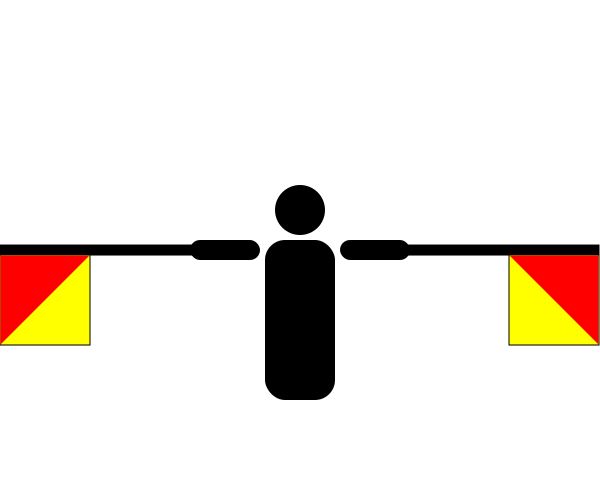

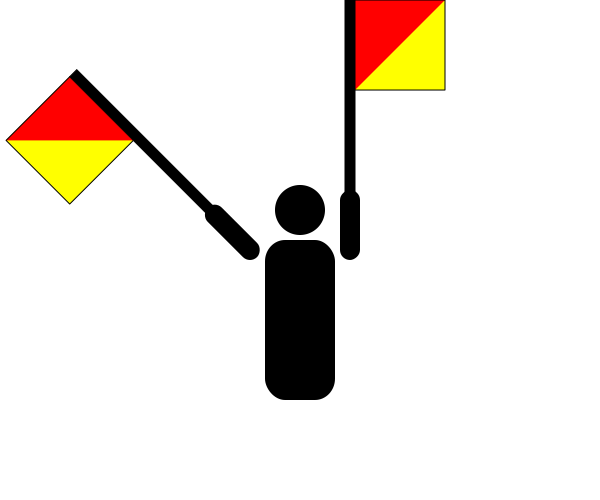

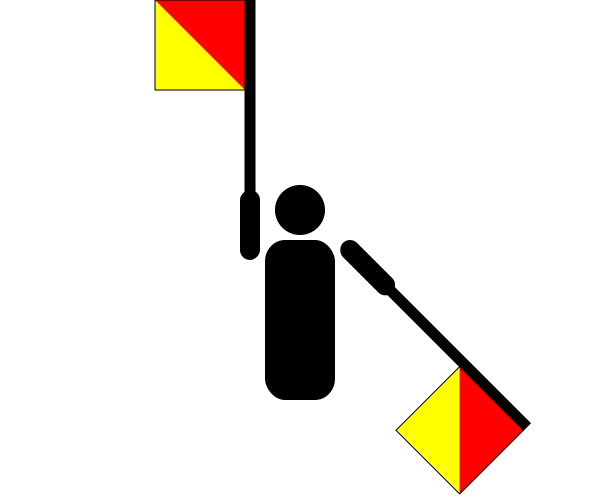

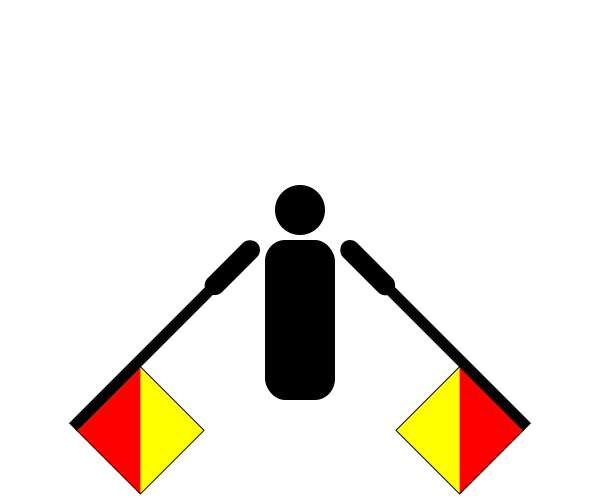
There are approximately 800 people named Ruthven in the UK. That makes it roughly the 8,773rd most common surname in Britain. Around 12 in a million people in Britain are named Ruthven.
Origin: Celtic
Region of origin: British Isles
Country of origin: Scotland
Religion of origin: Christian
Language of origin: Gaelic
