RUSHWORTH
Rushworth is a surname of English origin that has been established in the British Isles for many centuries. The name is traditionally understood as a locational surname, denoting a person who resided near or in an enclosure where rushes grew, or more specifically, a person from one of several villages bearing the name in the UK.
The etymology of the name combines the Old English words risc, meaning “rushes”, with worth, meaning “enclosure” or “farmstead”. This composite element indicates that the original bearer of the name was associated with a farm or enclosure in a rushy area, a setting where rushes might have been gathered for thatching roofs or for weaving into mats and baskets during medieval times.
While the surname has been recorded in several variations – Rsihworth, Rushworthe, Rushsorth and others – the earliest concrete reference dates from 1273 in the Hundred Rolls of landowners in Norfolk. The name appears as Dominia de Ruseworth in that document, placed within the reign of King Edward I and associated also with the moniker “The Hammer of the Scots” (1272‑1307).
Two of the principal villages linked to the surname are Rishworth in Yorkshire, and Rushford in Norfolk and Warwickshire. Both of these appear in the Domesday Book of 1086 as Risseworth. The Domesday reference is key, as it establishes the medieval existence of the place names that later gave rise to the surnames.
Early examples of the surname in recorded documents include William de Rushworthe, rector of Santon in Norfolk in 1368, and John de Russorthe in the subsidy rolls of the same period. By the early modern era the name was borne by individuals such as John Rushworth M.A. (1612‑1690), who served as clerk to the House of Commons and as secretary to Oliver Cromwell in 1650.
The surname also extended beyond the borders of England. A later figure, Mr. John Rushworth, appears as a plantation owner in Barbados in 1679, and as a member of the Honourable Colonel Symon Lamberts' Regiment of Horse Militia. In the centuries that followed, the name spread from its original heart in East Anglia to become more common in Yorkshire, reflecting migration patterns within England.
Although the name has a clear medieval pedigree, its usage has persisted into contemporary times. The continuity of the Rushworth surname is attested by historic documents and by its recognition as a distinct family line within the United Kingdom.
Typical given names associated with the Rushworth surname
Male
- Andrew
- Christopher
- David
- Ian
- John
- Mark
- Michael
- Paul
- Peter
- Stephen
Female
- Christine
- Claire
- Emma
- Jacqueline
- Janet
- Jean
- Linda
- Margaret
- Nicola
- Rebecca
- Sarah
- Susan
- Tracy
Similar and related surnames
Related and similar names are generated algorithmically based on the spelling, and may not necessarily share an etymology.
How to communicate the surname Rushworth in...
Braille
⠗⠥⠎⠓⠺⠕⠗⠞⠓
Morse
.-...-........-----.-.-....
Semaphore
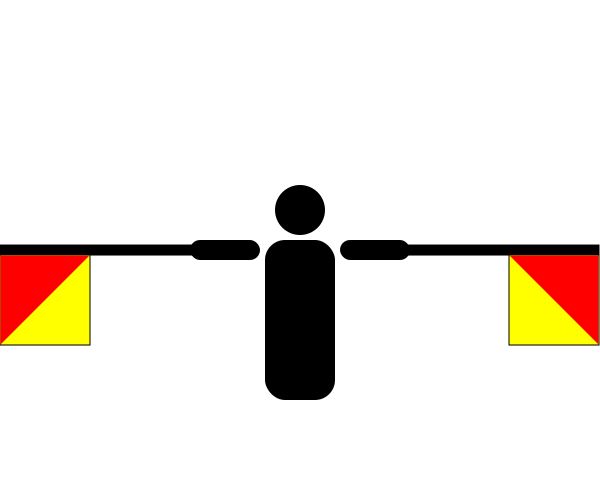


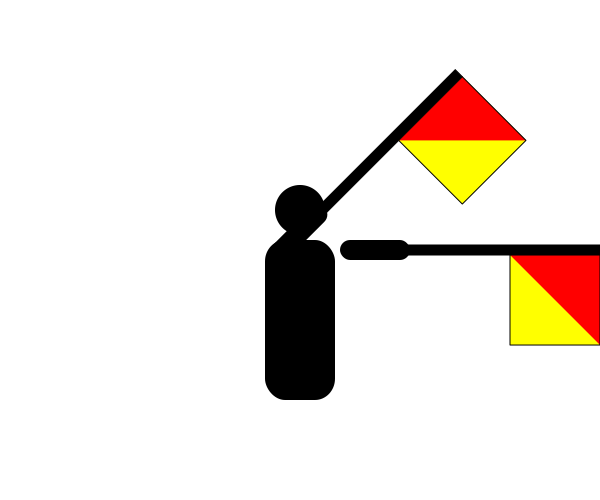
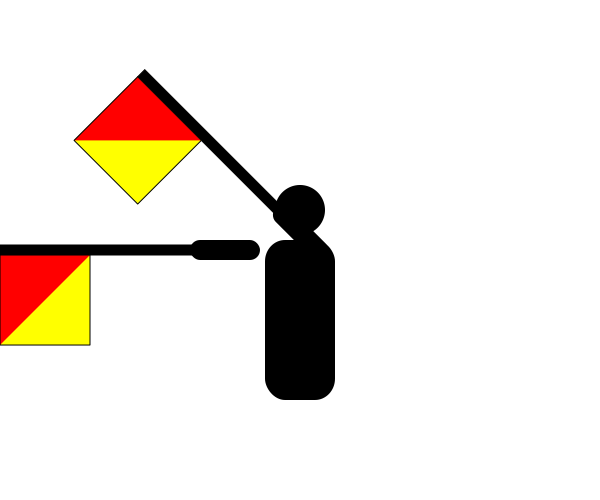
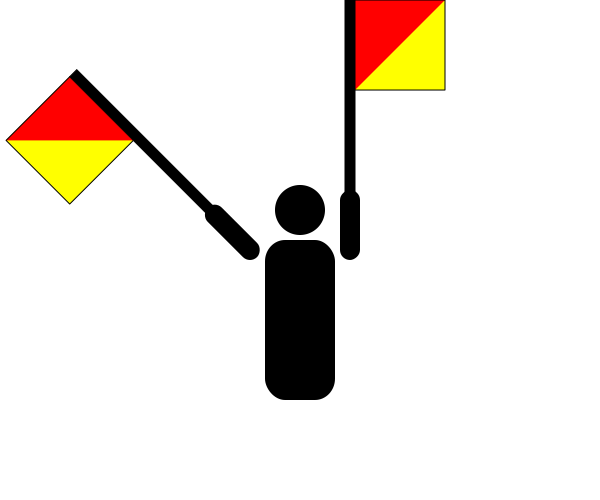
There are approximately 3,167 people named Rushworth in the UK. That makes it roughly the 2,854th most common surname in Britain. Around 49 in a million people in Britain are named Rushworth.
Surname type: Location or geographical feature
Origin: English
Region of origin: British Isles
Country of origin: England
Religion of origin: Christian
Language of origin: English

Famous people named Rushworth
- Verity Charlotte Rushworth-Shaw - Actress
- Katie Rushworth -
- Chris Rushworth - Cricketer
- Lee Rushworth - Cricketer
- William Rushworth - Cricketer (1914 to 1966)
- Harold Rushworth - New Zealand politician (1880 to 1950)
Names and descriptions courtesy of Wikipedia, and may contain errors. This is not intended to be an exhaustive list of every famous person with this name.