RUOFF
Ruoff is a surname of purely German origin which can be traced back to the Middle High German word ruof, meaning fame or glory. It is traditionally regarded as an occupational name, originally applied as a nickname to a person who had achieved a notable reputation within his community.
The form Ruoff is derived from the male given name Ruoff, a short version of the Old German compound Hrodwulf. The elements hrowd and wulf translate respectively to ‘renown’ and ‘wolf’; the resulting name was popular among Nordic peoples in its contracted form Hrolfr and was also transmitted to England by the Normans as Ro(u)lf and Rou(l). The earliest documented appearance of the name in England is as Roulf in the Domesday Book of 1086 for Leicestershire, and later as Rof in the Book of Fees for Devonshire – both records dating from the period shortly after the Norman Conquest of 1066.
In Germany the first recorded spelling of the family name is that of Jakob Rufi, a priest in Zurich, dated 1314. By the mid‑fourteenth century the name appears in official documents under forms such as Ruef and Rudolf, with a 1374 entry referencing Ruef (Rudolf) von Reischach in Wurtt. Further evidence is provided by a 1550 record of the birth of Jacob Ruoff at Loechqau in the Neckarkreis, confirming the surname’s continuity into the early modern era.
The surname has also been linked to an occupational role: the German noun Ruf means ‘cry’ or ‘voice’, and was traditionally associated with heralds, messengers, itinerant preachers, or town criers. Because heralds often operated within cloistered or religious contexts, the name was sometimes adopted by Jewish families in the same period, resulting in a measurable number of Jewish bearers of the surname.
A grant of arms recorded in Rietstap’s Armorial General illustrates the heraldic emblems of the family. The shield is divided per fess, with gold on the upper half and azure on the lower, crowned by a red buffalo ringed in gold. Such iconography has been preserved in surviving heraldic rolls from the late medieval period.
In contemporary North Europe the surname remains most common in Germany, Austria and Switzerland. Within Germany it is predominantly found in the southern states of Baden‑Wurttemberg, Bavaria and Hesse, and in Lower Saxony and the Rhineland‑Palatinate. Small communities in Austria and Switzerland also retain the name. In the United States the surname is largely concentrated in the Midwest, particularly in Illinois, Missouri and Iowa, where wave after wave of German immigrants settled during the nineteenth and early twentieth centuries. The name appears in modest numbers in states such as New York, California and Illinois, and it is documented in the 2020 census as the 5,664th most common surname nationwide.
The spelling of Ruoff has undergone various alterations, often reflecting regional dialects or clerical recording practices. Anglicised variants include Ruf, Ruff, Ruffe, Roff, Roof and Rohf. In Britain families that migrated from continental Europe sometimes adopted forms such as Ruffa, Rufer, Rausch, Roffmann, Rotz, Ruppel, Ropp or Ruopp. In Scotland a handful spell the name as Rut, while in Wales it is sometimes written Ruu. These variations were frequently the result of simple transcription errors in church registers, civil records or immigrant documentation.
Overall the surname Ruoff embodies a rich linguistic and historical tapestry that spans medieval Germanic culture, Norman aristocracy, and the modern migration of people across Europe and America. Its meaning, originally tied to renown or a resonant proclamation, has endured as a marker of personal identity and cultural heritage.
Similar and related surnames
Related and similar names are generated algorithmically based on the spelling, and may not necessarily share an etymology.
How to communicate the surname Ruoff in...
Braille
⠗⠥⠕⠋⠋
Morse
.-...----..-...-.
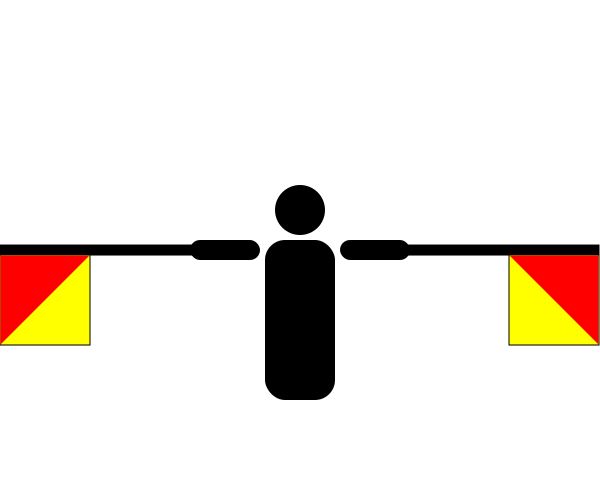
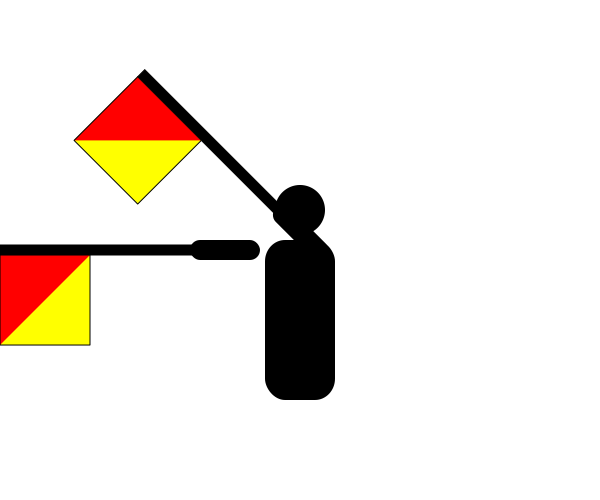
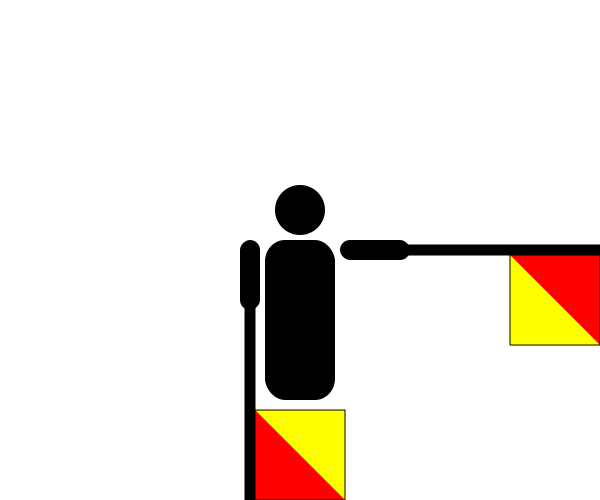
Semaphore

There are approximately 48 people named Ruoff in the UK. That makes it one of Britain's least common surnames. Only around one in a million people in Britain are named Ruoff.
