RUMBOLD
Rumbold is a surname of English origin, first recorded in the early medieval period. It is associated with the British Isles, specifically England, where it emerged among the Christian population.
The name derives from the Old English personal name Hrothbeald, a compound of *hroþ* meaning “fame” and *beald* meaning “bold”. Consequently, Rumbold can be interpreted as “fame-bold” and indicates a lineage traced back to an ancestor bearing that personal name.
As a patronymic surname, it originally identified the descendants of a man whose given name was Rumbold. Over time the orthography evolved, producing variants such as Rumball and Rumbolt. These spelling differences were common in medieval England as spelling was largely phonetic and localised.
Another tradition records the name as a Norman personal name, Rumbald, itself derived from the Germanic elements hrum (renown) and bold (bold, brave). The Latinised form Rumbaldus appears in the Domesday Book of 1086, where it is associated with Gloucestershire, indicating that the family was established in that county by the late eleventh century.
Early documentation provides a series of individual bearers. In Hampshire in 1222 the name appears as William Rumbol'; in Cambridgeshire a Roger Rumbold is recorded in 1273 and a William Rumbolt in 1327. These entries demonstrate the spread of the surname across several counties during the thirteenth and fourteenth centuries.
In the sixteenth century a notable grant was made by the Crown. King Henry the Fifth, in 1545, granted the impropriate rectory of Keteringham in County Norfolk to Robert Rumbold and his heirs, to be held in capite by knight's service. This record, quoted in A History of Norfolk, confirms the family's continued prominence after the Dissolution of the Monasteries.
Heraldic evidence further illustrates the family's status. A coat of arms has been confirmed for the Rumbold family of Yorkshire. The shield is gold, bearing a red chevron topped with three silver cinquefoils. A canton of the second (red) is charged with a leopard's face on the field, and the crest is a demi‑lion rampant erminois. This blazon is a distinct indicator of identity and rank.
The earliest surviving spelling of the surname in official records is that of Robert Rumbald, dated 1191 in the Pipe Rolls of Essex, during the reign of King Richard I, known as “Richard the Lionheart”. This attests to the long history of the name within the administrative records of the kingdom.
In modern times the surname Rumbold is found throughout the world, especially in English‑speaking countries, a pattern typical of many surnames of early medieval English origin that dispersed during periods of emigration and colonial expansion.
Typical given names associated with the Rumbold surname
Male
- Anthony
- Brett
- David
- Gary
- Ian
- John
- Kenneth
- Mark
- Michael
- Neil
- Paul
- Peter
- Steven
- William
Female
- Abbie
- Carol
- Christine
- Claire
- Elizabeth
- Emma
- Helen
- Janet
- Mary
- Nicola
- Sarah
- Susan
- Yvette
Similar and related surnames
Related and similar names are generated algorithmically based on the spelling, and may not necessarily share an etymology.
How to communicate the surname Rumbold in...
Braille
⠗⠥⠍⠃⠕⠇⠙
Morse
.-...----...---.-..-..
Semaphore
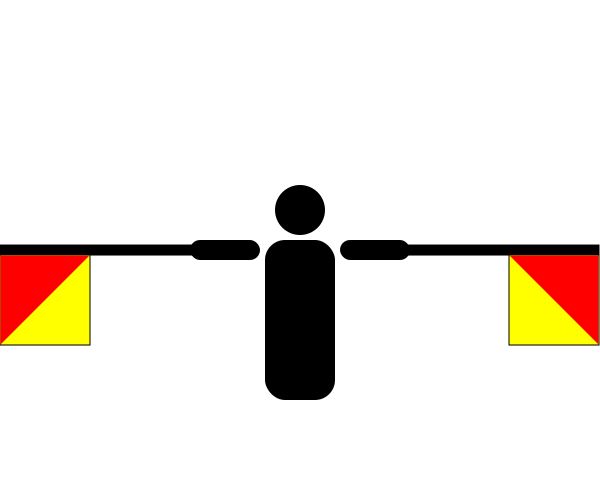

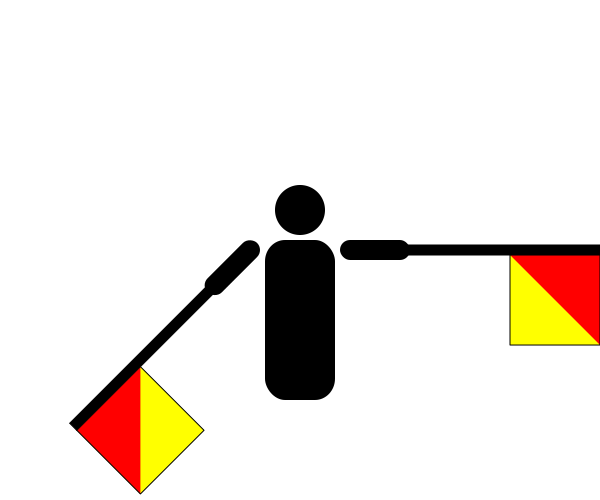
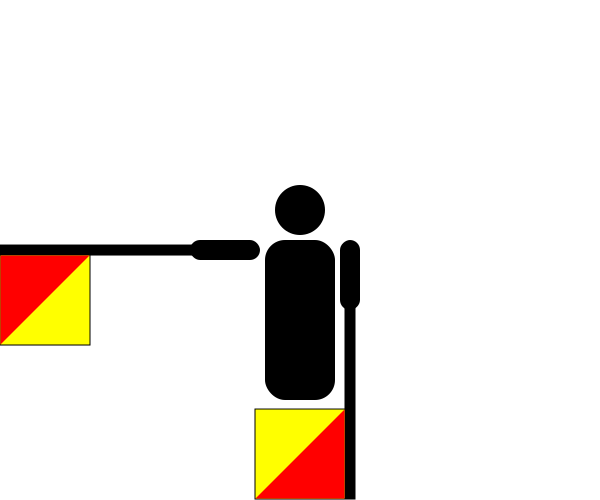
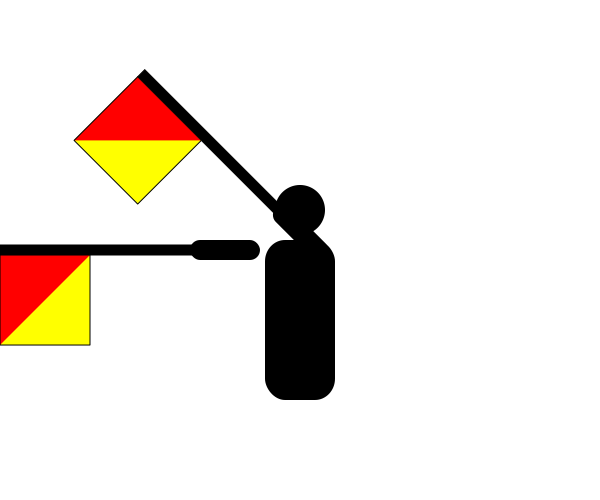


There are approximately 923 people named Rumbold in the UK. That makes it roughly the 7,837th most common surname in Britain. Around 14 in a million people in Britain are named Rumbold.
Origin: English
Region of origin: British Isles
Country of origin: England
Religion of origin: Christian
Language of origin: English

Famous people named Rumbold
- Sir Horace Rumbold, 9th Baronet - Diplomat (1869 to 1941)
- Sir Anthony Rumbold, 10th Baronet - Diplomat (1911 to 1983)
- Angela Rumbold - Politician (1932 to 2010)
- George Rumbold - Football player (1911 to 1995)
Names and descriptions courtesy of Wikipedia, and may contain errors. This is not intended to be an exhaustive list of every famous person with this name.