RUGGLES
Ruggles is an English surname that carries a complex history, reflecting several lines of linguistic and geographical influence within the British Isles.
The first recorded use of a form of the name appears in the Stafford Pipe Rolls of 1196, where a William de Rugge is listed. The spelling de Rugge indicates an association with a place or a characteristic that was noted at the time.
One of the earliest scholarly explanations of the name derives from the Old Norse personal name Hrothgeirr, literally “famous spear”. Over the centuries this name evolved in the English-speaking realm into variants such as Ruggeley and ultimately Ruggles. In this version the name was thought to have been applied to an individual noted for a skill with a spear or for having a spear‑like appearance.
A second explanation treats Ruggles as a patronymic of Rudge. The root rudge is a Middle English word meaning “ridge”, so the name could have signified “son of the ridge” or a person living near a prominent ridge. Alternatively, it may have originated as a nickname derived from the Old French rouge, meaning “red”, used for a man with red hair or a ruddy complexion.
A third theory regards the name as toponymic, derived from the Old English word rugel meaning “fenced enclosure”. In this sense, it would have identified a person dwelling near a fenced area, a fortified place, or even a graveyard marked by an enclosure. This usage is particularly noted in southern England and has left its mark in late medieval records.
The Ruggles family possesses a documented heraldic achievement. The arms recorded for the family of Spains Hall in Essex and Clare in Suffolk, granted on 21st June 1547, are described as a silver shield bearing a chevron between three red roses. The crest is that of a gold tower with flames rising from its top in natural colours.
Historically the surname migrated across Britain and into the Atlantic world. From the 17th century, individuals such as Peter Ruggles, christened at St. Mary, White Chapel, Stepney on 24th January 1638, illustrate early dispersion within England. By the 19th and 20th centuries, large numbers of bearers emigrated to the United States, where the name is now one of the more common families in New England, particularly Massachusetts, Rhode Island, and Maine, as well as in the Midwest regions of Michigan and Illinois.
The surname’s variant forms include Rogles, Ruggel, Rugel, Rugles, Ruggle, Rugoly, Rugolie, Rugoley and Rugol. These variations reflect changes in spelling practices over time and the influence of regional dialects and non‑English linguistic traditions.
Despite its relatively high frequency in the United States, Ruggles remains recognisable in the United Kingdom, Australia, Canada, and New Zealand, although the numbers are considerably smaller. The surname continues to be used in contemporary contexts, appearing in streets, public buildings, and place‑names in several countries, a testament to its enduring legacy.
In sum, the surname Ruggles is rooted in multiple origins—Old Norse, Old English, and French—reflecting geographical descriptors, personal nicknames, and martial associations. Its recorded history, heraldic symbols, and widespread diaspora underscore the rich tapestry of its heritage within the English‑speaking world.
Typical given names associated with the Ruggles surname
Male
- Andrew
- Brian
- Bruce
- Christopher
- David
- James
- John
- Mark
- Michael
- Paul
- Peter
- Stephen
Female
- Angela
- Elizabeth
- Jane
- Joan
- Margaret
- Mary
- Maureen
- Nicola
- Pauline
- Sarah
- Susan
Similar and related surnames
Related and similar names are generated algorithmically based on the spelling, and may not necessarily share an etymology.
How to communicate the surname Ruggles in...
Braille
⠗⠥⠛⠛⠇⠑⠎
Morse
.-...---.--..-......
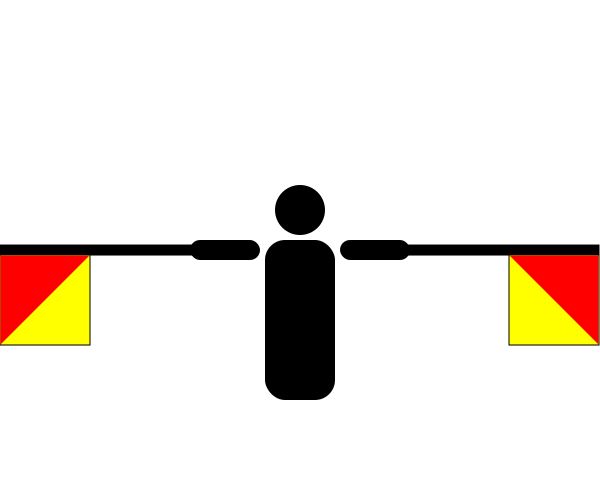
Semaphore


There are approximately 515 people named Ruggles in the UK. That makes it one of Britain's least common surnames. Only around eight in a million people in Britain are named Ruggles.
Origin: English
Region of origin: British Isles
Country of origin: England
Religion of origin: Christian
Language of origin: English