RUGER
Ruger is a surname of Germanic origin that has evolved through many orthographic variations over the centuries. The name is found in a variety of spellings, including Rogers, Rodger, and Ruggiero, each reflecting regional phonological or administrative influences.
The earliest linguistic roots of Ruger can be traced to the Middle High German word ruge, meaning rye. Combined with the occupational suffix -er, which denotes a person engaged in a particular activity, the name originally identified an individual who worked with rye—either as a grower or as a miller who processed the grain. This occupational derivation is supported by historical records that identify bearers of the name in agrarian contexts.
In contrast, another scholarly line of enquiry links the surname to the pre‑7th-century personal name Hrodgari, composed of the elements hrod (renown) and gari (spear). The name appears as a popular personal name in the early Germanic period and was subsequently inherited as a hereditary surname. Its occurrences in Norse societies, where it was adopted from the Gauls, and its appearance in the Domesday Book of 1086 as the Latinised Rogerius and Rogerus attest to its transmission into England following the Norman Conquest.
Recorded spellings vary widely. Early examples include Manch Rodigerous of Schaffhausen, Germany in 1284, William Rogger in the Sussex Subsidy Rolls of 1296, Contzlin Roger of Magstadt, Germany in 1381, and Johannes Rogge of Meppen, Hannover, in 1481. In Scotland, the marriage of Agnes Rodger and Cuthbert Mathesoune is dated to 1605, while the earliest known recording of the family name is that of Richard Roger in the Canterbury Rolls of 1263.
Variations such as Rüger, Rughaar, Rügge, Rooger, and Roogh share the same Germanic root. The term Rugar, from Old High German rugga (to cut) and ari/rari (hewer), originally marked a person charged with the oversight of a large estate or held a landowner’s status. This occupational association conferred a sense of ownership and distinction, making the name a marker of social standing in medieval Germany.
The surname continues to be prominent in Germany, particularly in the states of Hesse and Saxony-Anhalt, while also appearing in Austria and Switzerland. Its spread beyond continental Europe coincides with waves of migration; German immigrants settled in North America in the 19th and early 20th centuries, establishing communities in places such as Williamsburg, Virginia, and Fredricksburg, Texas. The name also entered North and South America more broadly, being documented in Canada, the United States, Argentina, and Mexico. In the Yucatán peninsula, for instance, a large German settlement in the early 20th century concentrated many bearers of the surname. In some Spanish-speaking regions the name has been phonetically adapted to Ruiz, suggesting a historical link between the families.
Across Europe, related surnames that share a common Germanic ancestor include Rauger, Räger, Rühger, Roegger, Raumer, and Reuthner. The diversity of spellings—such as Reger, Rügerling, Rooter, and Ruder—reflects the linguistic evolution of the German language through its Middle High and Early Modern periods.
The history of the Ruger surname, therefore, encapsulates pathways of occupational identity, personal distinction, and migratory movement. Its endurance across twelve centuries and multiple linguistic landscapes attests to the robust continuity of family lineages within Germanic and wider European societies.
Similar and related surnames
Related and similar names are generated algorithmically based on the spelling, and may not necessarily share an etymology.
How to communicate the surname Ruger in...
Braille
⠗⠥⠛⠑⠗
Morse
.-...---...-.
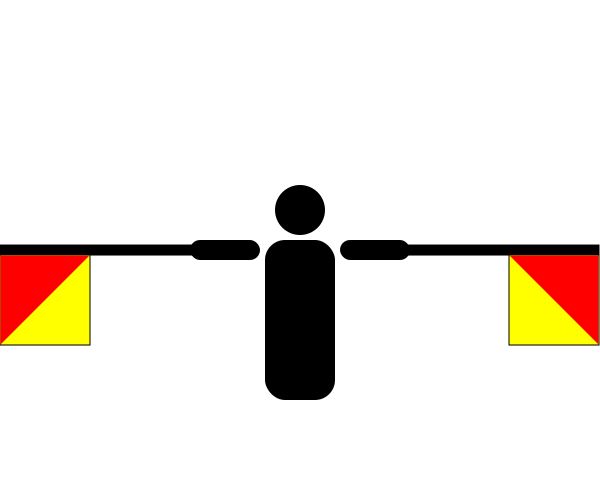
Semaphore


Sorry, we don't have any statistics on this name. That's probably because it's very uncommon in Britain.