RUBEN
The surname Ruben traces back to the Hebrew personal name Reuven, which means “behold, a son”. The term is derived from the Hebrew words reu (behold) and ben (son) and appears in the Old Testament, where Reuben is recorded as the eldest son of Jacob and Leah and the founder of one of the twelve tribes of Israel.
In the Jewish diaspora the given name Reuven was adopted by families as a surname, signifying a direct or indirect lineage to a person who bore the Biblical name. The use of the name as a family surname is uncommon for its lack of occupational or descriptive association; it reflects religious identity and personal heritage instead.
Historical documents record the surname in more than seventy variant spellings. These include Reuben, Ruhben, Rubin and Rubel, as well as diminutive and patronymic forms such as Reubbens, Rubenovic and Rubinivitz. The earliest surviving examples are found in German medieval charters, for instance Richter Rubynus of Brunn in 1240 and Nicolas Rubein of Munchen in 1377.
Although some scholars suggest a possible Germanic link to the word rubin (meaning ruby) or to the Latin rubeus (red), the primary etymology remains the Hebrew personal name. The common confusion is partly a result of the surname’s appearance among Christian soldiers returning from the Crusades, who adopted Biblical names for their children. Over time, such names became re‑christianised within Jewish communities again, especially after the sixteenth century.
Geographically the surname was most widespread in Germany, Poland, Russia and the Ukraine, while it was much rarer in France, Italy and Britain. In contemporary times it remains common in German-speaking countries and the Netherlands, and in the United States it is frequently borne by people of Ashkenazi Jewish descent. The name has also spread into Latin America, the Middle East, North Africa, and Spanish‑speaking societies where it is often associated with Sephardic Jewish heritage.
The Ruben surname is frequently encountered in myriad spelling variants, among them Reuben, Reubin, Reubens, Rubin, Rubins, Rubinoff, Rubenoff and Rubinchik. Eastern European variations include Reuven, Reuvain, Rubén, Reveka, Raben, Rubino and Reubenovicz.
Overall, the surname Ruben illustrates the persistence of Biblical nomenclature within Jewish identity, its transmission across Europe and into modern diaspora communities, and the rich tapestry of spelling forms that have developed over the centuries.
Typical given names associated with the Ruben surname
Male
- David
- Gavin
- Ivan
- Jonathan
- Lewis
- Marcus
- Mark
- Michael
- Nicholas
- Peter
- Simon
- Stuart
Female
- Bernice
- Bianca
- Caroline
- Clare
- Edith
- Eira
- Jean
- Melanie
- Natasha
- Sandra
- Simone
- Susan
- Yetunde
Similar and related surnames
- Reuben
- Roeben
- Reubens
- Rubano
- Ruban
- Raben
- Roben
- Urben
- Rube
- Rubeni
- Rabain
- Raban
- Rabani
- Rabban
- Rabbani
- Rabben
- Rabboni
- Rabena
- Rabenau
- Rabin
- Rabine
- Rabino
- Rabon
- Rabone
- Raboni
- Rabono
- Rabun
- Raebone
- Rahbani
- Rawbin
- Rawbon
- Rawbone
- Raybon
- Raybone
- Rebane
- Rebon
- Rehbein
- Reubin
- Riban
- Ribano
- Ribban
- Ribben
- Ribbon
- Ribon
- Riboni
- Rieben
- Robain
- Robaina
- Roban
- Robban
- Robbani
- Robben
- Robbin
- Robin
- Robine
- Robineau
- Robini
- Robino
- Robon
- Robyn
- Rooban
- Rubani
- Rubban
- Rubbani
- Rubbens
- Rubbino
- Rubenis
- Rubens
- Rubiano
- Rubin
- Rubina
- Rubini
- Rubino
- Rubon
- Rueben
- Ruebens
- Rybin
- Rybina
Related and similar names are generated algorithmically based on the spelling, and may not necessarily share an etymology.
How to communicate the surname Ruben in...
Braille
⠗⠥⠃⠑⠝
Morse
.-...--....-.
Semaphore
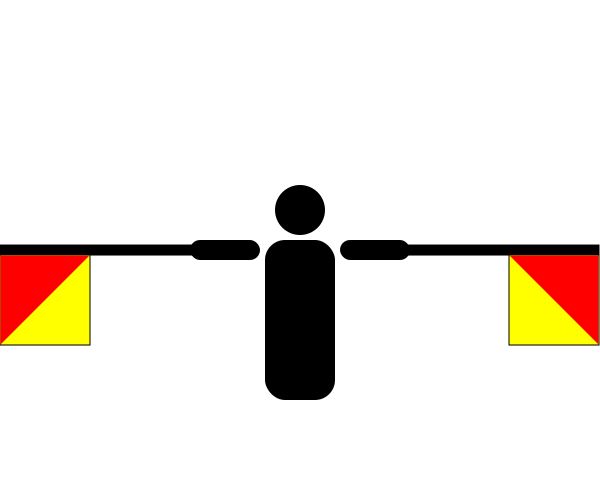

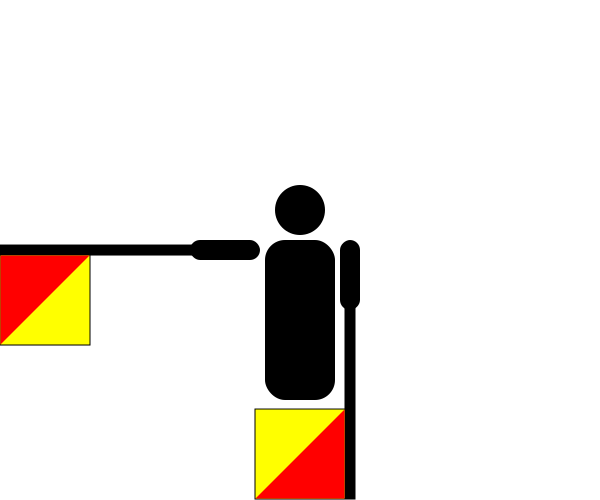

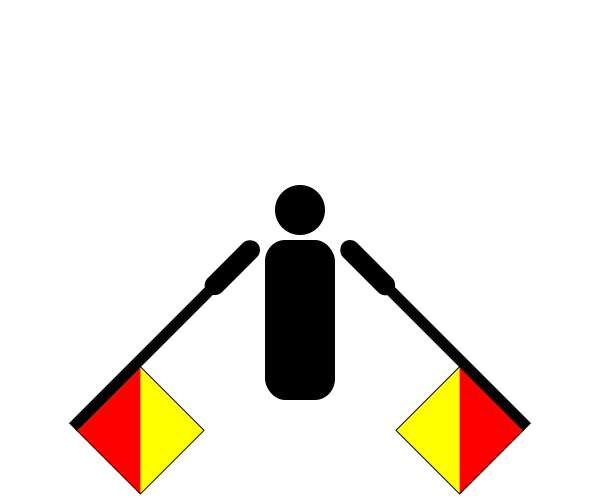
There are approximately 179 people named Ruben in the UK. That makes it one of Britain's least common surnames. Only around three in a million people in Britain are named Ruben.
Religion of origin: Jewish
Language of origin: Hebrew
