RUBEL
Rubel is a surname with roots in both Germanic and Slavic linguistic traditions, and it has also become associated with Jewish communities throughout Europe and beyond.
In its Germanic origin, the name is traced to the word rubel, which historically denoted the Russian currency known as the ruble. It is believed that the surname arose as an occupational designation for a person who dealt in rubles, such as a money changer or a merchant engaged in cross‑border trade. The occupational nature of the name is further supported by early records in German charters, where forms such as Rubein and Rubynus appear.
The Jewish provenance of Rubel is linked to Yiddish usage. One theory suggests derivation from the Yiddish *ruboyl*, a term that may be related to the word for "red" or to a description of a man of strong, imposing character. Another possibility connects the name to biblical Hebrew, where *rubel* can mean "raven," derived from the root *ruv* meaning black. These interpretations reflect the common Jewish practice of adopting surnames that reference biblical figures or descriptive attributes.
Variations of the surname are numerous. Recorded spellings include Reuben, Ruhben, Rubin, and Rubel, as well as diminutive and patronymic forms such as Reubbens, Rubenovic, and Rubinivitz. The Hebrew given name Reuven, meaning "behold my son", shares etymological roots with the surname, and there is also a link to the German word rubin meaning "ruby" and the Latin *rubeus*, meaning red. A further tradition interprets the name as "bright fame," drawing on Old German Hrod (“fame”) and Berht (“bright”).
Historical documentation of the surname stretches back to the medieval period. Examples found in surviving German documents include Richter Rubynus of Brunn in 1240 and Nicolas Rubein of Munchen in 1377. These attestations confirm the surname’s establishment in German-speaking regions during the 13th and 14th centuries.
Geographically, the surname Rubel is most frequently encountered in Germany, Poland, Russia, Ukraine, and Belarus. In the United Kingdom and Italy the appearance is rarer, yet the name has maintained a presence. In the United States and Canada, particularly in states such as Pennsylvania, New York, Iowa, and California, the surname has a notable concentration, a pattern that aligns with 19th‑century immigration from North Germany and Eastern Europe.
Within Jewish genealogical records, Rubel is most common among Ashkenazi families whose ancestry traces back to Eastern Europe, especially Belarus, Ukraine, and Russia. The name has also found footing in diaspora communities in Latin America, the United States, and Australia, often reflecting the migratory paths of Jewish families in the late 19th and early 20th centuries.
Overall, the surname Rubel exemplifies how a single family name can encompass multiple linguistic origins, occupational meanings, and cultural affiliations. Its documented history, variant spellings, and geographical spread provide a rich tapestry for those interested in the study of surnames and the sociolinguistic patterns that shape them.
Typical given names associated with the Rubel surname
Male
- Antonio
- Fazlul
- Michael
- Steven
- Syed
Female
- Jennifer
- Magdalene
- Phyllis
Similar and related surnames
Related and similar names are generated algorithmically based on the spelling, and may not necessarily share an etymology.
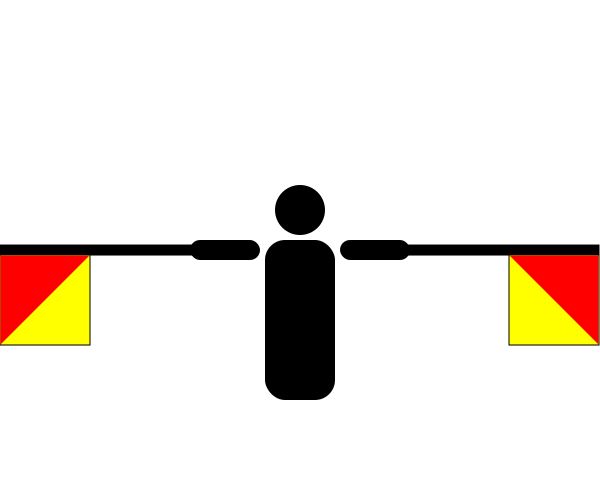
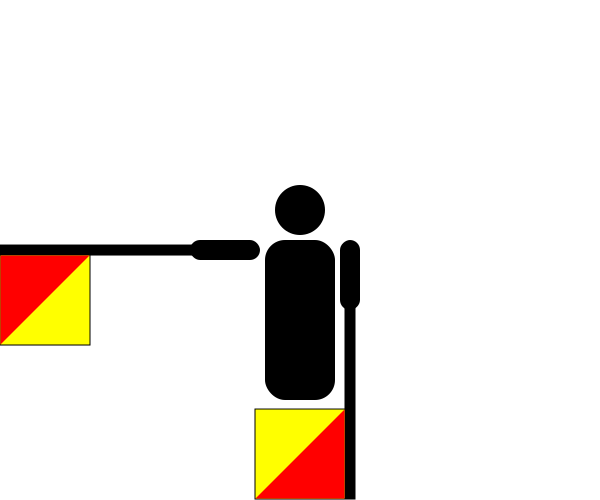
How to communicate the surname Rubel in...
Braille
⠗⠥⠃⠑⠇
Morse
.-...--.....-..
Semaphore



There are approximately 103 people named Rubel in the UK. That makes it one of Britain's least common surnames. Only around two in a million people in Britain are named Rubel.