ROSER
Roser is a surname of Germanic origin, traditionally associated with occupations or places linked to horses or roses. In the Middle High German language, the term ros denotes “horse,” and a surname derived from this root would have historically identified a person who worked with horses, such as a breeder, trainer or rider. In another accepted derivation, the name originates from the Middle High German rose combined with a suffix implying an occupation, thereby describing a grower or seller of roses. In both cases, the surname indicates a close relationship with either equine or floral commerce.
The name is also recorded in early‑medieval Wales, where it evolved from the Norman personal name Roger. The Old Germanic root of Roger, Hrothgar, comprises the elements hroth meaning “fame” and gar meaning “spear.” In Welsh phonology, the consonant g was often replaced by s or si, producing the variant Roser. The earliest documented instance of the spelling John Roser appears in the 1273 Pipe Rolls of Somerset during the reign of King Edward the First. Subsequent parish registers from London’s St. Dunstan’s and St. Giles Cripplegate record several bearers of the name in the early‑17th century, while a Humphrey Roser is noted in the St. Michael’s parish of Barbados in 1678.
Throughout the British Isles, the surname has been classed as an occupational name, and in England and Wales it has occasionally been treated as a derivative of the personal name Roger. The bearers of the name in the 13th and 14th centuries were almost invariably landholding or craft personnel, and the name was thereafter passed down patrilineally. In the 19th and early 20th centuries, records from the London Church Registers confirm that the name had spread to the metropolitan area, with entries such as the marriage of Richard Rosser to Susan Avery in 1630 and the christening of Thomas, son of Thomas Rosser, in 1631.
In continental Europe, the surname remains extremely common. In Germany it is listed as the 13th most frequent surname, with over 200,000 individuals. The same name has a high ranking in Austria and Switzerland, being 17th and 21st respectively. In Sweden it occupies the 117th position, with more than 20,000 holders. The United States counts it as the 2,153rd most common surname, with a population exceeding 15,000, and it is also notable in Argentina where it is the eighth most frequent, with over 18,000 people. In France and Italy, the name is less common, ranking 596th and 991st respectively.
Variants of the surname include Roser, Rosaer, Roseer, Roosar, Roesser, Rosser, Rose, and Rouse. These variations arose through Anglicisation, regional pronunciation shifts and administrative record‑keeping practices. Despite the different orthographies, all of these surnames have a shared Germanic heritage and are historically understood as occupational names linked to either horse or rose trade activities.
Typical given names associated with the Roser surname
Male
- Andrew
- Bruce
- Christopher
- Daniel
- David
- Geoffrey
- John
- Keith
- Michael
- Paul
- Philip
- Simon
- Stephen
- Timothy
Female
- Barbara
- Brenda
- Christine
- Della
- Diana
- Edith
- Elaine
- Helen
- Janet
- Kelly
- Lisa
- Nancy
- Patricia
- Sally
Similar and related surnames
- Rosier
- Rosar
- Roeser
- Rosario
- Roker
- Rosair
- Rosaire
- Roiser
- Orser
- Rose
- Rosea
- Rosero
- Raiser
- Raser
- Rasier
- Rasor
- Rasser
- Rauser
- Rayser
- Raysor
- Razar
- Razario
- Razer
- Razor
- Reaser
- Reasor
- Reeser
- Reesor
- Reiser
- Reisser
- Reizer
- Reser
- Resser
- Reuser
- Reusser
- Ricer
- Rieser
- Riiser
- Riser
- Risser
- Rocero
- Roissier
- Rooser
- Rosairo
- Rosaria
- Rosary
- Roscher
- Rosee
- Rosek
- Rosel
- Roserie
- Rosers
- Roset
- Rosher
- Roshier
- Rosker
- Rosler
- Rosner
- Rossar
- Rosser
- Rossert
- Rossier
- Rossor
- Roster
- Rouser
- Roussarie
- Rouzier
- Rowser
- Rozar
- Rozario
- Rozer
- Rozier
- Rozzier
- Rusere
- Russer
- Ruzario
- Ryser
- Roizer
- Rocker
Related and similar names are generated algorithmically based on the spelling, and may not necessarily share an etymology.
How to communicate the surname Roser in...
Braille
⠗⠕⠎⠑⠗
Morse
.-.---.....-.
Semaphore
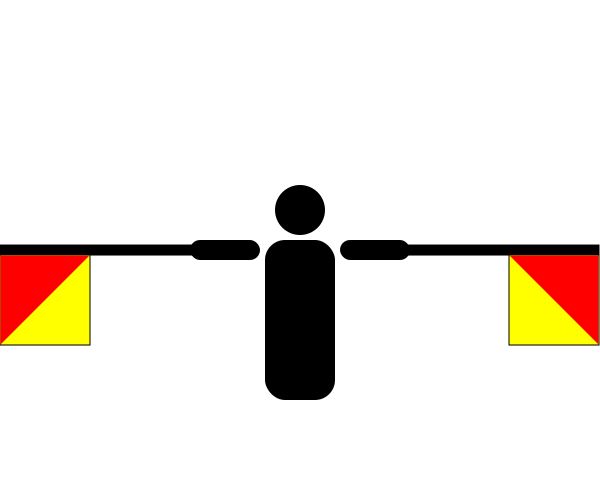
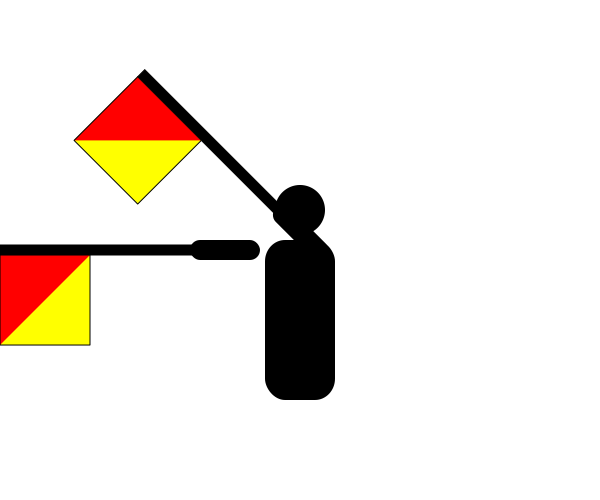


There are approximately 415 people named Roser in the UK. That makes it one of Britain's least common surnames. Only around six in a million people in Britain are named Roser.
Surname type: Occupational name
Origin: English
Region of origin: British Isles
Country of origin: England
Religion of origin: Christian
Language of origin: English
