ROSENGARTEN
Rosengarten is a surname of German provenance, literally translating to rose garden. It derives from the Old High German words rosen (“rose”) and gart (“garden”), and was originally employed as a topographic identifier for an individual who resided near, cultivated, or otherwise associated with a rose cultivation.
The name is recorded among the earliest German surnames, with the first documented spelling appearing in 1299 when the Dominican friar Conrad Rosenfeld is listed in the rolls of Freiburg. Earlier references such as Galter von Rosegarten in 1221 and Conrad Rosenfeld in 1299 attest to the antiquity of the form in Southern Germany.
While the literal sense denotes a rose garden, the surname is often described as ornamental, a pattern observed in many early Germanic surnames where the appellation served more as a pleasant or dignified attribute than a precise description of occupation or dwelling. In this light, names such as Rosegren (“rose branch”) and Rosengart (“rose garden”) illustrate the creative flexibility of the practice.
Variants of the surname abound across Central and Eastern Europe, reflecting linguistic shifts and migration. Common forms include Rosegarden, Rosengarden, Rosenkrantz, Rosenquart, Rosenera, Rosenberg, and Rosenbauer. In the Low Countries the name often appears as Rosenberg, while in the Palatinate and neighbouring regions it is usually rendered Rosengarten. The surname also underwent Anglicisation, giving rise to spellings such as Rosegarten, Rosenhagen, and Rosehagen in English‑speaking countries.
In addition to its secular use, the surname was adopted by Jewish families, who translated the literal meaning to the German language with the same spelling. Many of these families bear the name today in Germany, Austria, Switzerland, the United Kingdom, the United States, Canada, Spain, and Italy, indicating a persistent, global diaspora.
The prevalence of the name in Bavaria, Austria and Switzerland today reflects historical patterns of settlement and dispersion. Records of individuals such as Michael Rosenfelder of Schapbach (1651), Juergen Rosenfeld of Konigsberg (1632), and Liborius Rosenfelt of Ovenhausen (1689) demonstrate the name’s endurance through the early modern period.
Overall, the surname Rosengarten illustrates the evolution of a topographic designation into a widely dispersed family name, preserving its connection to the beauty and cultivation of roses while adapting to linguistic, regional and cultural changes across centuries.
Similar and related surnames
Related and similar names are generated algorithmically based on the spelling, and may not necessarily share an etymology.
How to communicate the surname Rosengarten in...
Braille
⠗⠕⠎⠑⠝⠛⠁⠗⠞⠑⠝
Morse
.-.---....-.--..-.-.-.-.
Semaphore
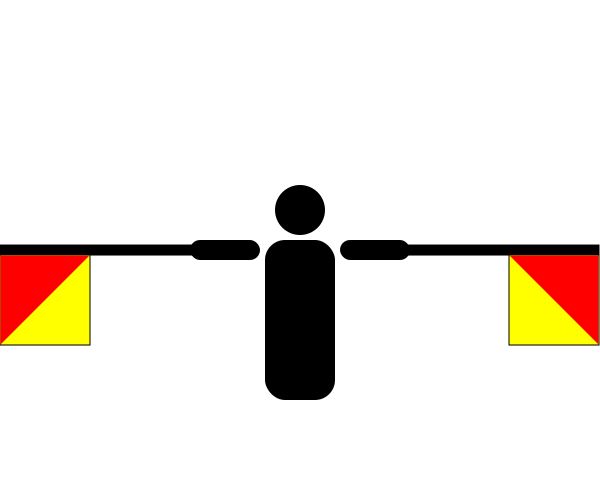
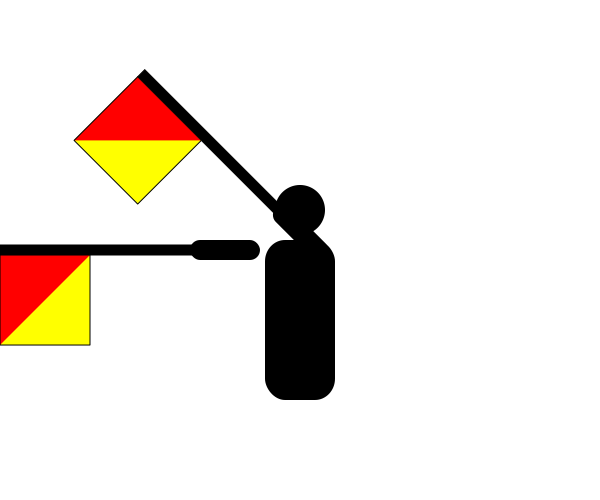


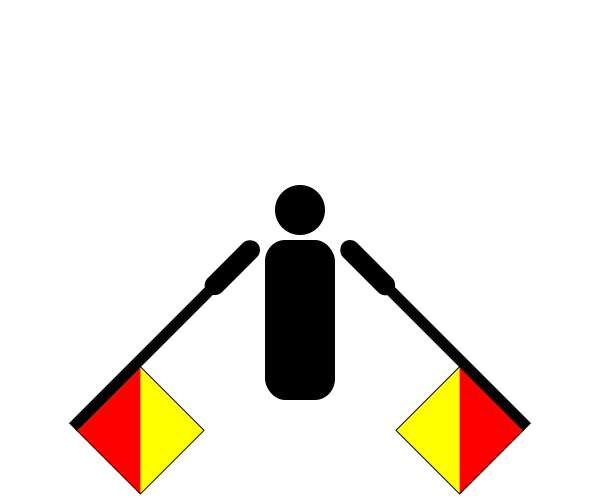


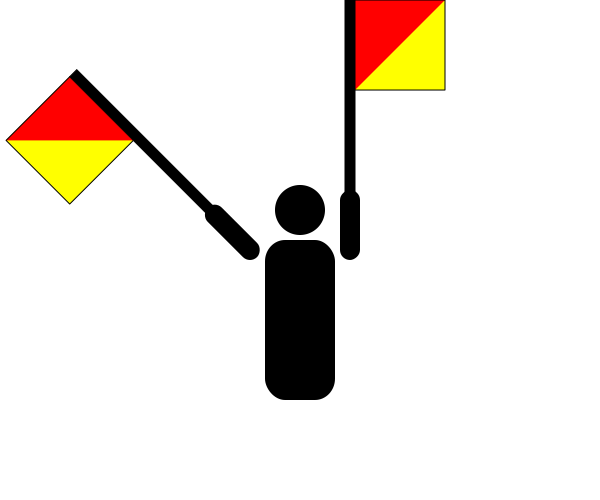
There are approximately 44 people named Rosengarten in the UK. That makes it one of Britain's least common surnames. Only around one in a million people in Britain are named Rosengarten.