ROSENDAHL
The surname Rosendahl is of Germanic origin, deriving from the combination of the elements rose and dahl. In German, rose refers to the flower, symbolising beauty and love, whereas dahl means “valley”. Consequently, the surname can be interpreted as “rose valley” or “valley of roses”, suggesting a connection to a place noted for an abundance of roses or to a person associated with the beauty and charm of the flower.
Historical records show that the name has existed in over two hundred spelling forms. Early medieval variations include Rose in England, Flanders and Germany, Larose and Roz of France, Ross of Scotland, Royce, Roset and Rising of England, Rosa and Rosi of Italy and Spain, Rosone and Rosetti of Italy, and Rosanski of Poland, among many others. These forms demonstrate the surname’s spread across Europe during the medieval period.
The earliest recorded instance of the family name is attributed to Baldungas Rose of Mainz, Germany, in 1283. Other notable medieval references appear in authentic charters and rolls: Rudolf Rosse of Basel, Switzerland, 1283; Richard Roys in the Subsidy Rolls of Suffolk, England, 1327; and Hugh Rosesone in the rolls of Staffordshire, 1342. Further examples include Christof Rosa of Friedberg, Germany, 1579, and Anna Russon, who married Evan Daniell at St Dunstans in East Stepney, London, 1628.
In a linguistic analysis, the surname is linked to four overlapping sources. It may be topographical, referring to a person who lived among wild roses; metonymic, denoting a rose grower; residential, indicating someone who lived at a place marked by the sign of the rose such as an inn; or derived from the early baptismal name Rosa or Rose. The baptismal name was recorded in the Domesday Book of 1086, but the surname only entered hereditary usage some two hundred years later.
Over the centuries the name has travelled with families across northern Europe. By the 12th century, Rosendahl ancestors were documented in northern Germany, the Netherlands, southern Denmark and throughout Sweden. Their mobility is reflected in the numerous spelling variations such as Rosendal, Rosendale, Rosinder and Rosindale. In modern times, the majority of bearers of the surname are found in Germany, Norway, Sweden, Denmark and the Netherlands, with significant populations in the United States, particularly in California, Arizona and Texas.
In Germany, most Rosendahls reside in Lower Saxony; in Norway they are mainly concentrated in the Nordland and Troms regions; and in Sweden they are largely found within the Skåne and Södermanland provinces. In the Netherlands, concentrations appear in Friesland, Utrecht, North Holland and Drenthe, while in Denmark the surname is most prevalent in Jutland.
Prominent individuals bearing the name include Lars Erik Rosendahl, a celebrated Norwegian Olympic rower, and Thomas Rosendahl, a Danish actor and director. These figures illustrate the continued presence of the surname in contemporary public life.
The surname also has cognates in other languages that share the same root meaning. Variants such as Rosenhal, Rozenvale, Rozenhal and Rosendale have arisen through linguistic and cultural adaptation. For example, Rosenhal combines the German Rosen (rose) and hal (hall or manor), producing the meaning “Rose Hall”. The Dutch variant Rozenvale merges Rozen (rose) with dale (valley), yielding “Rose Valley”. Similarly, Rozenhal denotes “Rose Hall” or “Rose Manor”. The Americanised form Rosendale reflects adaptation of the Norwegian Rosendahl.
Thus, the surname Rosendahl carries a heritage that spans linguistic, geographical and historical dimensions, with its most enduring meaning rooted in the natural beauty of the rose and the landscape of valleys.
Similar and related surnames
Related and similar names are generated algorithmically based on the spelling, and may not necessarily share an etymology.
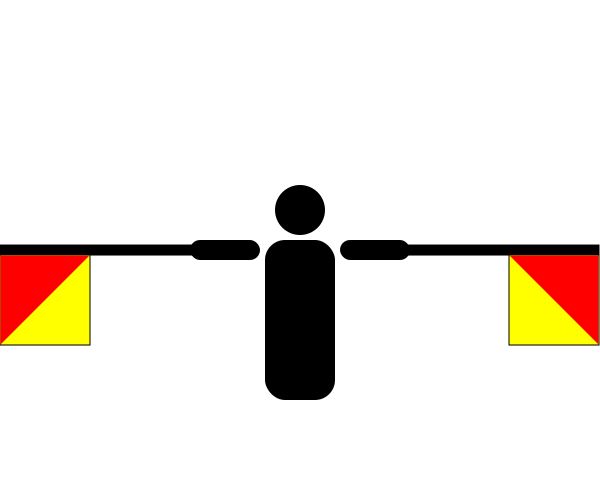
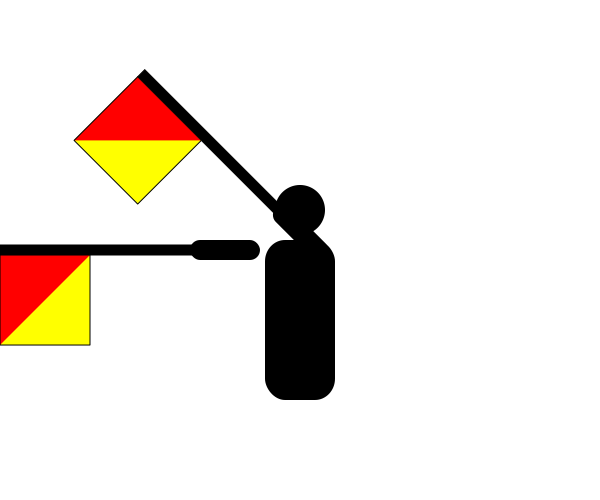
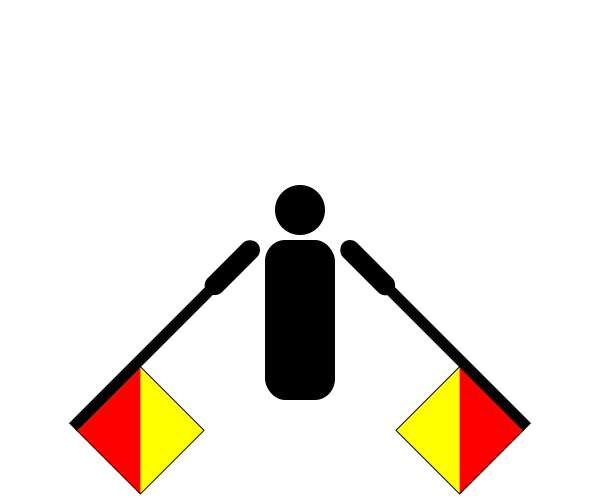
How to communicate the surname Rosendahl in...
Braille
⠗⠕⠎⠑⠝⠙⠁⠓⠇
Morse
.-.---....-.-...-.....-..
Semaphore




Sorry, we don't have any statistics on this name. That's probably because it's very uncommon in Britain.
