ROSENBLOOM
Rosenbloom is a surname of Germanic origin that has been adopted by many Ashkenazi Jews. It is derived from the German words rose and blume, meaning rose and flower respectively, and literally translates as rose in bloom or blossoming rose. The name was originally a descriptive nickname for a person who lived near a rose garden or who cultivated roses.
During the medieval period, German surnames often took on an ornamental quality, and the compound form Rosenbloom is one of many such examples. Early records show a variety of related surnames, including Rosegren, Rosengart and Rosenblum, each suggesting a connection to roses but not necessarily indicating literal residence by a rose bed. The base form Rose itself may have referred to a red-complexioned person or simply someone who tended roses.
Historical documents trace the earliest appearance of a closely related name in 1299, when a Dominican friar named Conrad Rosenfeld was mentioned in the archives of Freiburg under the reign of Emperor Albert I of Hapsburg. Later records from the 17th century, such as Michael Rosenfelder of Schapbach (1651) and Juergen Rosenfeld of Konigsberg (1632), indicate that the name persisted throughout German-speaking regions.
The absorption of such surnames into Jewish communities coincided with the period when Jews were required to adopt permanent family names for identification and tax purposes. It was common to choose names derived from nature, such as flowers and plants, symbolising growth and resilience. Consequently, many families of Jewish origin adopted Rosenbloom or similar variations at that time.
In the modern era, the name is frequently found in North America, particularly in the United States and Canada, where it often appears as an Americanised version of the German Rosenblüm. Concentrations exist in states that were major immigration hubs, including New York, Pennsylvania, and New Jersey. Across Europe, Rosenbloom can be encountered in the United Kingdom—especially London and the Midlands—as well as in Germany, France, Holland, Belgium, and Austria. The larger Jewish diaspora has carried the surname to Eastern European countries such as Poland, Romania, Ukraine, Belarus, Lithuania, Latvia, Hungary and Russia; to Israel, South Africa; and even to Caribbean and South American nations including Jamaica, the Dominican Republic, Barbados, Argentina, Brazil and Colombia.
Variants of the surname are numerous. Common alterations include Rozenblum, Rosebloom, Roesenbloom, Rozenbloom, Rosaenbloom, Rosanbloom and Rozenblatt. Related names that share the same floral theme are Rosenbaum, Rosebaun, Rozowsky, Rozenson, Rosenblit, Rosenzweig and Rosenstock. The multiplicity of spellings can make genealogical research challenging, yet recognising these variants can enable a more thorough tracing of family histories.
In sum, Rosenbloom is a surname with deep roots in German linguistic tradition that was embraced by Ashkenazi Jews during the era of compulsory family names. Its continued use across the globe reflects both its ornamental appeal and the historical migrations of the communities that bear it, and it remains a marker of cultural heritage and linguistic heritage alike.
Typical given names associated with the Rosenbloom surname
Male
- Tom
Female
Similar and related surnames
Related and similar names are generated algorithmically based on the spelling, and may not necessarily share an etymology.
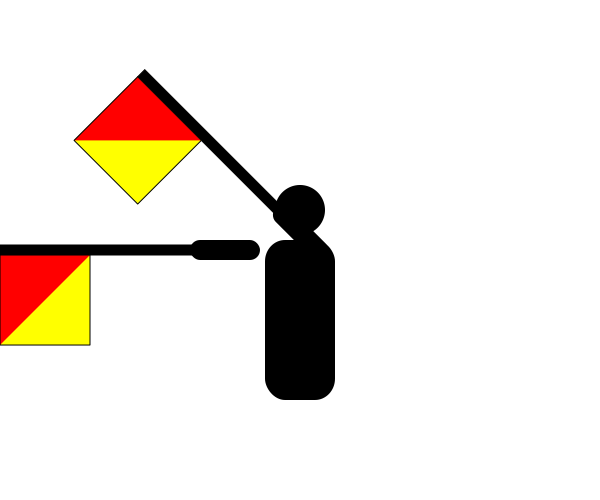
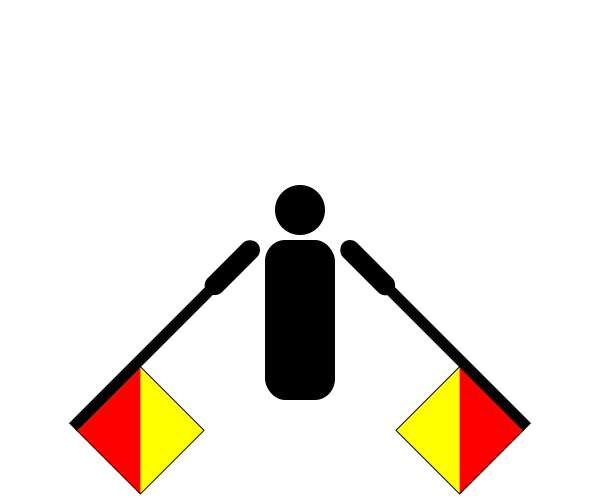
How to communicate the surname Rosenbloom in...
Braille
⠗⠕⠎⠑⠝⠃⠇⠕⠕⠍
Morse
.-.---....-.-....-..--------
Semaphore






There are approximately 94 people named Rosenbloom in the UK. That makes it one of Britain's least common surnames. Only around one in a million people in Britain are named Rosenbloom.
