ROSENBERGER
Rosenberger is a surname of definitive German provenance, recognised throughout Europe as a reflection of its linguistic roots in the German words rosen (rose) and berger (from berg, meaning mountain or hill). The composite conveys the notion of a hill of roses or a mountain dweller among roses, and has persisted as a patronymic or locational identifier since the Middle Ages.
Historical documentary evidence indicates that variations of the name were common across medieval Europe. Over two hundred recognised spellings appear in contemporary sources, ranging from Rose and Rosa in England and Italy to Larose in Flanders and Rosetti in Italy. These variants were often influenced by the linguistic context of each region, reflecting changes such as Latinised forms (e.g., Rosa), French adaptations (e.g., Roz), and Slavicised versions (e.g., Rosanski).
The earliest documentary occurrence of a family name of this type is believed to be Baldungas Rose of Mainz in 1283. Earlier references, however, appear in the form of baptismal names recorded in the Domesday Book of 1086, with an instance of Rosa serving as a personal name rather than a hereditary surname.
Medieval charters and tax rolls provide other evidentiary strands: Rudolf Rosse of Basel is cited in 1283; Richard Roys is found in the Subsidy Rolls of Suffolk, England, in 1327; and Hugh Rosesone appears in the rolls of Staffordshire in 1342. The record of Christof Rosa of Friedberg in 1579 and that of Anna Russon, who married Evan Daniell at St Dunstans in Stepney, London, in 1628, further illustrate the surname’s geographical spread.
The name is often classified as either topographic – indicating a resident near a rose-bearing hill – or occupational, denoting a grower, seller or gardener of roses. A residential variant is also possible, referring to someone who lived near a shop or inn marked by a rose sign. These theories are supported by analogous medieval naming practices, where surnames derived from prominent natural features or trades were common.
In addition to its Germanic origins, Rosenberger has long been recorded among Ashkenazi Jewish communities. The adoption of hereditary family names in the late eighteenth and nineteenth centuries led many Jews in German-speaking regions to adopt surnames based on natural imagery; thus Rosenberger entered Jewish nomenclature alongside other rose-derived names such as Rosenheim and Rosenzweig. This usage can frequently be found in contemporary records of Jewish families in Germany, Austria and the former Russian Empire.
During the nineteenth and twentieth centuries the surname expanded beyond its German heartland. In the United States it has most prominently settled in Pennsylvania, followed by California and Ohio, largely through waves of immigration from Germany and Eastern Europe. Comparable concentrations can be observed in Canada, Austria and Switzerland, typically in areas with substantial German or Jewish populations.
Variants of the surname, while retaining the core rosen motif, are many. Lexical adaptations include Rosenburg, Rosenburgg, Rosenburgh, Rosenbarg, and, in some dialects, forms such as Rozenberg or Rozenberger. These alterations usually reflect regional orthographic preferences or phonetic shifts over time.
The enduring nature of the Rosenberger name, with its dual allusion to both floral beauty and topographical distinction, exemplifies the lasting influence of medieval naming conventions. Whether denoting a dwell in a rose-rich hill or a craft rooted in rose cultivation, the surname continues to identify a lineage that is both historically grounded and geographically expansive.
Similar and related surnames
Related and similar names are generated algorithmically based on the spelling, and may not necessarily share an etymology.
How to communicate the surname Rosenberger in...
Braille
⠗⠕⠎⠑⠝⠃⠑⠗⠛⠑⠗
Morse
.-.---....-.-.....-.--...-.
Semaphore
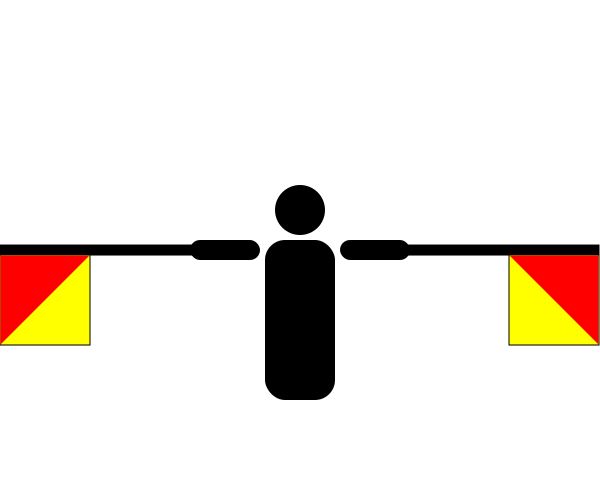
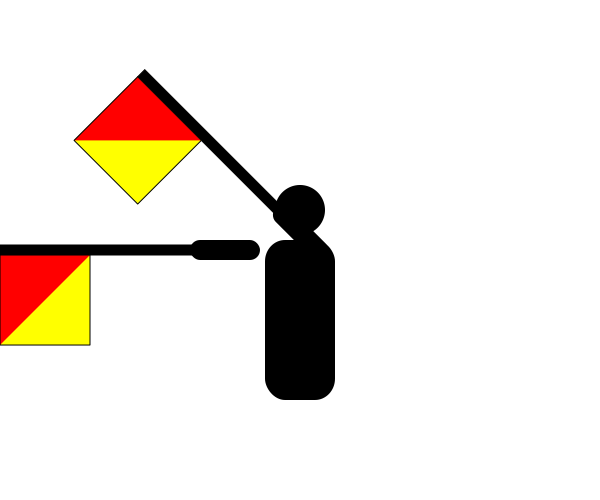


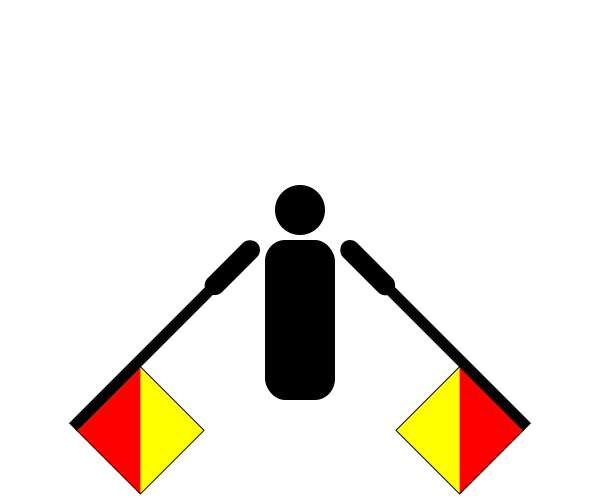
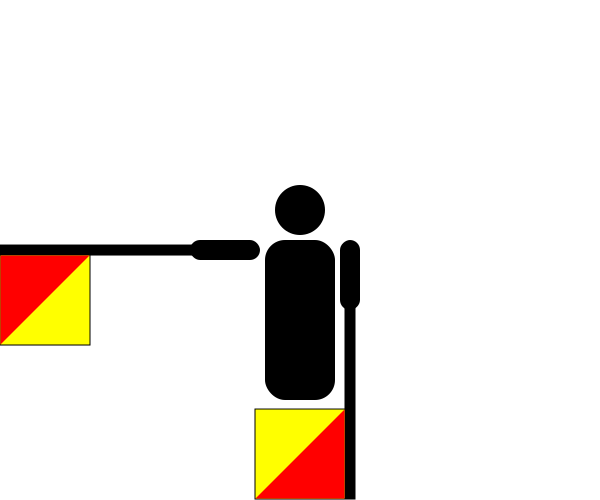

There are approximately 23 people named Rosenberger in the UK. That makes it one of Britain's least common surnames. Fewer than one in a million people in Britain are named Rosenberger.
Region of origin: Europe
Country of origin: Germany
Language of origin: German