ROSAS
Rosas is a surname of Spanish origin, deriving from the word rosa, which translates to “rose” in English. The name is therefore intrinsically linked to the symbolism and beauty associated with the rose and is usually regarded as a topographic or locational surname, applied to someone who resided near a place where roses grew, or who was otherwise connected with the flower.
The earliest medieval instance of the surname appears in 1283 in Switzerland, where a man identified as Rudolf Rosse is recorded in the archives of Basel. The form of the name at that time was already adapted to local spelling conventions, and further evidence of the name can be found in England in 1327 in the Subsidy Rolls of Suffolk, where a Richard Roys is mentioned, and in Staffordshire in 1342, in the rolls of the same year, a Hugh Rosesone is recorded.
Variations of the surname are widespread across Europe. In France the name appears as Larose or Roz; in Scotland as Ross; in England as Rose, Royce, Rising, and Rose of England and Rose of Flanders; in Italy as Rosa, Rosi, Rosone, and Rosetti; in Poland as Rosanski; and in Germany as Rosee and Rosen. These variants illustrate the name’s adaptability to local linguistic and cultural contexts.
According to the Domesday Book of 1086, the forename Rosa was used as a baptising name in England. The surname, however, was not adopted as a hereditary family name until roughly two hundred years later, as the period when surnames generally became fixed and passed from generation to generation. In addition to the earlier medieval habits of notation, later records include the marriage of Anna Russon to Evan Daniell at St Dunstans in London in 1628, and the mention of Henry Rose, Baronn Strathnairn (1801-1885), a field‑marshal in the British Army who served in Syria, India and Ireland.
Throughout its history, the surname has evoked the gentle and delicate nature traditionally associated with the rose, and it has been borne by a number of individuals who distinguished themselves in military, civic and religious fields across Europe. The name’s persistence from the medieval period to the present day is a testament to its cultural resonance and its adaptability.
Similar and related surnames
Related and similar names are generated algorithmically based on the spelling, and may not necessarily share an etymology.
How to communicate the surname Rosas in...
Braille
⠗⠕⠎⠁⠎
Morse
.-.---....-...
Semaphore
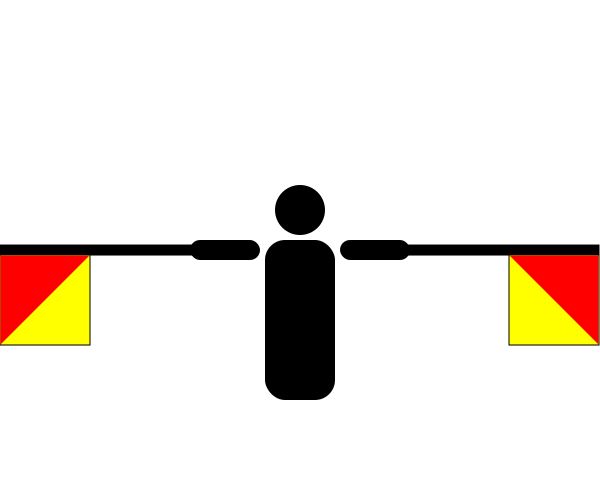
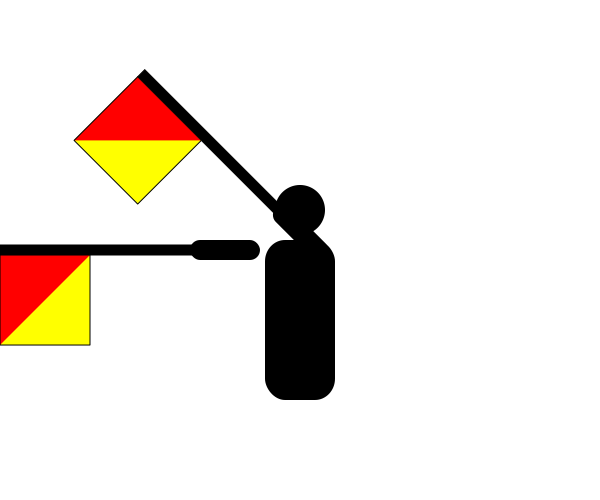


Sorry, we don't have any statistics on this name. That's probably because it's very uncommon in Britain.
Origin: Iberian
Region of origin: Europe
Country of origin: Spain
Religion of origin: Christian
Language of origin: Spanish
