ROOF
Roof is a surname that arises from both English and German linguistic traditions. It is a family name that has been borne by individuals for many centuries, and its variations reflect the diverse linguistic and cultural influences that have shaped it.
The English source of the name is linked to the Middle English word rofe or roove, which denoted a small plot of arable land. From this stem the surname likely developed as a topographic designation for a person who lived near such a plot or whose occupation involved farming that land.
In German the name derives from the Middle High German word ruof, meaning “rest” or “peace”, but it is also associated with the Old English word hrof and, in some cases, with a person who lived in a house with a distinctive roof or who worked as a roofer. The German root rauf meaning “rough” or “rugged” also contributes to the name’s sense of a person dwelling in a rough terrain.
Another important source is the Old Germanic personal name Hrodwulf, composed of the elements hrod (“renown”) and wulf (wolf). Through the influence of Scandinavian settlers this name entered England, where it appeared in forms such as Hrolfr, Rolf and Rolfe. The Normans introduced further variants, notably Rou or Roul, often Latinised as Rollo. More than twenty modern variants of the surname have emerged, including Rolf, Rolfe, Rolph, Roalfe, Rofe, Roff, Roffe, Roof, Rulf and Rule.
The earliest recorded spelling of the family name is that of Robert Rolf, dated in 1272 and preserved in the “Customary Laws of Battle Abbey, Sussex”, during the reign of King Edward I. A later documented marriage appears in London, where John Roffe and Elizabeth Blythe took vows at St. Stephan’s, Coleman Street, on 3 November 1560.
The surname reflects the medieval practice of adopting names that described a person’s occupation or residence. As a topographic name it was applied to those in locales noted for small plots of land or rough terrain, while as an occupational name it applied to those who undertook roof‑making or who were associated with a house’s roof. Variants such as Roff, Rooves, Roofer, Rufe and Ruffener arise from regional dialects and changes in social circumstance.
In the United States and Canada the surname is most common in the English‑speaking regions, with large concentrations in Pennsylvania, Ohio, North and South Carolina and Georgia. In the United States it is also widespread in states with historic German immigration such as Washington, Indiana and Illinois, and in Canada it is found principally in Ontario and Alberta. The name’s frequency in Ohio is highest, with 406 families, while Washington reports only 15 families. The distribution demonstrates the migration patterns of Germanic and English settlers over the past few centuries.
When tracing lineage it is essential to recognise the many spelling variations, which include Rauf, Rouf, Ruf, Ruff and Rufe in German contexts, and Roffe, Roffey, Rouffe, Roffing and Roffin in English contexts. The name also appears in French‑speaking regions under forms such as Roff, Roffel, Rouffie, Roffa and Roffier. A careful consideration of these variants ensures accurate genealogical research.
Thus the surname Roof is an ancient name that preserves a rich tapestry of linguistic, occupational and geographical heritage, whilst demonstrating how surnames adapt to evolving social structures.
Similar and related surnames
Related and similar names are generated algorithmically based on the spelling, and may not necessarily share an etymology.
How to communicate the surname Roof in...
Braille
⠗⠕⠕⠋
Morse
.-.------..-.
Semaphore
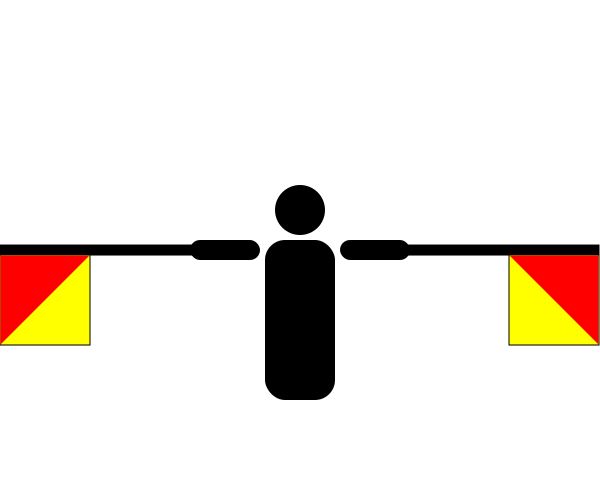
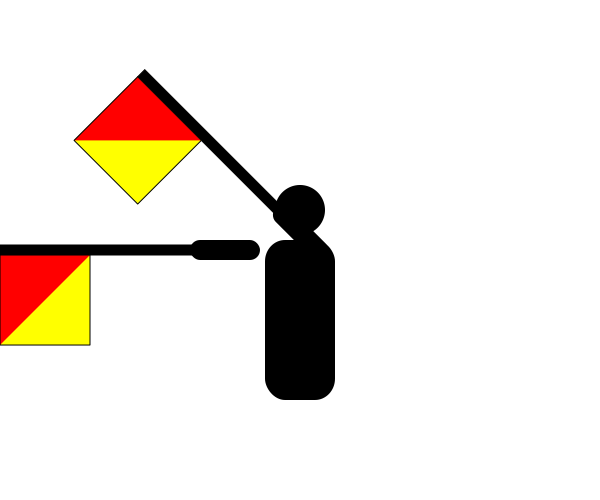
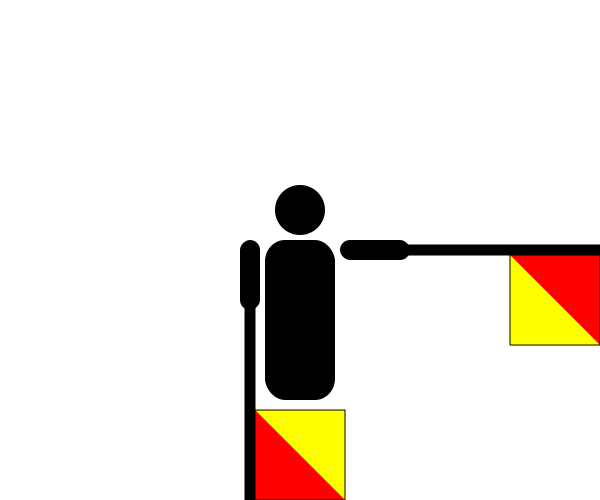
There are approximately 81 people named Roof in the UK. That makes it one of Britain's least common surnames. Only around one in a million people in Britain are named Roof.
