ROLF
The surname Rolf is of Germanic and Norse provenance, deriving ultimately from the Old Norse personal name Hrolfr. The compound Hroð meaning “fame” and wulf meaning “wolf” yields the translation “famous wolf”. This construct was typical of early medieval naming practices, where martial and divine attributes were often signalled in personal names.
Following the Viking incursions of the eighth and ninth centuries, the name was popularised across the British Isles, Scandinavia and continental Europe. It was initially a given name, later adopting the modern pattern in which a personal name is passed on as a family surname. The transition from given name to hereditary surname is evident in medieval charters, where combinations of the element Rolf appear as both first and last names.
Recorded spellings exceed fifty variations, including Rolf, Roffe, Ruff and Ruffell in England; Rudolf and Rotlauf in Germany; Rohlf in Switzerland; Ridulfo and Firidolfi in Italy; and Roelof in the Netherlands. In the Scandinavian context, the contracted form Hrolfr was anglicised to Rolf, and this is the form that was subsequently transmitted to the north‑eastern regions of England and the Lowlands.
Early documentary evidence for the hereditary use appears in the 13th and 14th centuries. Examples include Johan Rodolfi of Hamburg, recorded in 1252; Robert Rolf of Battle in Sussex, England, in 1272; Jakob Rufi, priest at Zurich, in 1300; and Johan Rudolf of Andelshoven, Germany, in 1332. A marriage record from London, involving John Roffe and Elizabeth Blythe, appears on St. Stephan's, Coleman Street, on 3 November 1560.
In contemporary times the name is still most commonly found in northern and eastern Germany, particularly the states of Schleswig-Holstein, Lower Saxony, Berlin and Mecklenburg‑Vorpommern. In Scandinavia it is prevalent in Sweden, Norway and Denmark. In the United Kingdom, the surname occurs in both England and Scotland, with the spelling Roul gaining some traction in north‑eastern England. Within Britain the name remains predominantly of English descent, rather than continental.
In the United States the surname is largely a legacy of nineteenth‑ and early twentieth‑century German and Scandinavian emigration. It ranks among the more frequently occurring surnames in the northeastern and mid‑western states, and is also represented, though to a lesser extent, in Canada, Australia, New Zealand, South Africa and other former colonies. The name has largely retained its original spelling and pronunciation across these diaspora communities.
Although its use as a given name has declined over the centuries, the surname continues to be borne by individuals throughout Western Europe and the Americas. The persistence of the name attests to the enduring cultural memory of a lineage characterised by renown and strength, attributes eloquently captured by the original epithet “famous wolf”.
Typical given names associated with the Rolf surname
Male
- Andrew
- Christopher
- Daniel
- David
- John
- Keith
- Martin
- Michael
- Nicholas
- Paul
- Philip
- Thomas
Female
- Alison
- Caroline
- Emma
- Gemma
- Helen
- Jane
- Joanne
- Linda
- Lucy
- Patricia
- Samantha
- Susan
Similar and related surnames
Related and similar names are generated algorithmically based on the spelling, and may not necessarily share an etymology.
How to communicate the surname Rolf in...
Braille
⠗⠕⠇⠋
Morse
.-.---.-....-.
Semaphore
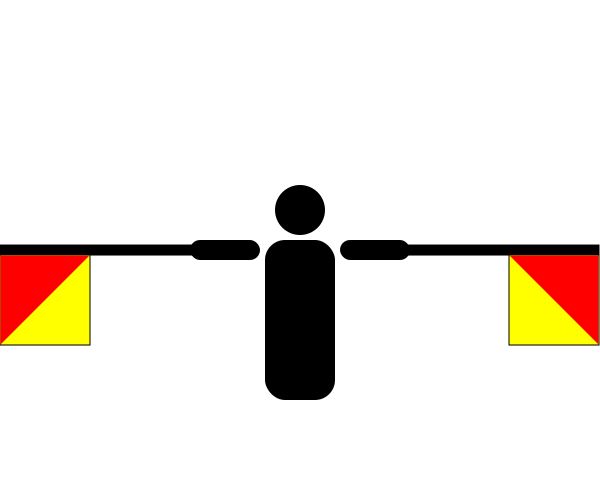
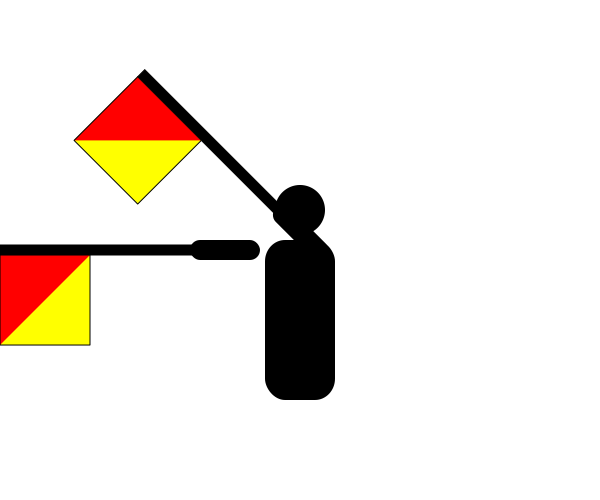

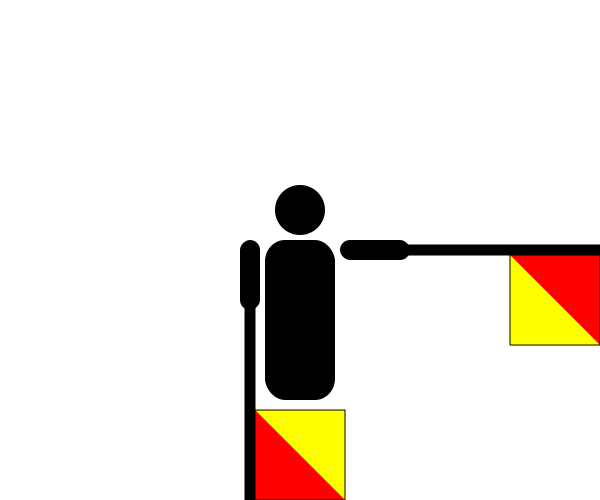
There are approximately 584 people named Rolf in the UK. That makes it one of Britain's least common surnames. Only around nine in a million people in Britain are named Rolf.
Surname type: From given name or forename
Origin: English
Region of origin: British Isles
Country of origin: England
Religion of origin: Christian
Language of origin: English
