ROAN
The surname Roan is rooted in Gaelic tradition, with its earliest association in Scotland and Ireland. It derives from the Gaelic word ruadh, meaning “red”, and was historically applied as a descriptive appellation to those with red hair or a ruddy complexion.
In Ireland the name is an Anglicised form of the ancient patronymic O’Ruadhain, which translates as “the descendant of the red one”. The first recorded instance of this surname appears in 1215, with Felix O’Ruadhain, Archbishop of Tuam in County Galway. He is mentioned in the Register of the Irish Prelates kept in Rome during the reign of King John of England.
The 16th‑century Elizabethan land Registers and the 1659 Petty census list a variety of spellings – O’Rowane, O’Rowghan, O’Rowan, Rown, Roan and Rowan – all referring to the same family. An early example is Morietagh O’Rowane of Ballinvalle in County Wexford, who received a royal pardon in 1584 and was described as a “Gentleman”. By 1659 the O’Rowans of County Mayo were noted as “persons of property”, a description that was not afforded to Timothy Ruane of County Galway, one of the famine emigrants who left on the ship Barlow bound for New York in April 1847.
During the 17th century the name was also recorded in Northern Ireland, particularly in counties Londonderry and Antrim. It is possible that some bearers of the name were originally from settlements called Roan or Roane in Scotland and Ireland, hence a locational element may have also contributed to the surname’s development.
The spelling of the surname varies widely, reflecting the fluidity of Anglicisation. Common variants include Roane, Rowan, Rhoen, Roen, Roanes, Rouen, Rowens and Rohane. Other forms such as Rohan, Roohan and Ruane appear in historical records and, although less common, are still in use today.
From the 1600s onwards the surname spread beyond the British Isles through emigration. In the United States it is most frequently found in states with large Irish populations, such as New York, Pennsylvania, Massachusetts, Connecticut and Rhode Island, as well as in the Midwest and the South – for example Ohio, Michigan, Illinois and Alabama. Within Canada, the name is especially prominent in the Maritimes and Ontario, and it can also be found in Australia and the United Kingdom.
While the predominant origin of Roan is Gaelic, some alternative derivations have been suggested. In Wales the surname may stem from the word rhun meaning “spear”, and in England it has occasionally been linked to the Old English personal name Hrothw(e)ald or the Old Norse Rōgnvaldr. These associations are not supported by definitive evidence and are considered secondary to the Gaelic root.
Today, individuals bearing the surname Roan occupy a wide range of professions and can be found throughout the globe. Their lineage, firmly anchored in Celtic heritage, reflects a long history of migration and cultural integration across the world.
Typical given names associated with the Roan surname
Male
- Alan
- Alexander
- Andrew
- Anthony
- David
- James
- Jamie
- Jay
- John
- Mark
- Michael
- Robert
- William
Female
- Ann
- Caroline
- Catherine
- Eileen
- Emma
- Helen
- Jemma
- Joyce
- Kathleen
- Margaret
- Patricia
- Rosamund
- Susan
- Yvonne
Similar and related surnames
Related and similar names are generated algorithmically based on the spelling, and may not necessarily share an etymology.
How to communicate the surname Roan in...
Braille
⠗⠕⠁⠝
Morse
.-.---.--.
Semaphore
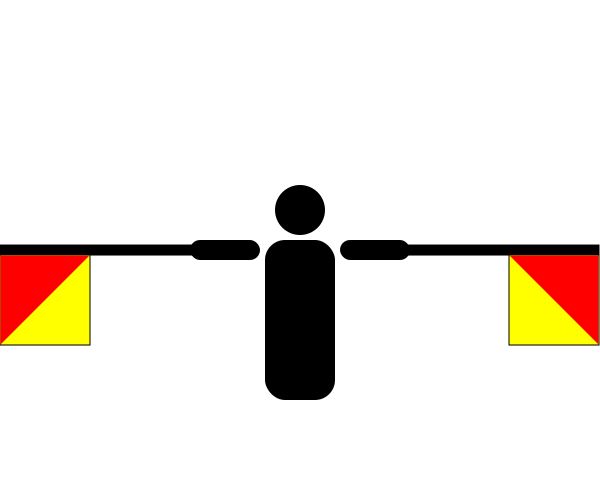
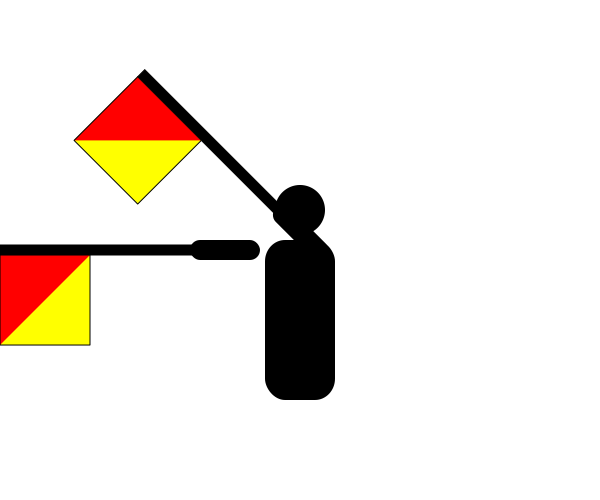

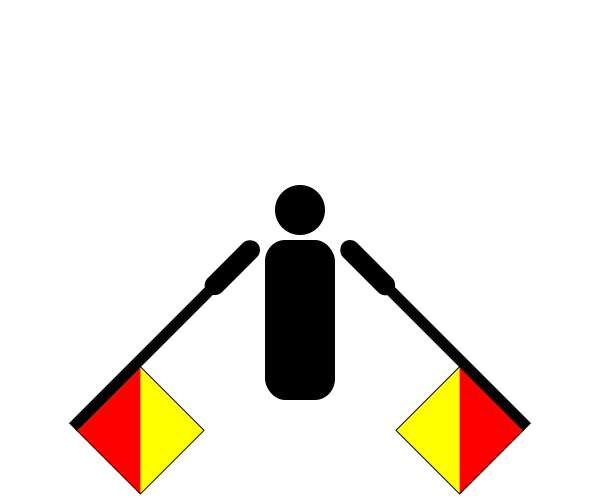
There are approximately 371 people named Roan in the UK. That makes it one of Britain's least common surnames. Only around six in a million people in Britain are named Roan.
Surname type: Location or geographical feature
Origin: English
Region of origin: British Isles
Country of origin: England
Religion of origin: Christian
Language of origin: English
