RIEGER
Rieger is a surname of Germanic origin that appears in a variety of linguistic contexts across Europe. It is most commonly associated with German‑speaking regions but is also found in neighbouring countries and in overseas diaspora communities.
The first documented derivation of Rieger comes from Middle High German. In that period the word rieger meant “heron”, and the surname was applied as an occupational name to a heron‑catcher or to a person who lived near an area where herons were plentiful. The bird’s gentle elegance was often attributed to the character of those who bore the name.
Another occupational origin is linked to the Middle High German verb riegen, meaning “to rake”. Rieger would therefore have denoted a person who raked grain or engaged in a related agricultural activity. In medieval England the term was sometimes extended to describe a reeve, an official responsible for local administration and justice.
In Jewish communities the surname appears with a different background. It is believed to derive from the Hebrew name Reuven and from the Yiddish word Regerer, which translates as “man of the city”. The name may also trace back to the Latin word Regina, meaning “queen”, though this link refers more to a descriptive class than to a direct linguistic ancestry.
A third strand of evidence shows that Rieger is a German cognate of the name Roger, introduced into England by the Normans. The original Germanic components hrod (renown) and geri or gari (spear) combine to form a personal name that later produced the Norman variants Roger and Rogier. In England this gave rise to diminutives such as Hodge and Dodge and to patronymic forms including Rogers, Rodgers and Rogerson. The earliest record of a surname identical to Rieger appears in a document dated 1263 in Canterbury, where a Richard Roger is mentioned during the reign of King Henry I, known historically as “The Frenchman” (1216‑1272). Subsequent entries such as the christening of Edith Rigar in 1582 and the marriage of Frederick Rieger in 1792 further illustrate the name’s early use in England and Scotland.
Geographically, Rieger is predominantly located in German‑speaking countries. In Austria it is most common in Vienna, Upper Austria and Styria. In Germany the surname is widespread, with higher concentrations in Lower Saxony, Schleswig‑Holstein and Mecklenburg‑Vorpommern. The Czech Republic, Poland, Hungary, Romania, Slovakia and various Balkan states also report significant numbers. Outside Europe, substantial populations are seen in Brazil, Argentina, Uruguay and the United States. In the United States the name clusters largely in the Midwest, especially in Wisconsin, Michigan, Illinois, Indiana, Pennsylvania and Ohio, where more than 2,000 individuals carried it in 2016.
Several spellings and closely related names are found throughout its history. Variants include Regar, Reger, Rigear, Riger, Reeger, Rycher, Riegger, Reichar, Reigar and Reigher. These alternate forms can provide useful clues for genealogical research, indicating a particular regional, ethnic or linguistic background. The earliest recorded bearer of the name is believed to be Melchior Rieger, born around 1628 in Erlangen, Germany.
Similar and related surnames
Related and similar names are generated algorithmically based on the spelling, and may not necessarily share an etymology.
How to communicate the surname Rieger in...
Braille
⠗⠊⠑⠛⠑⠗
Morse
.-....--...-.
Semaphore
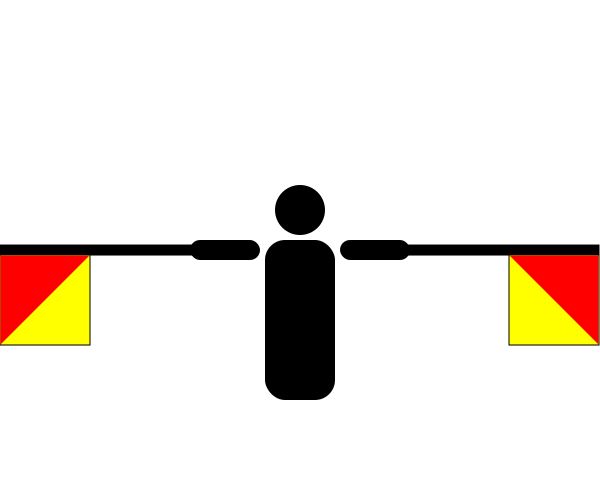
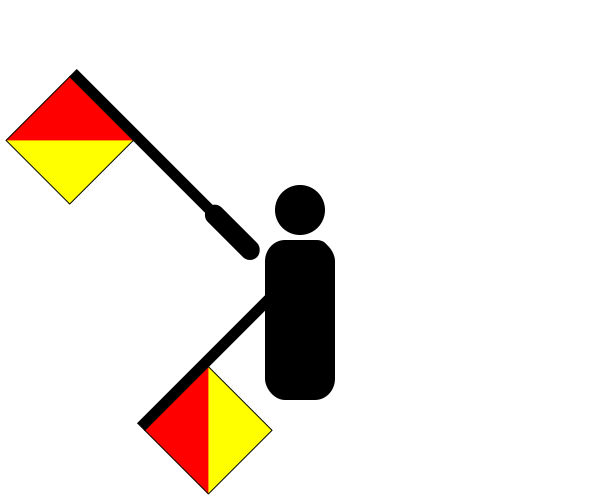


There are approximately 108 people named Rieger in the UK. That makes it one of Britain's least common surnames. Only around two in a million people in Britain are named Rieger.
Region of origin: Europe
Country of origin: Germany
Language of origin: German