RHOADES
Rhoades is a surname of English origin, whose roots lie in the Old English word rod, meaning a clearing in woodland or a road. It entered the onomastic landscape of the British Isles in the Anglo‑Saxon period and later evolved along several lines of spelling, including Rhodes, Roades, Rodes and Rhoads.
The earliest documented forms of the name appear in the 13th century: Alexander de la rode in Norfolk (1277), John atte Rode in Bedfordshire (1294) and Robert del Rodes in Lancashire (1332). These attestations confirm that the name was used as a topographical identifier for individuals living near a clearing or a crossing, and also functioned as a locational marker for those who had moved away from a place named Rhodes, such as the hamlet near Middleton in Lancashire or Rhodes Hill to the north of Ashton‑under‑Lyme.
The suffix -es in the original form denotes a patronymic relationship, rendering the meaning of the name essentially as “son of the clearing” or “son of the road.” Thus, Rhoades is categorised as a patronymic surname deriving from a topographical element.
Records from the 12th and 13th centuries, particularly the Assize Court Rolls of Yorkshire, document the first spelling of the family as Hugh de Rodes (1219). These documents date to the reign of King Henry the ‘Frenchman’ (1216‑1272), thereby establishing the surname’s presence in Yorkshire during the early Middle Ages.
By the early modern period, the surname was most commonly found in the counties of Yorkshire and Lancashire, where the name’s meaning resonated with the local landscape. The distribution of the name across these counties reflects the medieval practice of identifying individuals by prominent landscape features or estates.
In the 19th century, a distinguished bearer of the name, Cecil John Rhodes (1853‑1902), rose to prominence as a colonial financier and statesman in South Africa. His role as Prime Minister of the Cape Colony (1890‑1896) involved the extension of British influence in the region. A family Coat of Arms was granted to this line, featuring a silver shield, a red lion passant quadranted between two acorns, and a trefoil as a mark of difference.
In the United States, the surname Rhoades migrated with English settlers in the 17th century and subsequently became established in various regions. Its most frequent concentrations in the United States today are found in the South – especially in Texas, Oklahoma and Arkansas – as well as in the Appalachian region and in several counties of Pennsylvania and Virginia. The 2020 Census lists Rhoades among the top five hundred most common surnames in the country.
Modern genealogical research utilises digital databases such as Ancestry.com and FamilySearch.org to trace the lineage of individuals bearing the surname. These resources can help confirm the geographical origins of a family line and illuminate the historical migration patterns that have shaped the present distribution of the name.
While the spelling variants differ – with Roads being the most frequent, followed by Rhodes and Rhoads – each form retains the same etymological heritage. The presence of diverse spellings is a reflection of regional dialects and the administrative practices of record‑keeping throughout history.
Typical given names associated with the Rhoades surname
Male
- Anthony
- Daniel
- David
- James
- John
- Lee
- Paul
- Peter
- Robert
- Simon
- Stephen
Female
- Alison
- Elaine
- Emma
- Julie
- Karen
- Louise
- Lucy
- Nicola
- Pamela
- Rebecca
- Sarah
- Vera
Similar and related surnames
Related and similar names are generated algorithmically based on the spelling, and may not necessarily share an etymology.
How to communicate the surname Rhoades in...
Braille
⠗⠓⠕⠁⠙⠑⠎
Morse
.-.....---.--......
Semaphore
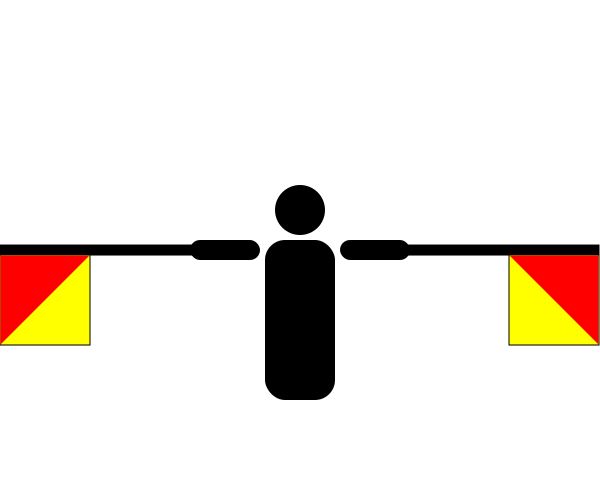

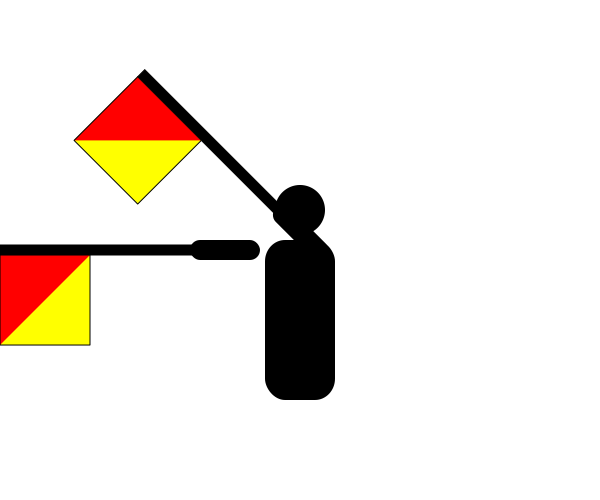


There are approximately 524 people named Rhoades in the UK. That makes it one of Britain's least common surnames. Only around eight in a million people in Britain are named Rhoades.
Origin: English
Region of origin: British Isles
Country of origin: England
Religion of origin: Christian
Language of origin: English
