REX
In the context of British anthroponymy, the surname Rex originates from the Latin word rex, meaning king. The assignment of this name to individuals in medieval England is generally understood to have been occupational, attributing to those who held positions of authority or those who performed roles in a regal manner.
Historical records indicate that the name appears in various forms, including Regis, Regus, Recks, Reekes and Reeks. While these variants are recorded in English documents, the ultimate etymological root remains Latin. The surname was most likely used in a ceremonial sense, designating individuals who acted as temporary local leaders during festivals such as Christmas, Easter and Michaelmas. Such persons were sometimes elected to serve for a single day, a custom that possibly influenced the hereditary adoption of the name.
The earliest extant documentation of the surname in England dates to 1273, where an individual named Adam Rex is listed in the Hundred Rolls of landowners of Cambridgeshire during the reign of King Edward I. Subsequent ecclesiastical records further attest to the surname: a marriage between John Rex and Debra Chapman was recorded at St. Dunstan's, Stepney on 4 April 1650; a christening witness named Lewis Regis is noted in Sunbury on Thames on 6 May 1724.
In addition to its English occurrence, the surname Rex is also prevalent in continental Europe, particularly in Germany where, according to a 2011 study, over 73,000 individuals bear the name, making it the sixteenth most common surname in that country. The name appears, albeit in smaller numbers, in Hungary, Austria, Switzerland, France, Spain, Italy and Portugal, and it is also represented among minority populations such as the Basques and Hispanics.
In the United States, the 2000 census placed Rex at the 1,734th position in terms of commonality, though more recent figures suggest a continued growth in the surname’s frequency. The distribution of the name across these nations reflects its multifaceted linguistic and cultural heritage, spanning Latin, Old German, Old French and Anglo‑Saxon influences.
Despite its royal connotations, the surname is unlikely to denote direct descent from a monarch. Instead, it has served as a symbolic marker of authority or as an occupational reference, conveying respect for the role or character of those who carried it. The enduring presence of the name in legal, parish and census records over the centuries testifies to its persistent place within the British and European naming landscape.
Typical given names associated with the Rex surname
Male
- Andrew
- Anthony
- Daniel
- David
- James
- John
- Michael
- Paul
- Peter
- Phillip
- Stephen
- Stuart
Female
- Alison
- Ann
- Camilla
- Caroline
- Elizabeth
- Emma
- India
- Julia
- Karen
- Lesley
- Margaret
- Patricia
- Rebecca
- Samantha
Similar and related surnames
- Rax
- Rec
- Rake
- Reak
- Reeks
- Reek
- Reck
- Raike
- Rakes
- Racke
- Reeck
- Recks
- Reaks
- Re
- Rea
- Raagas
- Racaza
- Raccio
- Racks
- Racs
- Racz
- Raczi
- Ragas
- Ragasa
- Ragazzi
- Ragazzo
- Raggs
- Rags
- Ragus
- Ragusa
- Raguso
- Raguz
- Raigosa
- Raikes
- Raikis
- Rakas
- Rakoci
- Rakos
- Rakosi
- Rakus
- Raoux
- Raucci
- Raux
- Reake
- Reakes
- Recce
- Recci
- Reecks
- Reecse
- Reeke
- Reekes
- Regas
- Reggis
- Reggs
- Reghis
- Regos
- Regs
- Regus
- Reick
- Reigosa
- Reik
- Reikes
- Rek
- Rekas
- Rekasi
- Reke
- Rekkas
- Rekus
- Relk
- Reux
- Rexha
- Ricci
- Riccio
- Rickes
- Rickis
- Ricks
- Rickus
- Rickuss
- Rieck
- Riek
- Rieke
- Rigas
- Rigazio
- Riggs
- Rigos
- Rigozzi
- Rigs
- Rikes
- Rioux
- Rix
- Roakes
- Rocas
- Rocci
- Roccio
- Rockes
- Rocks
- Rocos
- Roex
- Rogas
- Rogos
- Rogosz
- Rogoz
- Rogoza
- Rogues
- Rogus
- Rokas
- Rokes
- Rokkas
- Rokos
- Rokosz
- Rokus
- Rookes
- Rooks
- Roques
- Roukis
- Roux
- Rox
- Roxo
- Ruaux
- Rucci
- Ruckes
- Rucks
- Ruggs
- Rughes
- Rukas
- Rukes
- Ruks
- Rux
- Ryks
- Wraggs
- Wreakes
- Wreaks
- Wriggs
- Wrycza
Related and similar names are generated algorithmically based on the spelling, and may not necessarily share an etymology.
How to communicate the surname Rex in...
Braille
⠗⠑⠭
Morse
.-..-..-
Semaphore
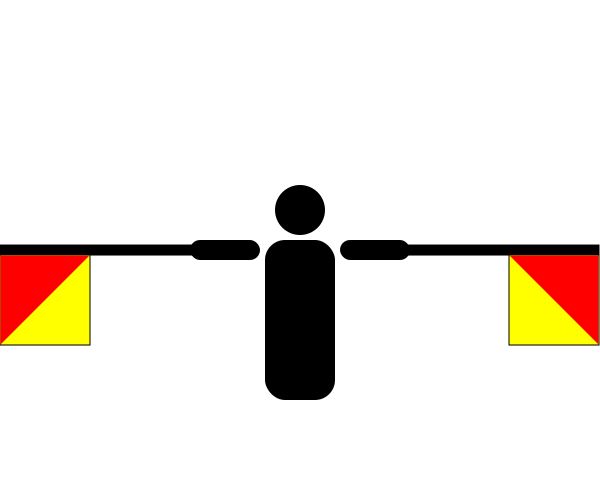

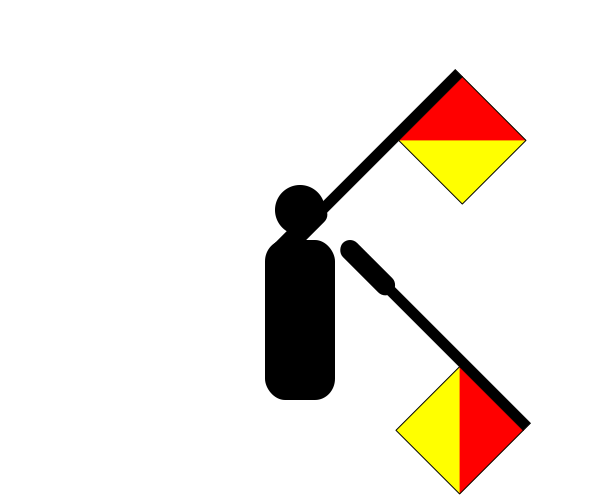
There are approximately 1,006 people named Rex in the UK. That makes it roughly the 7,347th most common surname in Britain. Around 15 in a million people in Britain are named Rex.
Origin: English
Region of origin: British Isles
Country of origin: England
Religion of origin: Christian
Language of origin: English
