REPP
Repp is a surname of German provenance, most commonly associated with the western and eastern regions of Germany. It is recorded in England from the early medieval period, both in the church and civil registers of that time.
Its etymology is primarily occupational: the Middle High German word repp translates as “rope” or “cord.” Consequently, the name was usually bestowed on persons engaged in the manufacture or sale of ropes, or on those who possessed a dexterity in rope‑making. An alternate derivation, based on the Middle High German verb reppen meaning “to cut,” has been proposed for use as a topographic surname for someone who lived by a neatly cut ridge or a clearing where trees were felled.
The earliest surviving spelling of the name dates from the splintered legal records of the 13th century: in 1219 the Assize Court Rolls of Yorkshire record a man called Roger Raper. In England, further instances appear in the Curia Regis Roll of Hertfordshire in 1220 (Richard le Ropere) and in the Yorkshire poll‑tax registers of 1379 (Robertus Roper). German documentation records Bernard Riep in 1420 in Saulgau and James Refe or Reef in London in 1588.
Throughout the centuries the name has taken many forms. All commonly recognised variants are listed here: Reef, Reff, Rope, Roope, Roper, Rooper, Raper, Rapier, Riep, Repp, Reep, Reeper, Reepmaeker, and, in the Flemish and Dutch tradition, Riepmaeker. The spelling has evolved with language and immigration patterns, yet the core consonant cluster rep remains constant.
Demographic records show that the bulk of bearers of the Repp surname concentrate in the former East German states. The name also appears, albeit in smaller numbers, throughout Germany as well as in the British Isles, North America, Australasia, and other continental European countries. It is a surname of considerable antiquity, recognised in ancient ordinances and in commonplace modern censuses.
Historical anecdote: during the first half of the 16th century, William Roper, who had married Margaret More, the daughter of the distinguished scholar Sir Thomas More, was laid to rest in St. Dunstan’s Church, Canterbury. In 1824 a lead box was opened in the Roper Vault of the same church and an ironboard bearing the name of Sir Thomas More, who had been executed by King Henry VIII in 1535, was identified. While this object was associated with a variant spelling of the surname, it serves as evidence of the enduring presence of the name in the aristocratic record books of England.
In sum, the surname Repp remains a witness to a longstanding occupational tradition, a varied set of morphological variants, and a widespread geographic dispersion that spans multiple continents. Its history stretches from medieval German markets and English parish rolls to contemporary population registers, demonstrating a continuity that has survived linguistic change and migration.
Similar and related surnames
Related and similar names are generated algorithmically based on the spelling, and may not necessarily share an etymology.
How to communicate the surname Repp in...
Braille
⠗⠑⠏⠏
Morse
.-...--..--.
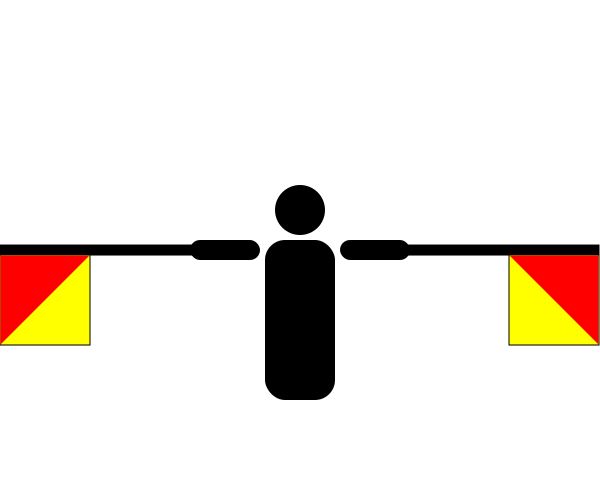
Semaphore


There are approximately 17 people named Repp in the UK. That makes it one of Britain's least common surnames. Fewer than one in a million people in Britain are named Repp.