RENARD
The surname Renard is of French origin and derives from the Old French word renard, which itself comes from the Latin renardus meaning fox. The association with this animal conveys attributes such as quick‑wittedness, slyness and cleverness, qualities that have long been ascribed to individuals who bore the name.
In the medieval period the name appears in a variety of spellings, including Reynard, Reinhard, Reigny, Reintsema, Reinaert and Raardot, reflecting its evolution in different linguistic regions. The earliest recorded use of the family name is dated to 1205, when Elias Reynardi was baptised at St. Benet Holme in Norfolk during the reign of King John of England.
While the modern name is firmly anchored in French, early records suggest pre‑7th century Germanic roots, derived from the personal name Raginhard – a compound of ragin ‘counsel’ and hard ‘hardy, brave, strong’. The medieval cycle of beast‑tales also popularised the image of a cunning fox named Reynard, further cementing the link between the animal and the surname.
In the English realm the name was recorded in several parish registers, such as the christening of Beatrice, daughter of James Reynard, in London in 1571. Germanic variations appear in German documents of the early fourteenth century, for example Heinrch Reinhart of Bonnigheld (1286) and Heinrici Reinhart of Homburg (1315). These instances confirm the name’s trans‑national presence across Europe.
Contemporary distribution data show that Renard remains a common surname across the French‑speaking world. In France it ranks as the thirty‑eighth most common surname, while in Belgium it is the ninth. In Canada it is the seventh most common name in Québec and the sixteenth in Brittany, and it ranks 71st in Canada as a whole.
In the United States, the surname is ranked sixty‑fourth among American citizens, and in Germany it appears as the seventy‑ninth most common surname. It also features in the Netherlands (114th), Austria (114th) and the Czech Republic (91st), indicating a broad European presence that extends to North America.
Variations of the surname reflect linguistic shifts and regional pronunciation differences. In French the name is typically pronounced ruh‑narr, whereas in German it is pronounced ry‑naardt. Spanish, Italian and other languages offer further variants such as Renaldo, Renaldi and Renar, illustrating the name’s adaptability across cultures.
Throughout history the surname Renard has been associated with an individual’s personality traits rather than lineage alone. Medieval chroniclers noted that the name was often applied to those considered crafty or resourceful – a perception that persists today, where the name still evokes a sense of wit and ingenuity.
Because the surname has clear etymological origins and is well documented in historical records, no speculative claims are made about its development. The associations with the fox, the documented spellings, and the demographic statistics collectively provide a reliable picture of the name’s heritage and contemporary standing.
In sum, the surname Renard exemplifies a linguistic lineage that spans from Latin through Old French to modern vernaculars, reflecting both a specific cultural symbolism and a long‑standing prevalence across Europe and North America.
Typical given names associated with the Renard surname
Male
- Christopher
- David
- Ian
- John
- Lee
- Mark
- Michael
- Nicholas
- Paul
- Richard
- Stephen
Female
- Alexis
- Caroline
- Claire
- Elsie
- Jacqueline
- Jean
- Melanie
- Michelle
- Stephanie
- Virginie
- Zoe
Similar and related surnames
Related and similar names are generated algorithmically based on the spelling, and may not necessarily share an etymology.
How to communicate the surname Renard in...
Braille
⠗⠑⠝⠁⠗⠙
Morse
.-..-..-.-.-..
Semaphore
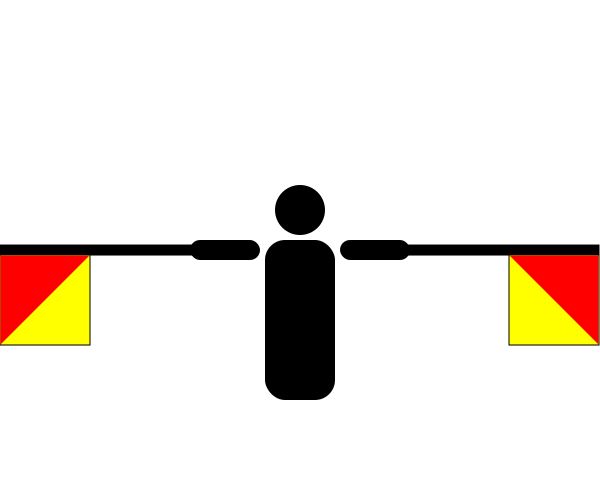

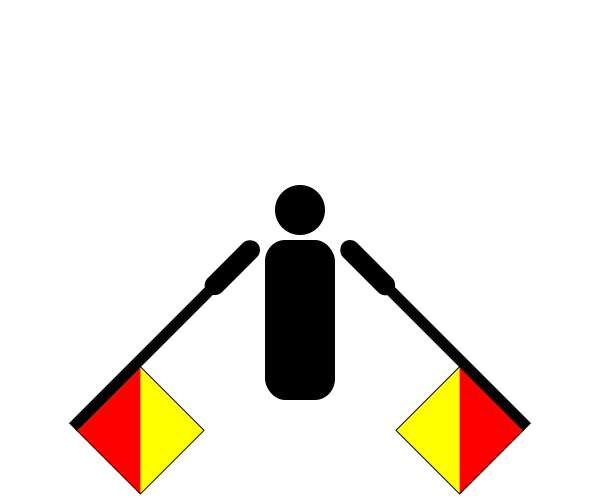


Did you know?
According to a survey carried out by Democracy Club, politicians and candidates with the surname Renard are most likely to say that their favourite biscuit is a Chocolate finger.
There are approximately 219 people named Renard in the UK. That makes it one of Britain's least common surnames. Only around three in a million people in Britain are named Renard.
Region of origin: Europe
Country of origin: France
Language of origin: French
